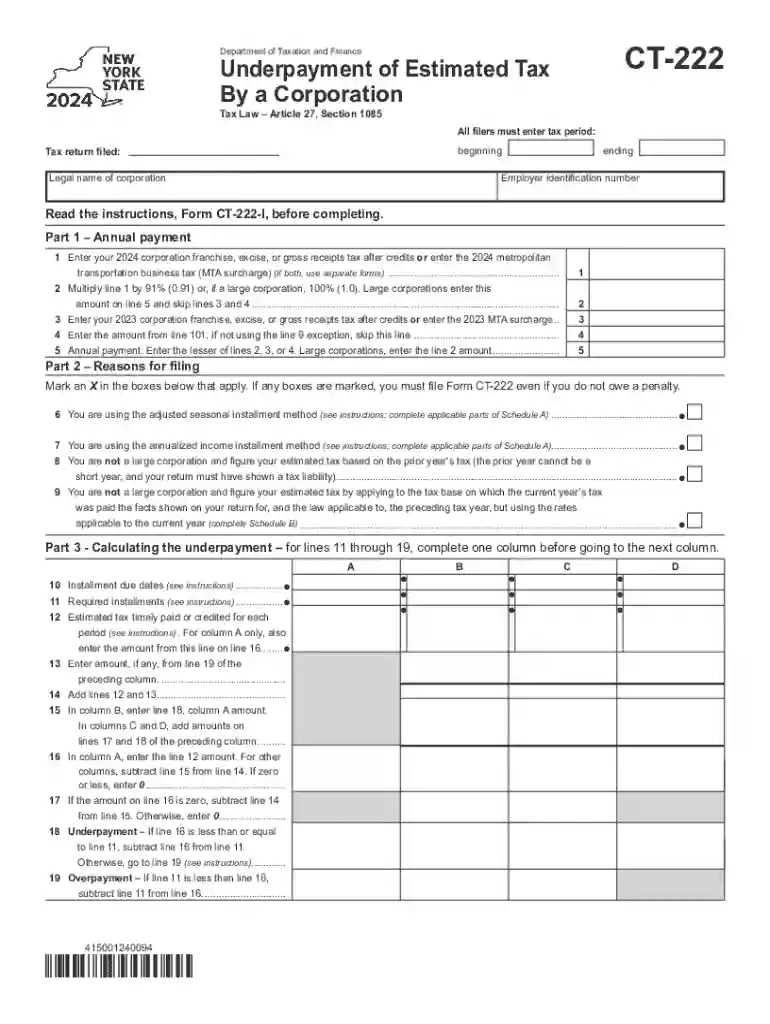
Form CT-222 Underpayment of Estimated Tax By a Corporation Tax Year 2024-2026

Get Form
ct 222 Preview on Page 1

Here's how it works

01. Edit your ct 222 online
Type text, add images, blackout confidential details, add comments, highlights and more.

02. Sign it in a few clicks
Draw your signature, type it, upload its image, or use your mobile device as a signature pad.

03. Share your form with others
Send it via email, link, or fax. You can also download it, export it or print it out.

Definition and Purpose of Form CT-222

Form CT-222 is a tax document issued by the Department of Taxation and Finance, designed to report the underpayment of estimated taxes by a corporation. This form is crucial for corporations that need to disclose any discrepancies in their estimated tax payments during the tax year 2024. By accurately completing Form CT-222, corporations can ensure compliance with tax laws and avoid potential penalties for underpayment. It contains calculations for annual payments, outlines reasons for filing, and provides methods for determining underpayment penalties.

How to Use Form CT-222

Using Form CT-222 requires a comprehensive understanding of your corporation's tax obligations. Typically, this involves:

  1. Reviewing Tax Payments: Compare the estimated payments made throughout the fiscal year against the required amounts.
  2. Identifying Underpayments: Determine any discrepancies where payments fell short of the estimated requirements.
  3. Calculating Penalties: Use the provided formulas within the form to calculate any penalties associated with these underpayments.
  4. Filing the Form: Submit the completed form as part of the fiscal year 2024 tax filing to report these discrepancies.

Steps to Complete Form CT-222

Completing Form CT-222 involves several detailed steps:

  1. Gather Financial Information: Ensure access to all financial records reflecting the estimated tax payments made.
  2. Calculate Total Payments and Calculate Required Estimates: Cross-verify the total tax payments under your corporation’s estimated liability.
  3. Complete Form Sections: Fill out each relevant section of the form, including annual payment calculations and penalties.
  4. Verification: Double-check all calculations and entries to avoid errors that could result in penalties.
  5. Signature and Submission: Once completed and verified, ensure all necessary signatures are in place before submitting the form by the required deadline.

Who Uses Form CT-222

Form CT-222 is primarily used by corporations operating within the United States that are required to make estimated tax payments. Corporations are responsible for reviewing any underpayments of these estimated taxes. This form is essential for entities that are classified as large corporations and need to accurately report their tax liabilities to avoid penalties.

Importance of Form CT-222

Filing Form CT-222 holds critical significance for corporations:

  • Compliance: It aids corporations in maintaining compliance with tax laws by accurately reporting tax payment discrepancies.
  • Avoiding Penalties: Proactive filing helps avoid additional penalties related to underpayment of estimated taxes.
  • Financial Planning: Provides corporations with insight into their tax payment structures, facilitating informed future financial strategies.

Legal Use and Compliance Requirements

Form CT-222 has specific legal requirements that corporations must adhere to:

  • Accurate Reporting: Corporations must ensure the information provided within the form is accurate and complete.
  • Deadline Adherence: The form must be submitted in accordance with the designated deadlines to ensure compliance.
  • Verification Procedures: Corporations should conduct internal checks or use professional services to verify the accuracy of entries, minimizing legal exposure.

IRS Guidelines for Form CT-222

The IRS provides clear guidelines on using Form CT-222:

  • Estimated Payment Calculations: Corporations must follow specified procedures to calculate estimated payments and identify discrepancies.
  • Review and Audit: The IRS may review these forms as part of routine audits; therefore, precision and clarity in completing the form are paramount.
  • Consultation Encouraged: Engaging with tax professionals is recommended to ensure full compliance with IRS requirements.

Key Elements to Include in Form CT-222

Several critical elements should be addressed when preparing Form CT-222:

  • Corporate Identification Information: Includes your corporation’s contact details and tax identification numbers.
  • Estimation Details: Exact details on how estimates were calculated, including identified underpayments.
  • Reason for Underpayment: Explanation on why discrepancies between estimated and actual payments may have occurred.
  • Impact of Underpayment: Detailed calculations on the penalties incurred due to underpayment.

Penalties for Non-Compliance

Failure to accurately complete Form CT-222 or to file by the deadline can lead to:

  • Financial Penalties: Calculated based on the extent and duration of the underpayment.
  • Additional Interest: Interest may accrue on unpaid tax liabilities, increasing the financial burden.
  • Legal Repercussions: Continuous non-compliance with IRS standards can result in further legal actions and audits.
be ready to get more

Complete this form in 5 minutes or less

Get form

Got questions?

We have answers to the most popular questions from our customers. If you can't find an answer to your question, please contact us.
Contact us
Penalty. 0.5% of the unpaid tax for each month or part of the month its unpaid not to exceed 40 months (monthly).
Estimated tax payments are due by the 15th day of the 4th, 6th, 9th and 12th months of the corporations tax year. If the due date falls on a weekend or a legal holiday, the payment is due on the next regular business day.
The law allows the IRS to waive the penalty if: You didnt make a required payment because of a casualty event, disaster, or other unusual circumstance and it would be inequitable to impose the penalty, or.
You know you need to send the IRS a check every quarter, but the question is: should you pay extra just in case, or stick to the estimate? TL;DR: Paying a little extra can give you peace of mind and protect you from penalties, but overpaying means the IRS holds onto your money interest-free.
Form 2220, Underpayment of Estimated Tax by Corporations, is used by corporations, tax-exempt organizations, and private foundations to calculate and report any underpayment of estimated taxes. For corporations that have underestimated their tax liability, Form 2220 is necessary to determine if a penalty is due.

Security and compliance

At DocHub, your data security is our priority. We follow HIPAA, SOC2, GDPR, and other standards, so you can work on your documents with confidence.


Learn more
ccpa2
pci-dss
gdpr-compliance
hipaa
soc-compliance
be ready to get more

Complete this form in 5 minutes or less

Get form

People also ask

Interest and/or penalties paid to the IRS are not deductible on your tax return.
Generally, taxpayers should make estimated tax payments in four equal amounts to avoid a penalty.

Related links