




01. Edit your form online
Type text, add images, blackout confidential details, add comments, highlights and more.

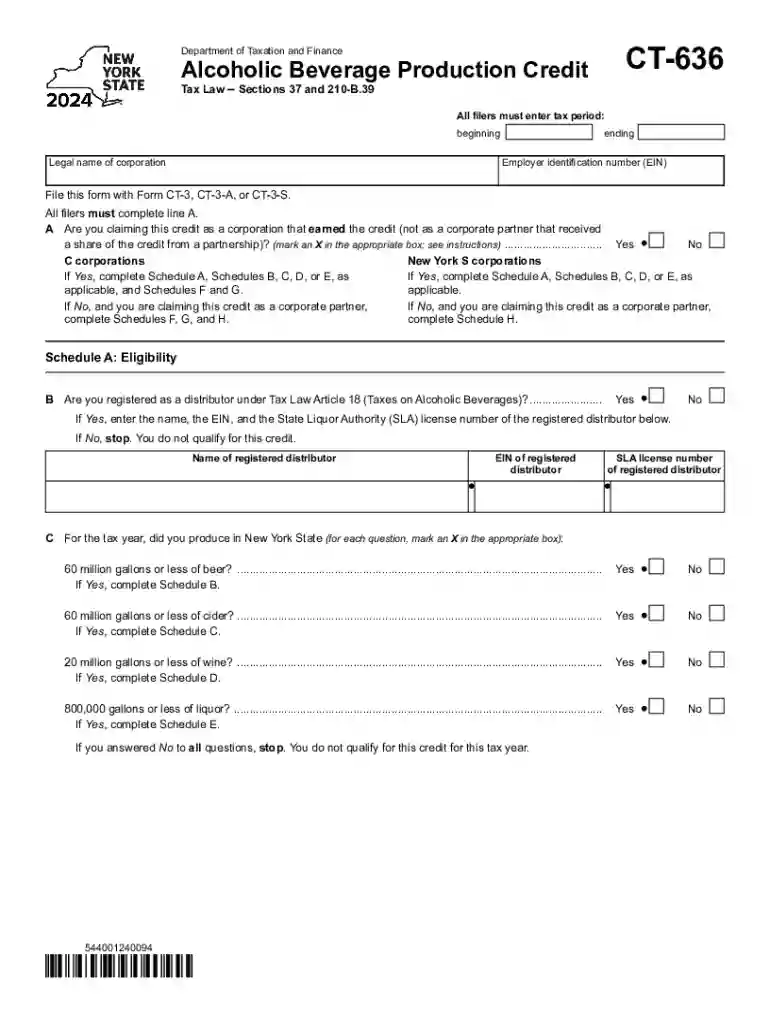
Type text, add images, blackout confidential details, add comments, highlights and more.

Draw your signature, type it, upload its image, or use your mobile device as a signature pad.

Send it via email, link, or fax. You can also download it, export it or print it out.
Form CT-636 is designed to facilitate New York corporations in claiming the Alcoholic Beverage Production Credit. This tax credit is applicable specifically to corporations involved in producing alcoholic beverages such as beer, cider, wine, and liquor. By using this form, businesses can calculate the credit owed based on their production levels, thus potentially lowering their tax liability. Understanding the purpose and application of this form is crucial for businesses aiming to maximize their eligible tax benefits.
The eligibility to claim the Alcoholic Beverage Production Credit through Form CT-636 is primarily extended to New York corporations engaged in producing alcoholic beverages. Key criteria include:


Utilizing Form CT-636 appropriately requires understanding its legal implications. Companies must ensure compliance with New York State tax laws, accurately report their manufacturing activities, and retain supporting documentation to substantiate the credit claimed. Proper legal use of the form also involves adhering to the submission timeline and verifying that any amendments to tax legislation have been incorporated into the form's completion.
Timeliness in filing Form CT-636 is crucial to avoid potential penalties. Generally, the form should be submitted alongside the business's annual tax return. Filing deadlines will align with New York State corporate income tax deadlines, typically due within 30 days of filing the federal return. Companies should verify any specific dates applicable for the current fiscal year to ensure compliance.
To illustrate effective use, consider a mid-sized brewery in New York with a production line dedicated to craft cider. By meticulously tracking their production output and utilizing Form CT-636, the brewery is able to claim significant tax credits for their beverage production, aiding in their expansion and operational scaling. Another scenario involves a winery maximizing its eligible tax savings by claiming credits for both wine and spirits produced within the state.
New York imposes specific regulations governing the usage of Form CT-636. These rules may include stipulations on the percentage of locally sourced materials used in production or compliance with state manufacturing laws. Additionally, businesses should be aware of any updates or changes in tax legislation that could impact their eligibility or credit calculations.
The instructions accompanying Form CT-636 provide detailed guidance on accurate completion. Key components include:
Companies utilizing Form CT-636 can leverage various software solutions to streamline the filing process. Programs like QuickBooks or TurboTax can facilitate data collection, organize financial records, and ensure accuracy in reporting. Integration with accounting software ensures seamless data transfer, reducing manual entry errors and saving time.
We've got more versions of the Instructions for Form CT-636 Alcoholic Beverage Production form. Select the right Instructions for Form CT-636 Alcoholic Beverage Production version from the list and start editing it straight away!
| Versions | Form popularity | Fillable & printable |
|---|---|---|
| 2025 | 4.1 Satisfied (58 Votes) | |
| 2024 | 4.6 Satisfied (60 Votes) | |
| 2023 | 4 Satisfied (29 Votes) | |
| 2022 | 4.5 Satisfied (31 Votes) | |
| 2021 | 4.8 Satisfied (240 Votes) | |
| 2020 | 4.3 Satisfied (55 Votes) | |
| 2019 | 4.3 Satisfied (48 Votes) | |
| 2018 | 4.3 Satisfied (83 Votes) | |
| 2017 | 4.3 Satisfied (48 Votes) | |
| 2015 | 4.4 Satisfied (336 Votes) | |
| 2014 | 4 Satisfied (56 Votes) | |
| 2013 | 4.4 Satisfied (275 Votes) | |
| 2012 | 4 Satisfied (36 Votes) |
At DocHub, your data security is our priority. We follow HIPAA, SOC2, GDPR, and other standards, so you can work on your documents with confidence.


by C Conlon 2023 Cited by 34 We assemble unique data on distilled spirits from Connecticut,including matched manufacturer and wholesaler prices, to evaluate the welfare consequences of PH.Read more
NOTICE: The project that is the subject of this report was approved by the Governing. Board of the National Research Council, whose members are drawn fromRead more
Eligibility. To be eligible for this credit, you must meet all of the following requirements: you are subject to tax under Article 9-A or 22,.Read more


