







Definition & Meaning
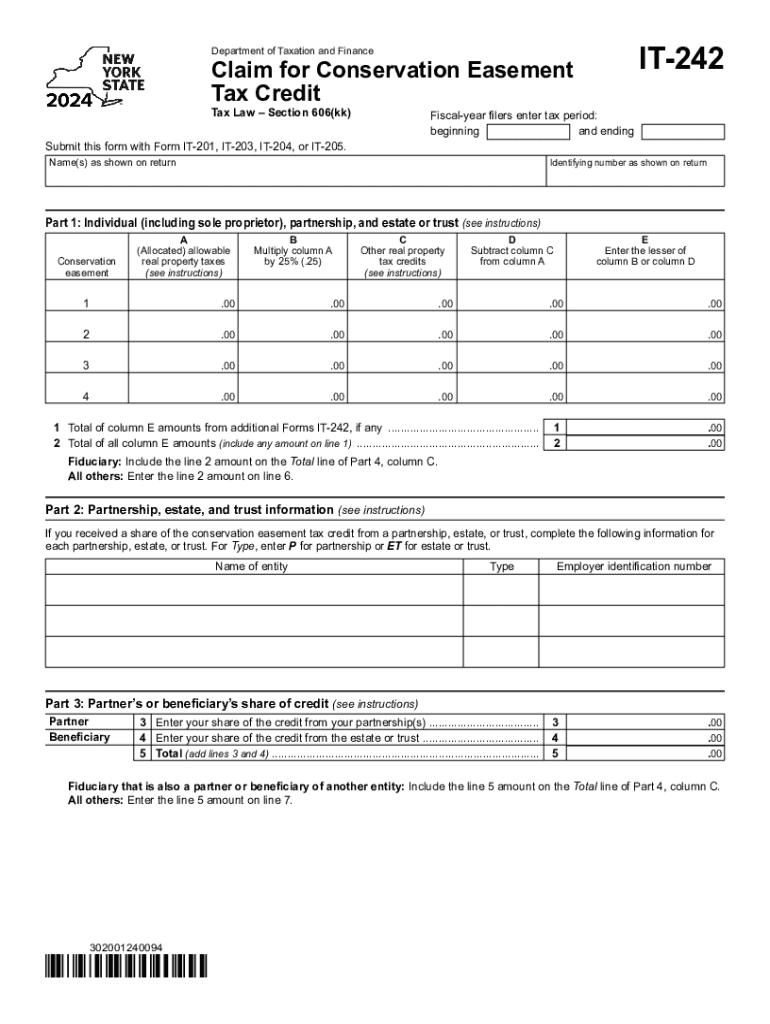
The New York Form IT-242 is a tax form issued by the Department of Taxation and Finance. It is designed for claiming a tax credit associated with conservation easements. A conservation easement is a legally binding agreement that restricts the use of a piece of land to preserve its conservation values, providing tax benefits to landowners in return. This form provides the necessary framework to calculate and report allowable tax credits, as per Tax Law Section 606(kk).
Steps to Complete the New York Form IT-242 Claim for Conservation Easement
-
Gather Required Information: Collect details about the conservation easement, including its location, size, and the party involved in establishing the easement. Make note of any previous credits claimed on the same property.
-
Fill Out Personal Information: Enter your taxpayer details, such as name, social security number, and address. If filing jointly or as a partnership, add information for all contributing parties.
-
Calculate the Tax Credit: Use the form to compute the conservation easement tax credit based on expenses incurred. This involves filling in the relevant sections that account for total conservation real property taxes.
-
Report Partnership or Trust Details: If applicable, provide comprehensive information concerning the partnership or trust involved. This section details individual shares of credits among partners or benefactors.
-
Attach Supporting Documents: Include any required documentation, such as proof of the conservation easement, property tax statements, and any previous filings related to the easement.
-
Review and Submit: Carefully double-check all the information before submission. Ensure that there are no errors or missing sections, as this could affect the claim's processing.
Eligibility Criteria
To qualify for a conservation easement tax credit using Form IT-242, one must satisfy certain eligibility requirements:
- Ownership: The claimant must own the real property on which the conservation easement has been established.
- Compliance: The easement must meet the statutory guidelines for conservation purposes, such as habitat preservation or open space conservation.
- Documentation: Adequate documentation proving the establishment and terms of the easement is necessary.


Legal Use of the New York Form IT-242 Claim for Conservation Easement
The completion and submission of Form IT-242 must adhere to the legal stipulations set forth by the New York Department of Taxation and Finance. It's vital for claimants to ensure:
- Accuracy: The information provided is truthful and represents accurate figures and facts pertaining to the tax credit and the conservation easement.
- Compliance with Tax Law: Tax Law Section 606(kk) dictates the conditions under which tax credits for conservation easements can be claimed and the qualifications required.
- Timely Filing: Adhering to filing deadlines is crucial to avoid penalties or the invalidation of the tax credit claim.
Important Terms Related to New York Form IT-242 Claim for Conservation Easement
- Conservation Easement: An agreement that limits certain types of development or land uses to preserve the property’s conservation values.
- Tax Credit: A direct reduction in the amount of tax owed, unique to eligible conservation easement properties.
- Real Property Taxes: Taxes levied on real estate, which contribute to the calculation of the conservation easement tax credit.
Filing Deadlines / Important Dates
Filing the Form IT-242 isn't just about proper completion but also about submitting it on time. Crucial dates include:
- Annual Tax Filing Deadline: Form IT-242 should typically be filed in tandem with your New York State tax return by April 15th for most taxpayers.
- Extension Requests: Filing an extension request can provide additional time, but ensuring correct estimation of your tax credits is vital even if a delay in submission occurs.
Key Elements of the New York Form IT-242 Claim for Conservation Easement
The document comprises several fundamental sections essential for credit calculation and compliance:
- Taxpayer Information: Basic information to identify the claimant and any involved parties.
- Conservation Easement Details: Specifics of the easement including nature, purpose, and documentation.
- Credit Computation: Detailed calculation model for the environmentally focused tax credit.
- Partnership Details: Information if the claimant is part of a partnership or a trust involving shared property rights.
State-Specific Rules for the New York Form IT-242 Claim for Conservation Easement
New York’s regulations for conservation easements may differ from those of other states:
- Dedicated Tax Law: The allowances made under Tax Law Section 606(kk) are specific to New York State, highlighting unique conservation priorities and tax benefit structures.
- Regulatory Compliance: Adhering to the specific New York environmental protection rules ensures continued eligibility for the tax credit.
These state-centric regulations ensure that resources, environments, and conservation efforts align with New York's larger ecological and economic goals.




