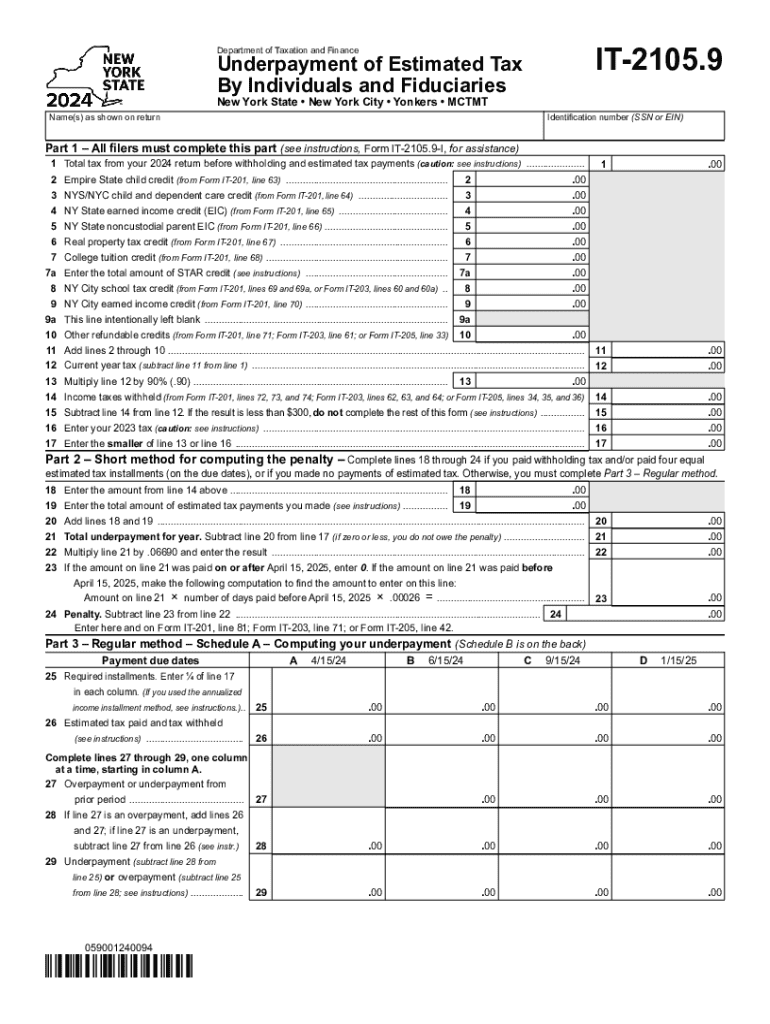







Definition and Purpose of Form IT-2105.9
Form IT-2105.9, used by individuals and fiduciaries, is essential for calculating the underpayment of estimated income tax in New York for the tax year 2024. This form helps taxpayers determine if they’ve underpaid estimated taxes throughout the year. Underpayment occurs when current payments (like withholding and estimated tax payments) fall short of 90% of the actual tax liability for the year, or if they are less than 100% of the prior year's tax. Filing this form can help avoid penalties by addressing the underpayment in a timely manner.
Steps to Complete Form IT-2105.9
- Calculate Total Expected Tax Liability: Determine your total tax obligations for the year, including income taxes and any other applicable state taxes.
- Evaluate Current Payments: Review the amounts you've paid through withholding, estimated tax payments, and credits.
- Calculate Underpayment: Subtract your current payments from your total expected tax liability to find any underpayment amount.
- Complete Form Sections: Fill out the required sections with accurate financial figures.
- Verify all Calculations: Double-check the calculations to ensure accuracy and prevent any penalties.
- Retain Copies: Keep copies of the completed form for your records.
How to Obtain Form IT-2105.9
- Online Download: Visit the New York State Department of Taxation and Finance website to download the form.
- Request by Mail: Contact the department to have a physical copy mailed to you.
- Tax Preparation Software: Use tax software platforms, which may include the form in their packages.
Key Elements of Form IT-2105.9
- Taxpayer Information: Includes personal details such as name, address, and taxpayer identification number.
- Income Details: Summarizes all sources of income, ensuring accurate tax liability calculations.
- Tax Calculation Section: Focus on calculating the potential underpayment through detailed line items.
- Signature and Date: Sign the form, ensuring that all data provided is accurate and true.
Penalties for Non-Compliance
Failure to complete and file Form IT-2105.9 accurately can result in penalties. The New York State Department of Taxation and Finance imposes interest on the underpaid tax if not addressed properly. The penalty may be calculated by assessing a percentage of the underpaid amount, depending on how late the payment has been made.
Filing Deadlines and Important Dates
- Quarterly Estimated Payment Dates: Payment should be submitted according to quarterly deadlines to avoid underpayment.
- Annual Tax Return Deadline: Form IT-2105.9 should be filed in conjunction with the annual state tax return.
- Penalty Relief Request Deadline: Submit requests for penalty relief if there’s valid cause for underpayment within the stipulated timeframe.
Who Typically Uses Form IT-2105.9
This form is specifically used by individuals and fiduciaries such as executors of estates and administrators of trusts. It's essential for those who pay estimated taxes to manage their yearly tax liability accurately. Entities that often rely on this form include:
- Self-Employed Individuals: Those without regular withholding need precise estimated tax calculations.
- Retirees: Pension or investment income necessitating quarterly tax estimates.
- Estate or Trust Administrators: Fiduciaries managing income from estates or trusts must ensure correct tax estimates.
Filing Methods for Form IT-2105.9
- Online Submission: Use the New York State Department of Taxation and Finance's online services to file electronically.
- Mail: Send the completed form to the designated mailing address provided by the Department.
- In-Person: Although rare, dropping off the form at designated offices is an option, subject to service availability.
Digital vs Paper Versions of Form IT-2105.9
Choosing between the digital and paper versions can depend on several factors:
- Convenience: Digital forms offer ease of submission and quicker processing.
- Record Keeping: Electronic submissions facilitate easy record storage and retrieval.
- Accuracy: Software-assisted digital forms often minimize errors compared to manual completion on paper.