
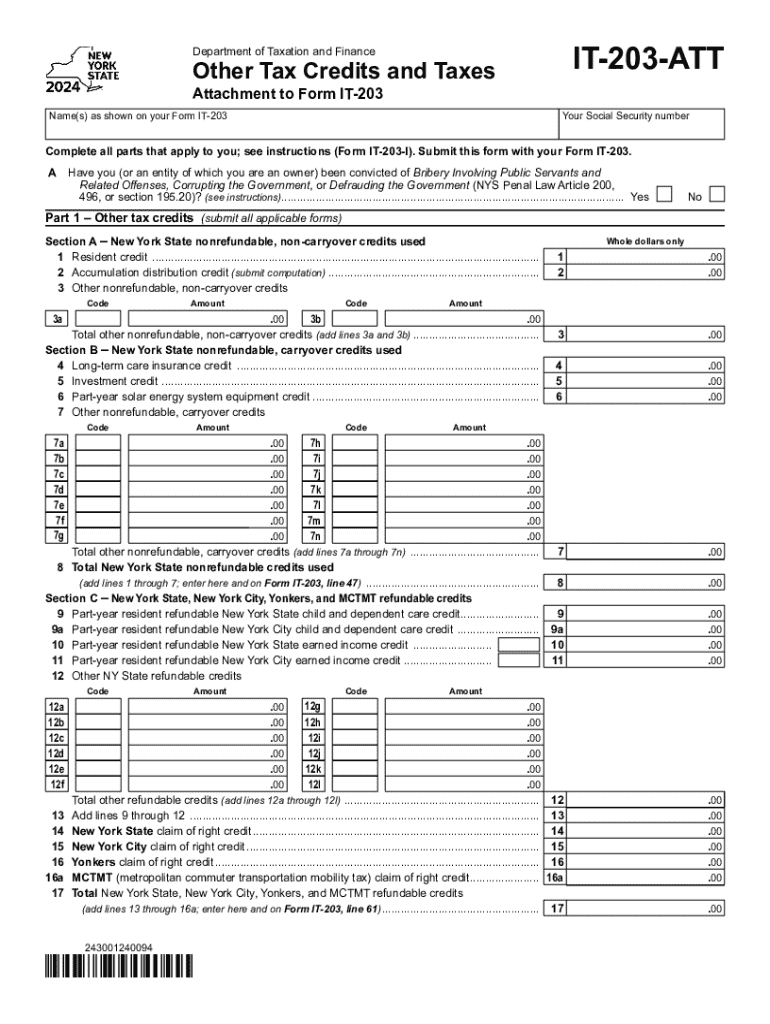







Definition and Meaning of Form IT-203-ATT
Form IT-203-ATT, an attachment to Form IT-203, is used by the New York State Department of Taxation and Finance. This form is essential for reporting various nonrefundable and refundable credits, along with other state taxes applicable to individuals or entities. Taxpayers must complete relevant sections of Form IT-203-ATT based on their circumstances, ensuring all applicable credits and taxes are accurately reported.
- Nonrefundable Credits: These credits can reduce tax liability to zero, but any excess is not refundable.
- Refundable Credits: These credits can reduce tax liability below zero, allowing taxpayers to receive a refund for the excess amount.
- Other State Taxes: This section requires reporting of applicable local or specific state taxes that taxpayers need to pay.
This form ensures proper compliance with New York State tax laws and facilitates accurate calculation of taxes owed or refunds due.
How to Obtain Form IT-203-ATT Other Tax Credits and Taxes Tax Year 2024
Securing the Form IT-203-ATT for the tax year 2024 can be straightforward. It is available through specific channels to ensure taxpayers can access it when necessary:
-
Online Access:
- Visit the New York State Department of Taxation and Finance's official website.
- Navigate to the forms section where tax documents are listed by year and type.
- Download the PDF version of the form directly to your device.
-
Tax Software Integration:
- Utilize tax preparation software like TurboTax or QuickBooks, where the form is typically included and can be filled out electronically.
- These platforms often guide users through completing the form as part of the overall tax filing process.
-
Request by Mail:
- Contact the New York State Department of Taxation and Finance to request a physical copy through their customer service line.
- Allow adequate time for mail delivery, especially if approaching filing deadlines.
-
Local Tax Offices:
- Visit local tax agency offices in New York State to find physical copies and additional assistance for filling out the form.
Steps to Complete the Form IT-203-ATT for Tax Year 2024
Accurately completing Form IT-203-ATT involves several critical steps to ensure compliance and correct reporting. Below is a detailed breakdown:
-
Gather Necessary Information
- Collect details on all applicable state tax credits and liabilities.
- Ensure you have documentation to support claims, such as receipts, prior tax returns, and other financial records.
-
Fill Out Personal Information
- Input identifying information such as name, address, and taxpayer identification number on the form.
-
Complete Credit Sections
- Determine eligibility for nonrefundable and refundable credits.
- Accurately record the amounts for each eligible credit. Refer to specific instructions provided by the New York State Department of Taxation and Finance for precision.
-
Report Other State Taxes
- Document any additional taxes owed to the state beyond income tax, such as local taxes or industry-specific taxes.
-
Verify Calculations
- Carefully add up credits and taxes to ensure all figures are correct.
- Double-check entries against documentation to avoid errors or omissions.
-
Review and Sign
- Conduct a final review of the entire form.
- Sign the form, attesting to the accuracy of the information provided.
-
Submission
- Submit the completed Form IT-203-ATT along with the primary Form IT-203 as part of your state tax return submission.
Eligibility Criteria for Form IT-203-ATT
Understanding Eligibility Criteria for this form is crucial to determine whether a taxpayer should fill it out:
- Residency Status: Primarily used by part-year residents and nonresidents of New York State who report income in the state.
- Income Sources: Taxation of income derived from New York sources, including wages, business income, or rental property.
- Credit Qualifications: Must qualify for certain credits or be subject to specific taxes based on state laws.
Eligibility varies based on individual and business circumstances, so consulting with a tax professional or referring to official state guidance is advisable to ensure compliance and benefit maximization.


Important Terms Related to Form IT-203-ATT
Familiarization with important terms enhances comprehension of Form IT-203-ATT and its completion:
- Taxpayer Identification Number (TIN): A unique number assigned by the IRS for tax purposes, essential for filing.
- Filing Status: Categories such as single, married filing jointly, or head of household that influence tax liability.
- Fiscal Year versus Calendar Year: Understanding the difference is crucial if the taxpayer operates on a fiscal calendar differing from the calendar year.
Key Elements of Form IT-203-ATT Other Tax Credits and Taxes
Identifying the key elements of the form focuses the completion process:
- Identification Section: Establishes the taxpayer's identity and tax filing period.
- Credit Calculation: Sections detailing each specific credit available and methods to compute them.
- Tax Obligation Reporting: Accurately detailing owed taxes to ensure compliance and regulation observance.
Filing Deadlines and Important Dates
Observing strict adherence to deadlines prevents penalties:
- Standard State Filing Deadline: Typically aligns with the federal tax deadline, which is April 15 unless it falls on a weekend or holiday.
- Extended Deadlines: Filing extensions may vary; typically require submission of specific extension forms like IT-370 by the regular filing deadline.
- Amendment Deadlines: Corrections or amendments generally have a three-year deadline from the original filing.
Form Submission Methods: Online, Mail, In-Person
Form IT-203-ATT accommodates multiple submission methods, offering flexibility to taxpayers:
-
Online Submission:
- File electronically through authorized e-filing platforms associated with the New York State Department of Taxation and Finance.
- Offers quick processing and instant confirmation of receipt.
-
Mail Submission:
- Print and mail the completed form to the designated state tax processing center.
- Ensure the envelope is postmarked by the filing deadline for timely submission.
-
In-Person Submission:
- Deliver directly to local tax assistance offices if available.
- Useful for those who prefer face-to-face interaction or have complex queries.
Understanding these options ensures compliance and enhances flexibility for individual taxpayers’ preferences.




