




01. Edit your form 100 es 2025 online
Type text, add images, blackout confidential details, add comments, highlights and more.

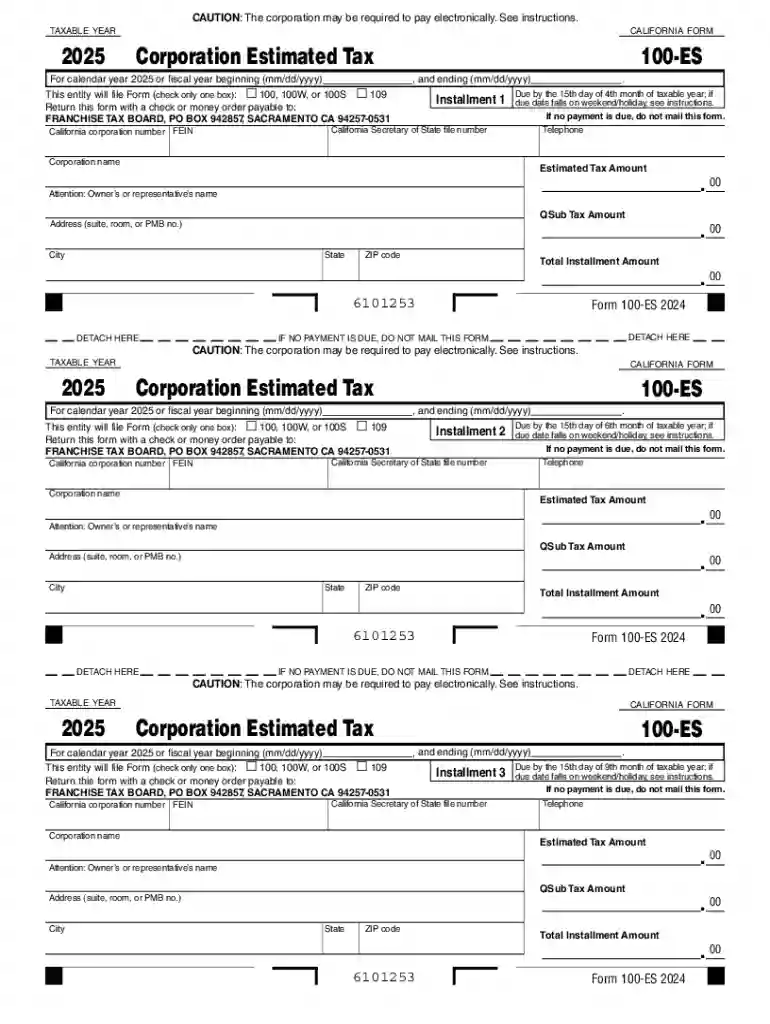
Type text, add images, blackout confidential details, add comments, highlights and more.

Draw your signature, type it, upload its image, or use your mobile device as a signature pad.

Send it via email, link, or fax. You can also download it, export it or print it out.
The 2025 Form 100-E S Corporation Estimated Tax (Form 100-E) and the Form 100-ES Corporation Estimated Tax (Form 100-ES) are essential tax documents used by S corporations operating in California. These forms are employed to fulfill the requirement for corporations to make estimated tax payments on the state level. Specifically, these forms guide corporations in calculating the estimated tax due and help in planning timely payments throughout the fiscal year to avoid potential underpayment penalties.
Using Form 100-E and 100-ES involves following a methodical process to accurately estimate and submit tax payments. Corporations must first determine their expected income, deductions, credits, and tax obligations for the year. The forms should be used to calculate quarterly payments, which are typically due in four equal installments. It is critical for S corporations to align their use of these forms with state-specific instructions to ensure compliance.
The 2025 Form 100-E and 100-ES can be obtained through multiple channels:
Identifying the crucial components of these forms is vital for precise completion. Each form comprises specific sections:
Meeting the deadlines for filing Form 100-E and 100-ES is crucial to avoid penalties:
Adhering to the completion and submission requirements for Form 100-E and 100-ES ensures legal compliance. These forms ensure that S corporations align with California's tax obligations and the Franchise Tax Board's regulations. Businesses must be aware that failure to comply may result in penalties, interest charges, or legal actions.
Several options exist for submitting the completed 2025 Form 100-E and 100-ES:
Consider a California-based S corporation that anticipates substantial revenue increases. By accurately using Forms 100-E and 100-ES, the corporation can:
We've got more versions of the form 100 es 2025 form. Select the right form 100 es 2025 version from the list and start editing it straight away!
| Versions | Form popularity | Fillable & printable |
|---|---|---|
| 2025 | 4.1 Satisfied (27 Votes) | |
| 2024 | 4.8 Satisfied (57 Votes) | |
| 2023 | 4.1 Satisfied (27 Votes) | |
| 2022 | 4.8 Satisfied (110 Votes) | |
| 2021 | 4.1 Satisfied (47 Votes) | |
| 2020 | 4.4 Satisfied (162 Votes) | |
| 2019 | 4.2 Satisfied (41 Votes) | |
| 2018 | 4 Satisfied (59 Votes) | |
| 2017 | 4.4 Satisfied (187 Votes) | |
| 2016 | 4.2 Satisfied (113 Votes) | |
| 2015 | 4 Satisfied (32 Votes) | |
| 2014 | 4 Satisfied (54 Votes) |
At DocHub, your data security is our priority. We follow HIPAA, SOC2, GDPR, and other standards, so you can work on your documents with confidence.



Displaying 1 - 15 of 689 results. Corporation Income Tax. Fiduciary Tax. Franchise Income Tax. Individual Income Tax. Property Tax.Read more
Use Form 100-ES, Corporation Estimated Tax, for the calendar year ending December 31, 2025, Form 100-ES to figure and pay estimated tax for a corporation.
T. Rowe Price, a global investment management firm dedicated to helping clients achieve long term success.


