
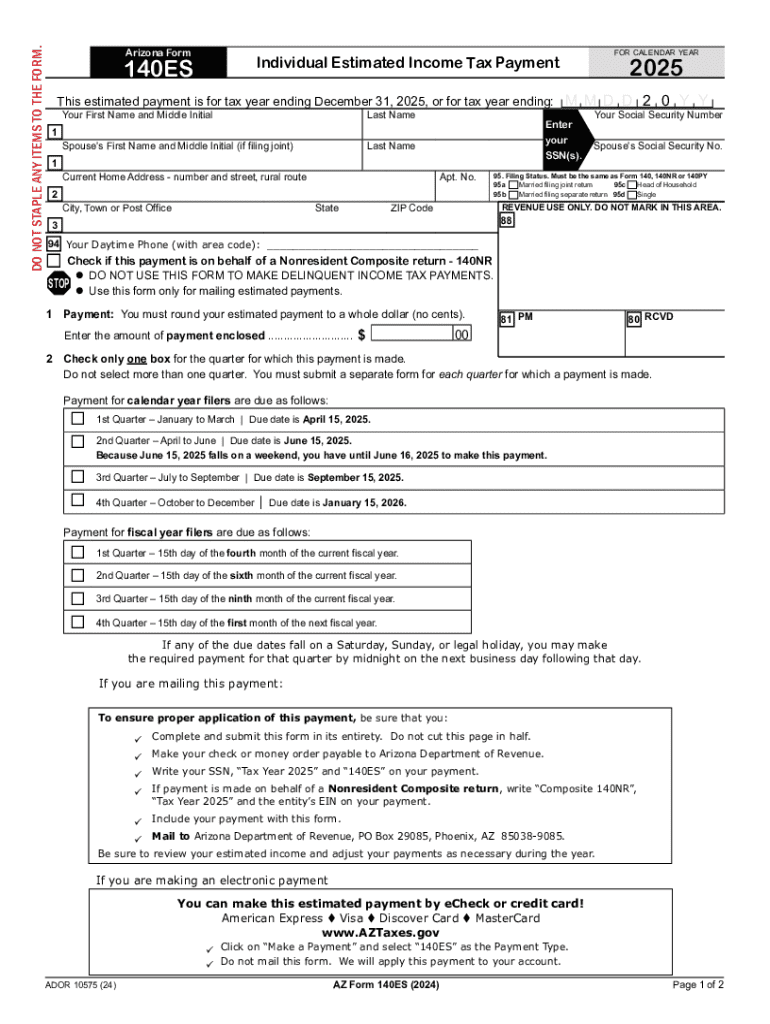







Definition and Purpose of Arizona Form 140ES
Arizona Form 140ES is a tax document used by residents of Arizona to estimate and pay income tax in installments throughout the year. This form is crucial for individuals who do not have taxes withheld from their income, such as self-employed persons. By making estimated payments, taxpayers can avoid penalties that accrue if too little is paid during the tax year. Form 140ES includes a worksheet to help calculate estimated payments based on anticipated taxable income, deductions, and credits.
How to Obtain the Arizona Form 140ES
To access Arizona Form 140ES, taxpayers have several options. They can download the form directly from the Arizona Department of Revenue’s website. Additionally, many tax preparation software packages include this form, making it easier to stay compliant with tax obligations. Some financial institutions or tax advisors might also provide the form as part of their customer service offerings.
Steps to Complete the Arizona Form 140ES
-
Calculating Estimated Payments:
- Use the worksheet provided in Form 140ES to determine your estimated tax liability.
- Consider previous year's tax returns, anticipated income changes, and applicable deductions.
-
Filling Out Personal Information:
- Enter your full name, address, and social security number to ensure your estimated payments are credited to the correct tax account.
-
Completing Payment Vouchers:
- Fill out the four payment vouchers included with the form. These vouchers correspond to each quarter of the tax year.
- Detach and submit the appropriate voucher with each estimated tax payment.
Filing Deadlines and Important Dates
Arizona Form 140ES requires quarterly estimated payments. Important deadlines include:
- First Quarter Payment: Due April 15
- Second Quarter Payment: Due June 15
- Third Quarter Payment: Due September 15
- Fourth Quarter Payment: Due January 15 of the following year
Timely submission of these payments is essential to avoid penalties for underpayment of estimated taxes.
Who Typically Uses the Arizona Form 140ES
Individuals who are most likely to use Form 140ES include:
- Self-Employed Individuals: Without employer tax withholdings
- Investors with Significant Capital Gains: Those whose investment income heavily impacts their tax liability
- Retirees with Untaxed Retirement Income: Those relying on retirement distributions not subject to automatic withholding
- Business Owners: Including those operating as sole proprietors needing to manage personal tax liabilities related to business profits


Digital vs. Paper Version
Both digital and paper versions of Form 140ES are available, providing flexibility to taxpayers:
- Digital Forms: Easily downloaded and filled out using tax preparation software, offering automated calculation features and e-filing options.
- Paper Forms: Provide a traditional method for those who prefer manual entry and mail submission.
Regardless of the chosen format, it is crucial to ensure accuracy and timeliness in submission.
Key Elements of the Arizona Form 140ES
- Estimated Payment Worksheet: Helps calculate the taxable income and forecast the total estimated tax payment.
- Payment Vouchers: Used for submitting each quarterly payment.
- Instructions Section: Provides detailed guidance and examples to accurately project income, deductions, and estimated taxes.
Penalties for Non-Compliance with Arizona Form 140ES
Failing to make appropriate estimated tax payments can result in penalties, including:
- Underpayment Penalty: Applied when quarterly payments do not meet required thresholds.
- Late Payment Penalty: Incurred if installment payments are submitted past due dates.
- Interest on Unpaid Taxes: Calculated daily from the due date until the payment date.
Avoiding these penalties requires careful planning and timely payments.
Software Compatibility with Arizona Form 140ES
Several tax preparation software packages support Arizona Form 140ES:
- TurboTax: Offers step-by-step guidance for calculating and submitting estimated taxes.
- QuickBooks: Integrates with business finance to streamline tax projections.
- H&R Block Software: Provides interfaces for entering and managing state-specific forms like 140ES.
Utilizing compatible software can enhance accuracy and efficiency in handling tax obligations.




