Form Mo-c 2026

Get Form
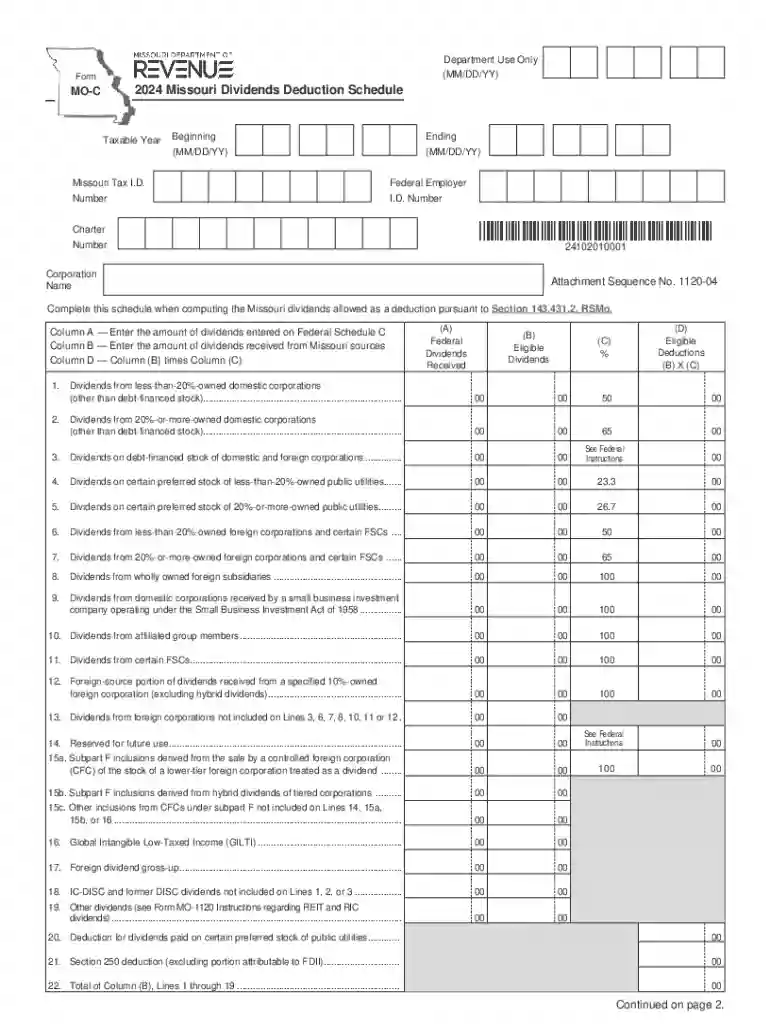
mo c Preview on Page 1

Here's how it works

01. Edit your mo c online
Type text, add images, blackout confidential details, add comments, highlights and more.

02. Sign it in a few clicks
Draw your signature, type it, upload its image, or use your mobile device as a signature pad.

03. Share your form with others
Send it via email, link, or fax. You can also download it, export it or print it out.

Definition and Purpose of the Missouri Dividends Deduction Schedule (Form MO-C)

Form MO-C, officially known as the Missouri Dividends Deduction Schedule, is used by corporations in Missouri to calculate eligible dividends for tax deductions. It is designed to aid these entities in reporting federal dividends received and determining the deductions based on ownership percentages of those dividends. This specific form aligns with Missouri tax laws, ensuring that corporations accurately file their dividends, which may affect their overall tax obligations within the state.

How to Use the Form MO-C

Using Form MO-C involves several critical steps to ensure that corporations accurately report and deduct dividends. It includes sections for entering data related to federal dividends received. Corporations will need to identify eligible dividends and provide detailed calculations regarding percentage ownership. The information provided must collectively lead to an accurate computation of the dividends deduction.

  1. Gather relevant dividend information from federal reports.
  2. Identify eligible dividends as per Missouri state guidelines.
  3. Complete the calculations required to determine eligible deductions.
  4. Cross-verify information to avoid discrepancies or errors.

Steps to Complete the Form MO-C

Completing Form MO-C requires attention to detail and accuracy. The following step-by-step guide helps ensure that the form is filled correctly:

  1. Federal Dividends Reporting

    • Start by entering dividends received from federal sources, ensuring all values are accurate and up-to-date.
  2. Determine Eligible Dividends

    • Identify dividends that meet the eligibility criteria set by Missouri law.
  3. Conduct Deductions Calculations

    • Follow the form’s instructions to calculate deductions based on ownership percentages and eligible dividend amounts.
  4. Review and Verify Information

    • Double-check all filled sections to confirm accuracy and compliance with Missouri’s taxation guidelines.
  5. Finalize and Submit

    • Ensure the form is complete and submit it following Missouri state's required procedure, whether online or via mail.

Who Typically Uses the Form MO-C

Form MO-C is predominantly utilized by corporations operating within Missouri that receive dividends eligible for tax deductions. This includes a range of business entities such as:


  • Large corporations with significant federal dividends.
  • Missouri-headquartered businesses seeking state-specific tax deductions.
  • Business entities involved in cross-state transactions.
decoration image ratings of Dochub

Important Terms Related to Form MO-C

Understanding the terminology related to Form MO-C is crucial for accurate completion:

  • Dividends: Corporate earnings distributed to shareholders, which may qualify for deductions.
  • Eligible Dividends: Portions of dividends that meet specific criteria for tax deductions under Missouri law.
  • Ownership Percentage: The proportion of a corporation’s ownership in dividend-yielding investments, critical for calculating deductions.

Legal Use and Compliance of Form MO-C

Legal compliance is vital when using Form MO-C. Misreporting or errors can lead to penalties, thus understanding the legal guidelines is essential. Corporations must ensure that all dividends reported are eligible under Missouri state law and accurately reflect their financial activity.

  • Compliance with Missouri taxation laws is mandatory.
  • Accurate and honest reporting can prevent legal issues.
  • Retain documentation in case of audits or verification by the Missouri Taxation Division.

Key Elements of the Form MO-C

Several critical components must be understood and completed in Form MO-C:

  • Section for Federal Dividends: This part requires precise data entry for federal dividends received.
  • Eligibility Criteria for Deductions: Figures out the guidelines that determine eligible dividends.
  • Deductions Calculations: Integral for computing the correct deduction amount based on eligible dividends.

Filing Deadlines and Important Dates

Abiding by filing deadlines is crucial to maintain compliance and avoid late fees or penalties.

  • Annual Filing Date: Typically aligned with corporate tax filings; check Missouri's current fiscal guidelines.
  • Extensions: Review possibilities for filing extensions if necessary, keeping deadlines in mind to avoid additional charges.

Example of Using the Form MO-C

A multinational corporation headquartered in Missouri may receive federal dividends and need to calculate eligible deductions. Using Form MO-C, the corporation reports these dividends, identifies eligible portions based on defined criteria, and calculates deductions, reflecting them in their state tax filings to optimize tax liabilities under Missouri law.

Software Compatibility and Integration Options

DocHub and other document management platforms can assist in completing Form MO-C effectively.

  • Integration with Tax Software: Ensure compatibility with common tax preparation tools like TurboTax and QuickBooks for streamlined processing.
  • Digital vs. Paper Filing: Evaluate benefits of digital filing through integrated tools like DocHub for efficiency and accuracy.

Penalties for Non-Compliance

Non-compliance with Form MO-C requirements can result in severe penalties, emphasizing the importance of thorough and accurate reporting.

  • Fines: Corporations may face monetary penalties.
  • Legal Consequences: Potential for further legal action if discrepancies are identified.

Understanding and adhering to the rules surrounding Form MO-C allows corporations to benefit from the deductions available while maintaining compliance with Missouri tax laws.

be ready to get more

Complete this form in 5 minutes or less

Get form

Got questions?

We have answers to the most popular questions from our customers. If you can't find an answer to your question, please contact us.
Contact us
TO FEDERAL ADJUSTED GROSS INCOME. Form MO-A, Part 1, computes Missouri modifications to federal adjusted gross income. Modifications on Lines 1, 2, and 3 include income that is exempt from federal tax, but taxable for state tax purposes.
Use Schedule C (Form 1040) to report income or loss from a business you operated or a profession you practiced as a sole proprietor. An activity qualifies as a business if: Your primary purpose for engaging in the activity is for income or profit. You are involved in the activity with continuity and regularity.
If your sole proprietorship business has no profit or loss during the full year, its not necessary to file a Schedule C (Form 1040), Profit or Loss from Business (Sole Proprietorship) for that year.
The purpose of the Schedule C is to calculate your net profit or loss from your business, which is then used to determine the amount of taxes you owe. Accurately filling out the Schedule C is important since it affects your overall tax liability.
Form MO-NRP of the partnership return is provided to aid the part- nership in computing the information required to be reported to each nonresident partner, and is required to be completed only when the partnership has (1) a nonresident partner, and (2) the part- nership has income from Missouri sources.

Security and compliance

At DocHub, your data security is our priority. We follow HIPAA, SOC2, GDPR, and other standards, so you can work on your documents with confidence.
Learn more
ccpa2
pci-dss
gdpr-compliance
hipaa
soc-compliance

People also ask

Schedule C FAQ What is the minimum income for filing a Schedule C? There is no minimum income for filing a Schedule C. If you earn any self-employment income youll need to report it on Schedule C. However, the limit for paying self-employment tax is $400.
Qualified dividends are taxed at a maximum rate of 20%. Ordinary dividends are taxed at the same rate as federal income taxes, or between 10% and 37%. State income taxes also may apply. Be cautious when considering investments that pay a high dividend.

Related links