




01. Edit your form online
Type text, add images, blackout confidential details, add comments, highlights and more.

Type text, add images, blackout confidential details, add comments, highlights and more.

Draw your signature, type it, upload its image, or use your mobile device as a signature pad.

Send it via email, link, or fax. You can also download it, export it or print it out.
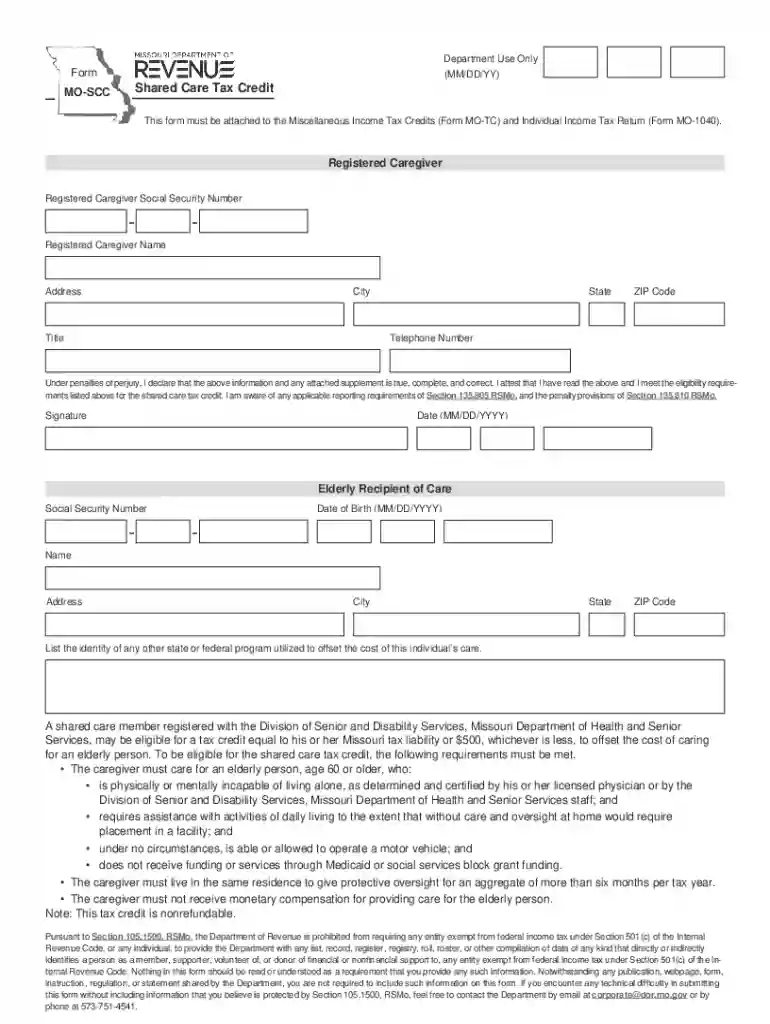
The Form MO-SCC, commonly referred to as the Shared Care Tax Credit, is an essential document for caregivers in Missouri who provide care for elderly individuals. This form helps caregivers claim tax credits, which are directly related to the shared services they offer to qualifying individuals. The tax credit amount is defined as either the lesser of the caregiver's Missouri tax liability or $500.
To qualify for the Shared Care Tax Credit, certain eligibility criteria must be met. Caregivers must provide necessary documentation and certification that proves their qualification. The primary requirements include:
Thorough understanding and compliance with these criteria are crucial for successful submission and claiming of the tax credit.


Form MO-SCC can be obtained through various means to accommodate different preferences and needs:
Completing the Form MO-SCC requires careful attention to detail to ensure accuracy and compliance. Below are the simplified steps:
Understanding key terms related to the form can simplify the application process:
Missouri has specific guidelines governing the application for and use of the Shared Care Tax Credit, making it vital for caregivers to:
Adhering to filing deadlines is critical in the application process:
The form can be submitted through multiple channels:
Failure to comply with the submission requirements of the Form MO-SCC might result in penalties, which could include:
Understanding these facets of the Form MO-SCC is fundamental for caregivers aiming to benefit from the Shared Care Tax Credit in Missouri. The detailed comprehension of eligibility, terms, filing procedures, and compliance ensures a smooth and effective process.
We've got more versions of the Form MO-SCC - Shared Care Tax Credit form. Select the right Form MO-SCC - Shared Care Tax Credit version from the list and start editing it straight away!
At DocHub, your data security is our priority. We follow HIPAA, SOC2, GDPR, and other standards, so you can work on your documents with confidence.



Next year, government will give everyone tax return form to fill out. You can fill out the form which informs the government how much tax it should return.
The 150% maximum timeframe limit is applied to all credit hours earned or attempted while enrolled at SCC, and includes transferred credit from previouslyRead more
Provides a tax credit to help families offset the costs of caring for an elderly person (age 60 or older). call 573-751-4842.


