01. Edit your form online
Type text, add images, blackout confidential details, add comments, highlights and more.

Type text, add images, blackout confidential details, add comments, highlights and more.

Draw your signature, type it, upload its image, or use your mobile device as a signature pad.

Send it via email, link, or fax. You can also download it, export it or print it out.
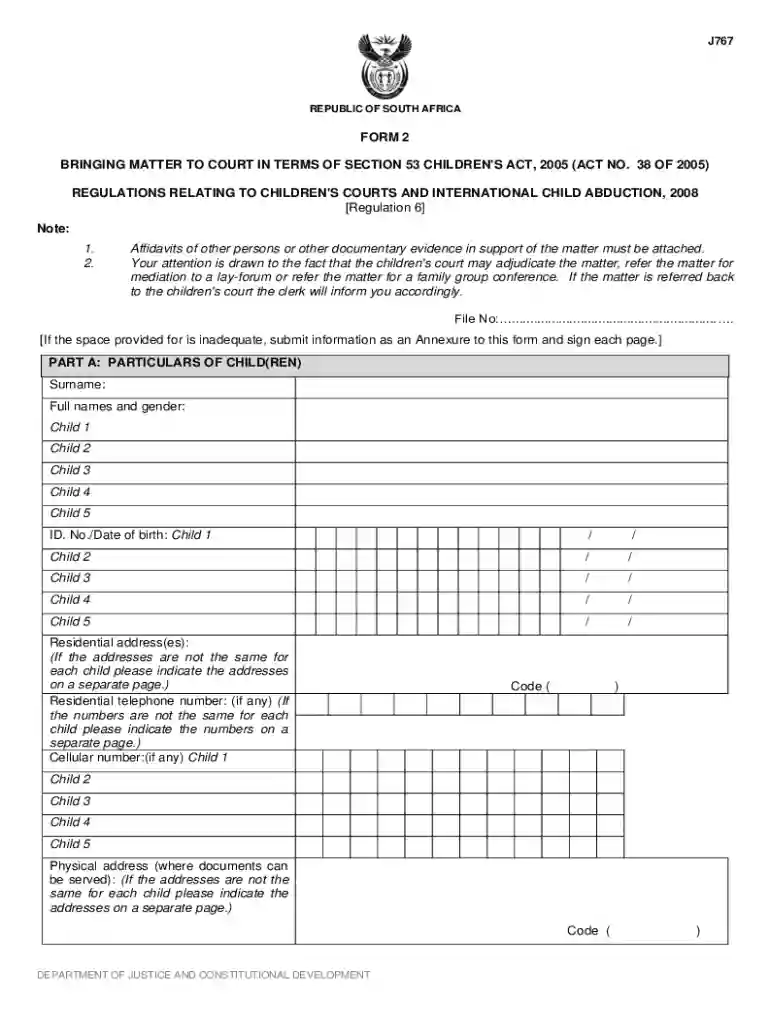
The J767 form is essential in legal contexts, particularly for initiating court proceedings under the Children's Act of 2005 in South Africa. It serves as a legal document required to bring matters involving children to court, ensuring comprehensive representation and safeguarding their interests. The form provides critical details such as the involved children's personal information, their residential addresses, and information on individuals representing or having an interest in the case. Understanding this form is crucial for anyone involved in legal proceedings related to children's welfare in South Africa.
Navigating the J767 involves specific steps that ensure proper filing and submission. Typically used by legal professionals or individuals with cases involving the Children's Act, this form must be completed with precision. It captures necessary information, including:
Each section of the J767 requires detailed input, often necessitating legal expertise to ensure accuracy. Once completed, the form should be submitted for processing, aligning with the court's requirements to start legal proceedings.
Completing the J767 involves organized steps to ensure accuracy and compliance:
Gather Necessary Information: Collect essential data about the children involved, including full names and residential addresses.
Identify Representatives: List details of individuals acting on behalf of the children, specifying their role and interest in the case.
Detail Case Nature: Clearly outline the nature of the matter being brought to court, providing relevant context and specifics.
Attach Supporting Documents: Ensure all supporting documentation is attached, verifying claims and substantiating the case.
Review for Accuracy: Double-check all entries for correctness and compliance with legal requirements.
This step-by-step approach facilitates accurate and effective completion of the J767, minimizing errors and ensuring legal compliance.
Grasping specific terminology associated with the J767 is vital for proper understanding and completion. Key terms include:
Having a grasp of these terms aids in navigating the form and understanding the broader legal implications involved.
The J767 is primarily utilized by:
These parties use the J767 to ensure that matters involving children's rights are legally represented and adequately addressed.


Legally, the J767 is recognized as a requisite form for initiating court proceedings concerning children's matters under South African jurisdiction. It aligns with the Children's Act, ensuring that all legal protocols are adhered to when dealing with cases involving minors. The form's completion is a procedural requirement, ensuring that:
Compliance with these legal requirements makes the J767 indispensable in relevant legal processes.
The core components of the J767 include:
Understanding these elements ensures thorough and accurate completion of the J767 form, facilitating effective legal processing.
Real-world applications of the J767 illustrate its versatility in legal contexts. For instance:
These examples underscore the form's practicality in safeguarding children's rights in legal settings.
We've got more versions of the j767 form. Select the right j767 version from the list and start editing it straight away!
At DocHub, your data security is our priority. We follow HIPAA, SOC2, GDPR, and other standards, so you can work on your documents with confidence.