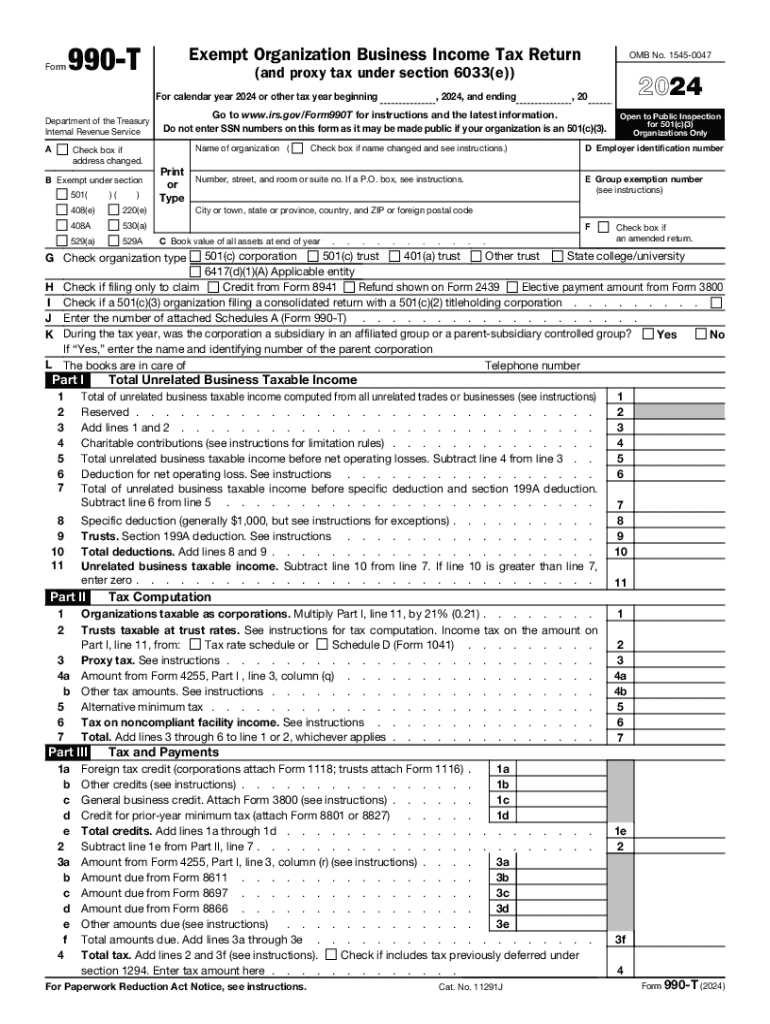







Definition & Meaning
The 2024 Form 990-T, known as the Exempt Organization Business Income Tax Return, is a tax document filed by tax-exempt organizations in the United States. These organizations use this form to report unrelated business taxable income (UBTI) and assess any applicable taxes. The form is crucial for maintaining transparency and compliance with IRS regulations, ensuring that non-profit entities do not gain an unfair competitive edge through untaxed income from unrelated business activities.
Organizations that qualify for tax exemption must file this form if their UBTI exceeds $1,000. The form serves as a vehicle to detail financial information that distinguishes between tax-exempt income and income derived from unrelated business activities. By properly classifying income, organizations ensure compliance with tax laws while maintaining their tax-exempt status.
How to Use the 2024 Form 990-T
To effectively use the 2024 Form 990-T, organizations should first gather all relevant financial documents, such as income statements and balance sheets. Understanding the instructions and definitions provided by the IRS will streamline the completion process. It’s essential that organizations accurately differentiate between unrelated business taxable income and income that is legitimately tax-exempt.
Organizations must fill out sections detailing their gross income, deductions, credits, and calculate their tax liabilities accordingly. Complex calculations may require assistance from tax professionals to ensure accuracy and compliance with IRS guidelines. Once completed, the form should be submitted using the appropriate method by the stipulated deadline to avoid penalties.
Steps to Complete the 2024 Form 990-T
-
Gather Financial Records: Collect all necessary documents, including income statements, records of expenses, and any prior tax filings.
-
Identify Unrelated Business Activities: Determine which activities conducted by the organization qualify as unrelated business income.
-
Calculate Gross Income: Accurately report all gross income derived from unrelated business activities on the form.
-
Determine Deductions: List any applicable deductions allowed under IRS guidelines to lower the reported taxable income.
-
Compute Tax Liability: Use the deductions to compute the final tax liability for the organization. This may involve complex calculations that necessitate consulting tax professionals.
-
Review and Sign: Ensure that the entire form is complete and accurate, then sign it to certify its validity.
-
Submit to IRS: File the complete form with the IRS using an accepted submission method.
IRS Guidelines
The IRS provides detailed guidelines for the 2024 Form 990-T to assist tax-exempt organizations in correctly reporting UBTI. These guidelines explain the distinctions between related and unrelated business activities, acceptable deductions, and the rates applicable to different forms of income. Adhering to these guidelines helps organizations maintain their tax-exempt status while complying with federal tax laws.
The IRS instructions also offer advice on maintaining records and documentation necessary for audit trails and potential reviews. Organizations are encouraged to familiarize themselves with these guidelines to avoid errors and penalties during the reporting process.
Filing Deadlines / Important Dates
Filing deadlines for the 2024 Form 990-T are critical to prevent penalties and ensure compliance. Organizations typically need to file this form by the 15th day of the 5th month after the end of their fiscal year. For example, organizations with a calendar year would file by May 15, 2024. Extensions may be available, but organizations must apply in advance using Form 8868 to avoid late filing penalties.
Required Documents
To complete the 2024 Form 990-T, organizations need specific documents that reflect their financial activities. These include:
- Income statements detailing gross revenue from unrelated business activities.
- Records of deductible expenses incurred during the year.
- Prior tax filings, if applicable.
- Supporting documentation for credits and deductions claimed.
Keeping these records organized and readily available simplifies the filing process and aids in compliance during audits or IRS reviews.
Penalties for Non-Compliance
Failing to file the 2024 Form 990-T or inaccurately reporting information can lead to substantial penalties. The IRS may impose monetary fines based on the degree of non-compliance and the organization's income. Penalties range from simple fixed fines for late filings to percentage-based penalties for underreported income.
Organizations should prioritize accurate tax reporting and timely submission to avoid these punitive measures, which can adversely affect their financial status and reputation.
Digital vs. Paper Version
The 2024 Form 990-T can be submitted both digitally and via paper. Each method has specific requirements and benefits. Filing electronically can expedite processing times and reduce errors through systems that automatically check for inconsistencies. Paper filings may be necessary for organizations with specific needs or those uncomfortable with digital submissions.
Organizations should consider the advantages and limitations of each method and choose the appropriate one based on resources, capabilities, and preferences. Following IRS recommendations for electronic filing can also enhance efficiency in document management.
Business Entity Types (LLC, Corp, Partnership)
Different business entity types, including LLCs, corporations, and partnerships, may be involved in or associated with tax-exempt organizations. Each has unique tax obligations concerning unrelated business taxable income. Understanding these distinctions is crucial when completing the 2024 Form 990-T to ensure allowable deductions are applied correctly, and appropriate tax liabilities are calculated.
Organizations should collaborate with tax advisors knowledgeable in specific business entity tax requirements to optimize the filing process and remain compliant with IRS regulations.