







Definition & Meaning
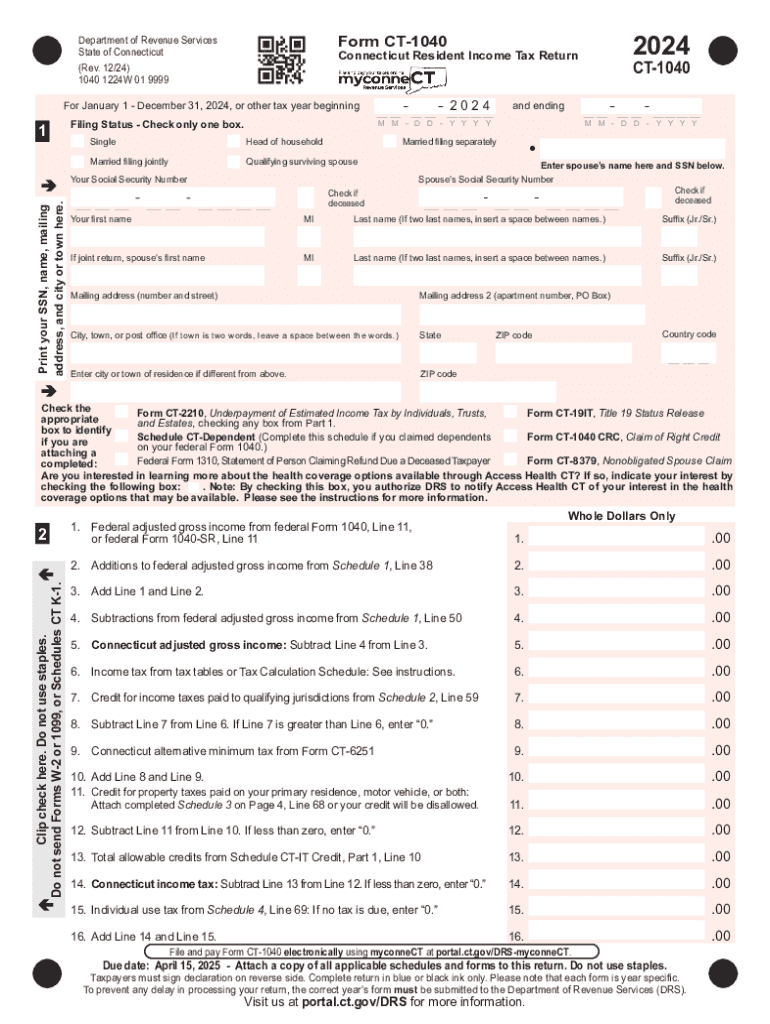
The Connecticut Resident Income Tax Return, known as the CT-1040, is a tax form used by residents of Connecticut to report income, calculate taxes owed, and request refunds for the tax year 2024. It encompasses various sections that guide taxpayers in accurately documenting financial details, including income sources, deductions, and credits.
The CT-1040 is crucial for ensuring correct tax payments are made to the state of Connecticut. By correctly completing this form, taxpayers ensure compliance with state tax laws and avoid potential penalties. The form serves as an official record that confirms all financial transactions and obligations within a given tax year.
How to Use the CT-1040
Using the CT-1040 effectively requires understanding each part of the form and its significance. Users begin by filling out personal information such as name, address, and Social Security number. This section ensures that the return is attributed to the correct individual.
Completing Income and Adjustments
-
Income Reporting: Document all income earned during the year, including wages, salaries, and other earnings. This comprehensive listing is necessary to determine the taxable amount.
-
Adjustments: Apply any applicable income adjustments. This may include deductions like health savings account contributions or student loan interest.
Claiming Deductions and Credits
- Deductions: Include state-specific deductions available to Connecticut residents, which can reduce taxable income and overall tax liability.
- Credits: Claim applicable credits, such as the Property Tax Credit, to further decrease the tax you owe.
Steps to Complete the CT-1040
- Start by gathering all necessary documents, such as W-2s, 1099s, and other income statements.
- Input personal information and filing status.
- Report all sources of income.
- Apply any adjustments to income.
- Calculate deductions and credits.
- Deduct total credits from the tax amount computed.
- Determine if a tax refund is due or if additional tax payments are needed.
Filing Deadlines / Important Dates
The CT-1040 must be filed by April 15, 2025. It is vital to adhere to this deadline to avoid late filing penalties and interest. For those unable to file by this date, Connecticut provides an extension request option, which must be filed prior to the original deadline.
Extensions and Late Filing
- Extension Request: File a Form CT-1040 EXT by the original due date for a six-month extension.
- Late Payment Penalties: These apply if taxes are not fully paid by April 15, regardless of any extension granted.
Important Terms Related to CT-1040
Understanding key terminology is essential for accurately completing the CT-1040:
- Filing Status: Options include single, married filing jointly, and head of household, each affecting tax calculations.
- Adjusted Gross Income (AGI): The total income after applying specific adjustments, serving as the basis for calculating taxable income.
- Taxable Income: The income amount after deductions, which is subject to tax rates.
IRS Guidelines
The IRS provides overarching tax guidelines that inform taxpayers about laws affecting federal and state taxes, including CT-1040. Understanding these guidelines ensures compliance with all regulatory requirements.
Compatibility with Federal Returns
- The CT-1040 complements federal tax forms by reflecting state-specific adjustments; always cross-reference with federal tax information to ensure accuracy.
Key Elements of the CT-1040
The form includes several critical components that dictate how taxes are calculated and what financial obligations or refunds are anticipated:
- Personal Information Section: Ensures the form is connected to the proper individual.
- Tax Reconciliation Section: Summarizes all income, adjustments, deductions, and credits to establish the final tax obligation.
Required Documents
To complete the CT-1040 accurately, gather all relevant documentation:
- Income Statements: W-2, 1099, or any other forms documenting income.
- Adjustment Records: Receipts and forms for deductible expenses.
- Credit Documentation: Proof for any state-specific credits claimed.
Having these documents on hand simplifies the process and helps prevent errors on the return.
Form Submission Methods (Online / Mail / In-Person)
Connecticut residents can file the CT-1040 through various methods, each providing unique advantages:
- Online Filing: Quick processing and confirmation of receipt.
- Mail: Traditional approach, though slower, provides physical documentation.
- In-Person: Submit directly to a local tax office for immediate acknowledgment.




