Docketing Statement (Appeal to the Alabama Court of Civil 2026

Get Form
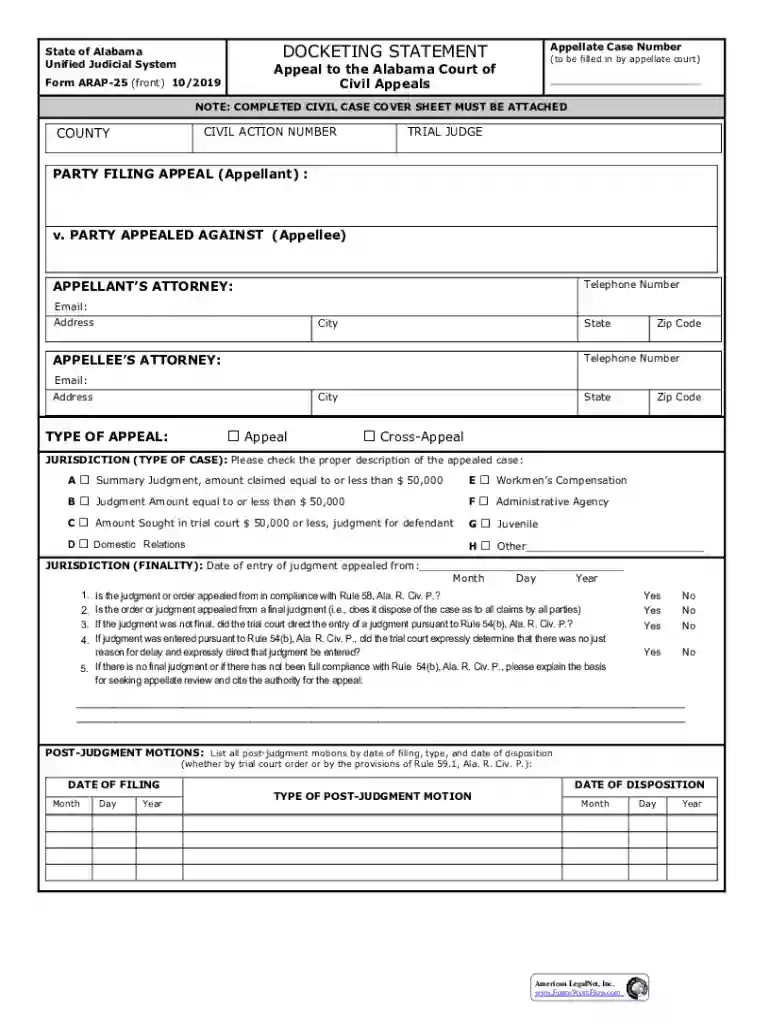
Docketing Statement (Appeal to the Alabama Court of Civil Preview on Page 1

Here's how it works

01. Edit your form online
Type text, add images, blackout confidential details, add comments, highlights and more.

02. Sign it in a few clicks
Draw your signature, type it, upload its image, or use your mobile device as a signature pad.

03. Share your form with others
Send it via email, link, or fax. You can also download it, export it or print it out.

Definition & Meaning of the Docketing Statement (Appeal to the Alabama Court of Civil Appeals)

The Docketing Statement for appeals to the Alabama Court of Civil Appeals plays an essential role in the appellate process, serving as a comprehensive overview of an appeal from a lower court decision. It provides the court with critical information such as the identities of the involved parties, the nature of the appeal, pertinent jurisdictional details, any post-judgment motions, and the core aspects of the case.

Purpose and Relevance

  • Streamlines Court Processes: The docketing statement ensures that the appellate court is adequately informed about the case, facilitating a more efficient handling of the appeal.
  • Establishes Jurisdiction: By outlining jurisdictional grounds, it helps ascertain that the court has the authority to hear the matter.
  • Clarifies Case Details: Including detailed information about the parties and legal issues involved ensures clarity and aids in the smooth progression of the appeal.

Steps to Complete the Docketing Statement

Filling out the Docketing Statement requires careful attention to ensure accuracy and completeness, reflecting all relevant details concerning the appeal.

Detailed Completion Instructions

  1. Identify the Parties Involved: Clearly list all parties involved in the appeal, providing full names and designations (e.g., appellant, appellee).
  2. Specify the Type of Appeal: Indicate whether the appeal is from a final judgment or involves particular interlocutory orders.
  3. Describe the Jurisdictional Basis: State the legal grounds that permit the appeal to be heard by the Alabama Court of Civil Appeals.
  4. Include Post-Judgment Motions: If applicable, detail any motions filed after the judgment in the lower court.
  5. Outline the Case Nature: Provide a summary of the case background, including the issues being appealed.
  6. Attach Required Documentation: Ensure all necessary documents, such as the trial court's judgment, are included.

Common Errors to Avoid

  • Inaccurate Party Names: Double-check the spelling and titles of all parties mentioned.
  • Incomplete Information: Ensure that no section is left unaddressed unless it is marked as non-applicable.

Key Elements of the Docketing Statement

Understanding the pivotal components of the Docketing Statement helps in accurately articulating the appeal details.

Principal Components

  • Appellant Information: Contact details and representation status of the appellant.
  • Appellate Court Information: Details specific to the Alabama Court of Civil Appeals, ensuring compatibility with the court's jurisdiction.
  • Case Summary: A brief overview of the case that includes the decision being appealed and pertinent legal questions.
  • Statement of Issues: Specific legal or factual issues that are being challenged in the appeal.

State-Specific Rules for Alabama

Appealing to the Alabama Court of Civil Appeals necessitates adherence to jurisdiction-specific regulations and procedures.

Alabama Specific Regulations

  • Jurisdictional Timeframe: An appeal must be filed within a specific period following the trial court's judgment.
  • Filing Fees: Be aware of any mandatory filing fees associated with submitting the docketing statement.
  • Document Format: Ensure documents comply with the court's format requirements, including paper size, font type, and filing medium.

Digital vs. Paper Version

While submissions can often be made physically, there are growing options for digital submission, facilitating easier and quicker filing processes.

Advantages of Each Format

  • Paper Version: Traditional and may be required in less technologically equipped jurisdictions.
  • Digital Version: Increases accessibility and reduces physical handling, often supported on platforms like DocHub for online completion and submission.

Examples of Using the Docketing Statement

Providing illustrative scenarios of how the docketing statement facilitates the appeal process enriches understanding and anticipation of potential outcomes.

Practical Applications

  • Appeal of a Civil Judgement: A business owner appeals a civil court decision impacting contractual obligations by providing detailed case background and jurisdictional claims.
  • Individual's Appeal on Family Court Ruling: An individual disputes a family court ruling, utilizing the statement to highlight changes in circumstance and legal arguments.

Form Submission Methods

Having multiple submission options provides flexibility, catering to different resources and preferences of the appellant party.

Available Submission Channels

  • Online: Through platforms like DocHub, allowing for a seamless digital submission process.
  • Mail: For those who prefer or are required to send physical copies of the docketing statement.
  • In-Person Filing: Direct submission at the court office for immediate confirmation of receipt.

Penalties for Non-Compliance

Failure to comply with submission requirements or inaccuracies in the docketing statement can lead to significant consequences.

Resulting Impacts of Non-Adherence

  • Delay in Appeal Processing: Errors or omissions may result in delays or outright dismissal of the appeal.
  • Legal and Financial Penalties: Non-compliance can lead to financial penalties or further legal challenges, emphasizing the importance of attention to detail during submission.
be ready to get more

Complete this form in 5 minutes or less

Get form

Got questions?

We have answers to the most popular questions from our customers. If you can't find an answer to your question, please contact us.
Contact us
Having strong arguments is the best way to win. So how do you make sure your appeal is as strong as it can get? Well, the data shows you should call in an appellate attorney. Most litigators understand that a trial is predominantly about facts, whereas an appeal is predominantly about law.
Any party may appeal from a final judgment of the district court in a civil case by filing notice of appeal in the district court, within 14 days from the date of the judgment or the denial of a posttrial motion, whichever is later, or, if the appeal is to an appellate court, within the time prescribed by the Alabama
After a Decision is Issued Step 1: File the Notice of Appeal. Step 2: Pay the filing fee. Step 3: Determine if/when additional information must be provided to the appeals court as part of opening your case. Step 4: Order the trial transcripts. Step 5: Confirm that the record has been transferred to the appellate court.
Medicares 5-Level Appeal Process Level 1: Reconsideration from your plan. Level 2: Review by an Independent Review Entity (IRE) Level 3: Decision by the Office of Medicare Hearings and Appeals (OMHA) Level 4: Review by the Medicare Appeals Council (Appeals Council) Level 5: Judicial review by a federal district court.
Understanding the 5-Step Appeal Simple Appeal: Listen Actively. The first step in the 5-Step Appeal is the Simple Appeal. Reasoned Appeal: Acknowledge Emotions. Personal Appeal: Explore Options. Final Appeal: Agree on a Solution. Action: Follow up.

Security and compliance

At DocHub, your data security is our priority. We follow HIPAA, SOC2, GDPR, and other standards, so you can work on your documents with confidence.
Learn more
ccpa2
pci-dss
gdpr-compliance
hipaa
soc-compliance
be ready to get more

Complete this form in 5 minutes or less

Get form