Understanding the EOP Income Verification Form
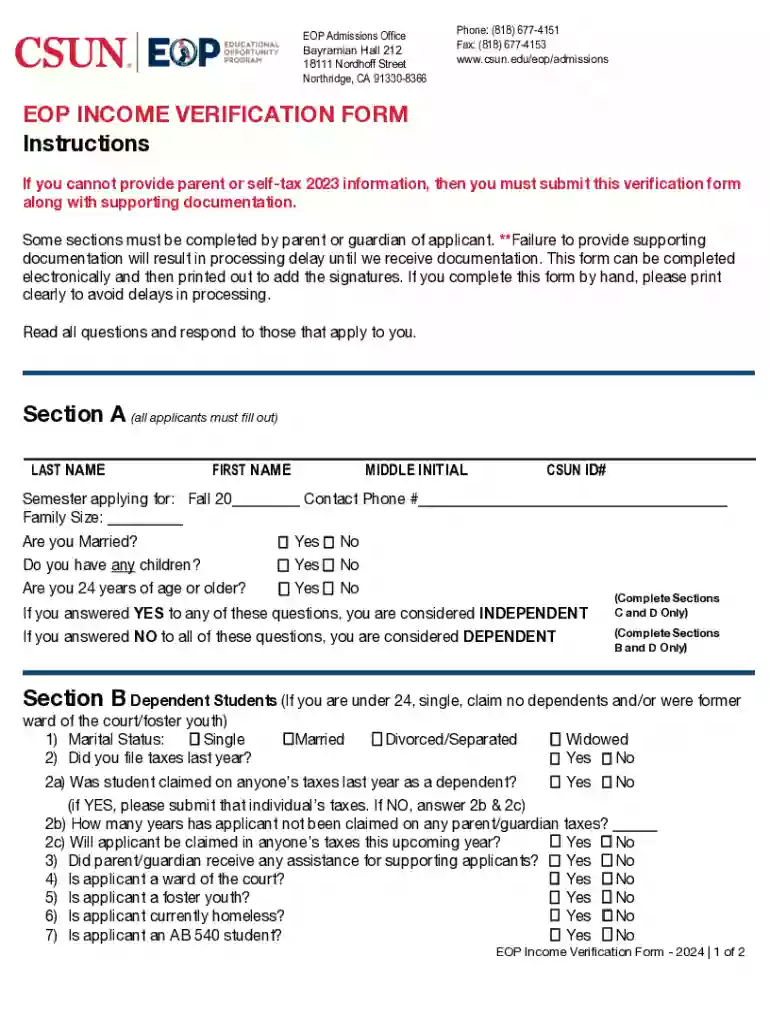
The EOP Income Verification Form is intended for students applying to the Educational Opportunity Program (EOP) at California State University, Northridge. It is specifically designed for applicants who are unable to provide standard tax documentation, ensuring that individuals from various financial backgrounds can participate in the program. The form captures information related to personal income, marital status, and other financial resources.
Key Elements of the Form
- Personal Information: Includes the applicant's name, student ID, and contact details.
- Marital Status: Provides details on whether the applicant is single, married, or in a similar status, which helps determine financial dependency.
- Income Sources: Requires a detailed list of income sources, including wages, benefits, and other financial support.
- Certification Statement: A declaration that the information supplied is accurate and complete, crucial for the legitimacy of the application.
Steps to Complete the EOP Income Verification Form
Completing the EOP Income Verification Form involves several crucial steps:
- Gather Necessary Information: Collect all relevant personal, financial, and tax-related data.
- Fill Out Personal Details: Start by providing your full name, student ID, and contact information.
- Specify Marital Status: Accurately select your marital or relationship status, as it influences financial assessments.
- Detail Income Sources: List all forms of income or financial aid, including estimated annual amounts.
- Complete Certification: Sign the certification statement to confirm all details are truthful and complete.
Required Documents
- Proof of Income: This could include pay stubs, letters from employers, or affidavits if typical tax documentation is unavailable.
- Marital Status Confirmation: Documents like marriage certificates or legal statements concerning dependents.
- Financial Aid Papers: Any available records of scholarships, grants, or benefits received.
Why Utilize the EOP Income Verification Form
Using the EOP Income Verification Form is essential for applicants who lack conventional tax documentation:

- Equitable Opportunity: Allows applicants from diverse financial backgrounds to verify income for program eligibility.
- Program Inclusion: Ensures that financial constraints do not impede access to educational support programs like EOP.
- Legal Compliance: Provides a compliant way to confirm income status without standard IRS forms.
Eligibility and Application Process
Eligibility Criteria
- Financial Need: The form targets students with a demonstrable need for financial assistance who cannot supply traditional tax documents.
- Program Applicant: Must be applying to or enrolled in California State University's EOP.
Application and Approval Process
- Complete the Form: Ensure all sections of the form are accurately filled.
- Submit Supporting Documents: Attach all required proof of income, marital status, etc.
- Review and Approval: The EOP office evaluates the application based on the information provided.
Processing Time
- Standard Review: Typically, the review process can take several weeks, depending on the volume of submissions.
- Follow-Up: Applicants may receive requests for additional documentation to clarify details.
Form Submission Methods
- Online Submission: Preferred for ease and tracking, allowing applicants to submit through university portals.
- Mail: Hard copies can be sent directly to the EOP office, though this may extend processing time.
- In-Person Delivery: Direct submission at the campus EOP office provides immediate acknowledgment of receipt.
Legal Use and Compliance
Ensuring that the EOP Income Verification Form is completed accurately is crucial for maintaining eligibility:
- Legal Declaration: Misrepresentation on the form can have legal repercussions, including ineligibility for the program.
- Documentation Integrity: Keep copies of all submitted documents and additional correspondence.
Penalties for Non-Compliance
Failure to submit required forms or falsifying information may result in:
- Loss of Eligibility: Disqualification from EOP funding or support.
- Legal Action: Potential legal consequences or review by university authorities.
Digital vs. Paper Versions
- Digital Forms: Offer convenience, with features for saving progress and easier edits.
- Paper Forms: Necessary for those without reliable access to digital platforms but often less efficient.
Examples of Using the Form
Example scenarios where the EOP Income Verification Form proves invaluable:
- Independent Students: Individuals who support themselves entirely and do not appear on typical tax records.
- Unconventionally Employed: Applicants who earn income from non-traditional sources such as gig work without formal documentation.
- Low-Income Deadlines: Students whose family income might not be officially documented due to informal employment.