





Definition & Meaning
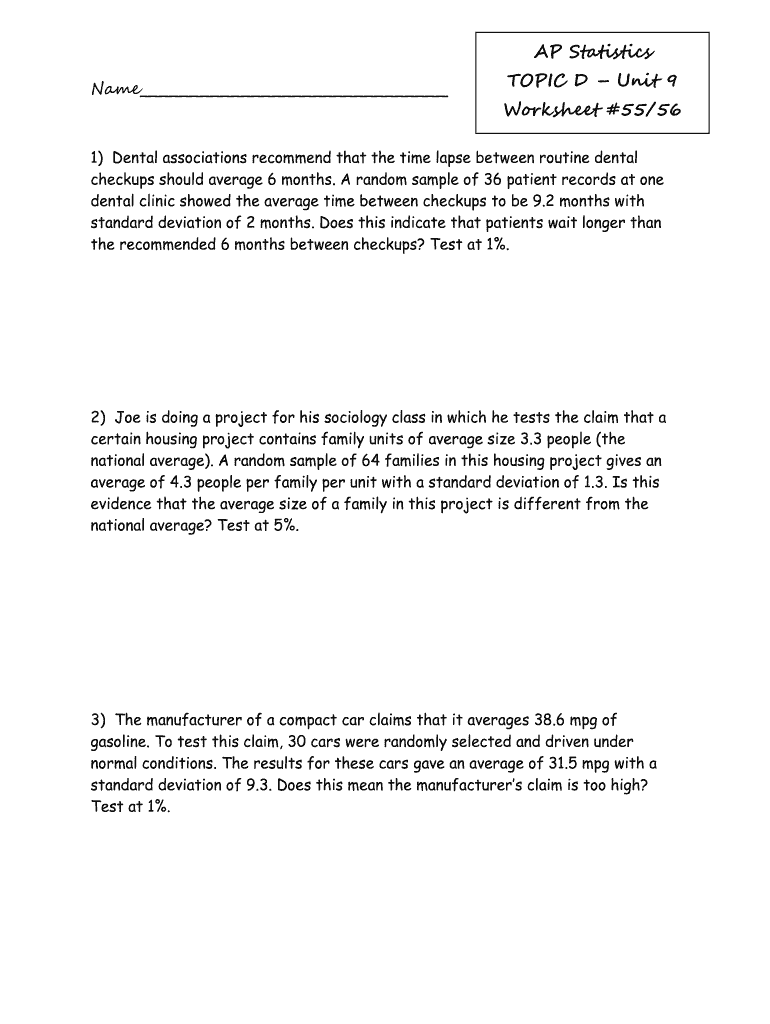
The "AP Statistics TOPIC D Unit 9 Worksheet #55 56 - Manhasset" is a specialized educational resource designed primarily for Advanced Placement (AP) Statistics students. This worksheet focuses on hypothesis testing, a critical concept in statistical analysis, offering students a structured way to practice and refine their skills. The document typically includes various scenarios that require students to formulate null and alternative hypotheses, apply significance levels, and conduct tests to determine the validity of these hypotheses. The worksheet's relevance extends to those preparing for AP exams, as it helps solidify understanding and application of statistical principles.
How to Use the AP Statistics Worksheet
Using the "AP Statistics TOPIC D Unit 9 Worksheet #55 56 - Manhasset" involves several key steps:
-
Review Hypothesis Testing Concepts: Before engaging with the worksheet, ensure a solid understanding of hypothesis testing, including concepts such as null and alternative hypotheses, p-values, and significance levels.
-
Read Each Scenario Thoroughly: Each section presents a unique scenario. Carefully read the details to understand the data and the context.
-
Formulate Hypotheses: For each scenario, define the null and alternative hypotheses.
-
Perform Statistical Tests: Use the provided data to perform the appropriate statistical tests, determining whether to reject or fail to reject the null hypothesis.
-
Interpret Results: Analyze the results of the tests, understanding the implications of Type I and Type II errors.
-
Discuss with Peers or Instructors: Engage in discussions to deepen understanding and clarify any uncertainties.
Steps to Complete the AP Statistics Worksheet
Completing this worksheet requires the systematic execution of several steps:
-
Preparation: Gather necessary statistical tools, such as calculators or statistical software, to aid in calculations.
-
Scenario Analysis: Begin with a scenario analysis, carefully noting the variables and data provided.
-
Set Up Hypotheses: Clearly state the null and alternative hypotheses relevant to each scenario.
-
Choose the Right Test: Select the appropriate statistical test (e.g., t-test or chi-square test) based on the data’s characteristics and hypothesis type.
-
Calculate and Compare: Perform calculations to find p-values or test statistics, then compare these to the significance level.
-
Draw Conclusions: Based on the statistical analysis, draw conclusions about the hypotheses’ validity.
-
Review Errors: Reflect on potential Type I or Type II errors arising from the hypothesis testing.
Important Terms Related to the AP Statistics Worksheet
Understanding key terms enhances the effective use of the worksheet:
- Null Hypothesis (H0): A statement that indicates no effect or no difference, serving as the default assumption to be tested.
- Alternative Hypothesis (H1): Contrasts the null, suggesting a potential effect or difference.
- Significance Level: The threshold for determining whether the null hypothesis can be rejected, commonly set at 0.05 or 0.01.
- Type I Error: Incorrectly rejecting a true null hypothesis.
- Type II Error: Failing to reject a false null hypothesis.
Examples of Using the AP Statistics Worksheet
The "AP Statistics TOPIC D Unit 9 Worksheet #55 56 - Manhasset" applies to varied real-world scenarios, including:
- Dental Checkups: Comparing the average interval between checkups to a believed standard.
- Car Fuel Efficiency: Testing whether the fuel efficiency of a new model differs from that of established models.
- SAT Scores: Assessing if a prep course effectively increases average scores.
- Apple Weights: Evaluating whether a certain type of fertilizer affects the average weight of apples.
Key Elements of the AP Statistics Worksheet
The worksheet consists of several core components designed to foster statistical skills:
- Scenarios: Real-world examples to apply hypothesis testing.
- Data Sets: Sample data to be used for analysis.
- Instructions: Guidelines for performing statistical tests.
- Discussion Points: Questions that encourage analysis of results and understanding of statistical errors.
Digital vs. Paper Versions
The "AP Statistics TOPIC D Unit 9 Worksheet #55 56 - Manhasset" is available in both digital and paper formats:
- Digital Format: Offers interactivity and ease of revision, with tools like DocHub for annotating and filling fields.
- Paper Format: Preferred by those who benefit from hands-on interaction with physical documents.
Software Compatibility
For a more efficient experience, students may utilize compatible software:
- Statistical Software: Programs like R or Python for executing tests.
- Document Preparation: Platforms such as DocHub for filling and annotating digital worksheets, ensuring accessibility and secure data handling.
Each of these components contributes to a cohesive educational experience, fostering a comprehensive understanding of AP Statistics concepts through practical application and iterative learning.