




01. Edit your form online
Type text, add images, blackout confidential details, add comments, highlights and more.

Type text, add images, blackout confidential details, add comments, highlights and more.

Draw your signature, type it, upload its image, or use your mobile device as a signature pad.

Send it via email, link, or fax. You can also download it, export it or print it out.
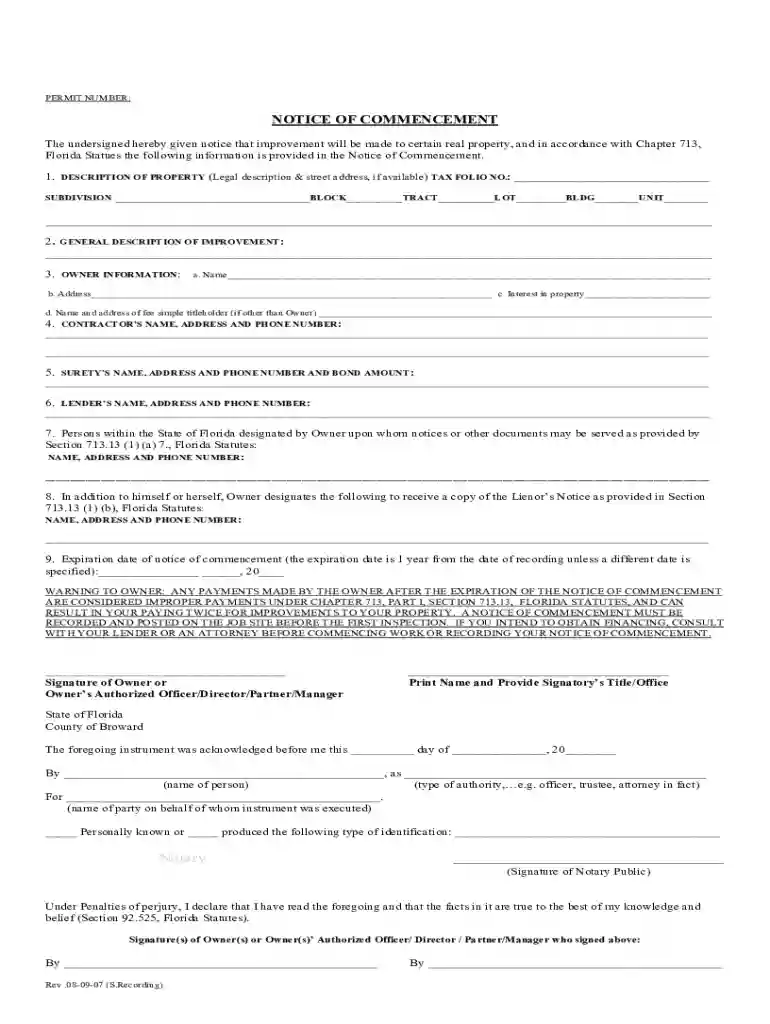
The "Notice of Commencement form" for Pinellas County, Florida is an official document filed to establish the onset of construction or property improvement activities. It serves a crucial role in the construction industry by providing detailed information about the project, including property description, contact information of stakeholders such as the owner, contractor, surety, and lender, and designating the address where notifications should be delivered. The document essentially signals the start of a project and acts as a legal safeguard for all parties involved by clearly outlining responsibilities and timelines.
Understanding its role is essential as it helps in managing lien rights and ensures that all credits and transactions related to the improvement are properly tracked. This form is not only a communication tool but also a legal requirement in the state of Florida, where it plays a significant part in dispute resolutions by detailing the commencement date and other vital data needed in legal contexts.
To acquire the Notice of Commencement form in Pinellas County, Florida, several methods are available:
Online Download: The form can typically be downloaded from the official Pinellas County website or other local government portals that frequently have public documents available for access.
In-Person Pickup: Individuals can visit the County Clerk’s office, where hard copies of the document are usually provided.
Mail Request: Some jurisdictions may allow you to request a copy by mail, although this process could take longer and might involve mailing fees.
It's important to verify that you are using the most current version of the form to avoid processing delays or rejection.
Filling out the Notice of Commencement form involves several detailed steps:
Property Information: Start by accurately recording the legal description of the property involved in the project, including the street address, if applicable.
Owner and Contractor Details: Provide comprehensive contact information for both the property owner and the contractor responsible for the work. This includes addresses and contact numbers.
Surety and Lender Information: Document the surety bond provider details if a bond has been obtained. For projects involving loans, include the lender's information.
Expiration Date: Clearly state the date of completion or the anticipated end of the construction activities.
Notary Requirement: The form must be signed in the presence of a notary public, which can be vital for legal acknowledgment and authentication of the document’s content.
Designate Notification Recipient: Indicate the person or entity to receive all official communication and notices related to the commencement.
The form includes several critical components that ensure its efficacy and legal standing:
These elements collectively maintain a clear record and facilitate better management of any legal queries or conflicts that may arise during or after the project.
The Notice of Commencement form is predominantly utilized by:
This tool is essential for orchestrating a mutually secure and legally recognized environment for property enhancement projects.


Filing the Notice of Commencement is an obligatory legal process under Florida law for construction projects. It declares the official start of work and ensures transparency by recording who is outsourcing and executing the work, what it entails, and when it begins. The form has legal implications, as payments made after its expiration may lead to complications in lien rights. Legal use primarily revolves around establishing priorities of payment, allocating responsibilities, and setting a formal timeline for the construction project.
Several key terms need clarification to fully navigate the Notice of Commencement form:
Understanding these terms can clarify the intricacies involved in filling and utilizing the Notice of Commencement form effectively.
Failing to properly file or comply with the Notice of Commencement requirements can result in significant repercussions. These can include:
Adherence to these guidelines ensures legal protection and smooth execution of construction activities. Proper filing of the form not only aligns with legal standards but also mitigates risks associated with construction projects.
At DocHub, your data security is our priority. We follow HIPAA, SOC2, GDPR, and other standards, so you can work on your documents with confidence.


Notice that improvements will be made to certain real property. When this form is required, the form needs to be recorded with the Clerk of the Circuit Court
Board of Pinellas County. 209 HOPPEN PLACE BOGALUSA, LA 70427 TEL: 985.732.5651 TOLL FREE: 888.665.6760 FAX: 985.735 5579. Page 9. 1.b. BP Governmental Claim


