




01. Edit your form online
Type text, add images, blackout confidential details, add comments, highlights and more.

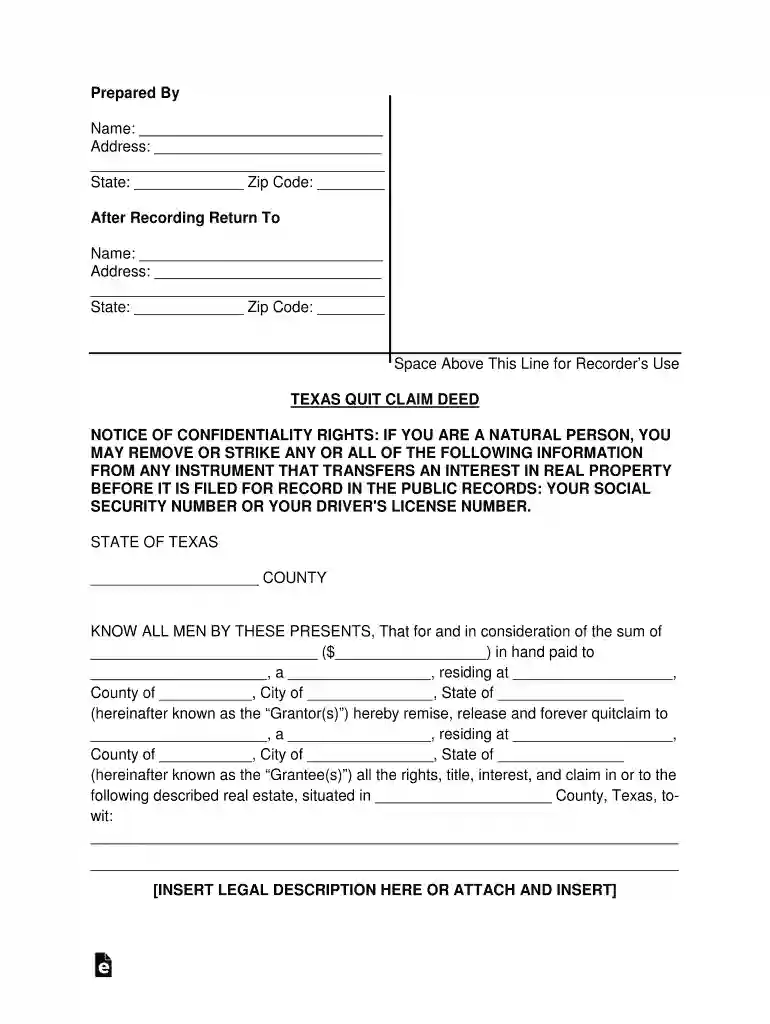
Type text, add images, blackout confidential details, add comments, highlights and more.

Draw your signature, type it, upload its image, or use your mobile device as a signature pad.

Send it via email, link, or fax. You can also download it, export it or print it out.
The Texas Quit Claim Deed Form is a legal instrument used to transfer property rights from one party, known as the grantor, to another, referred to as the grantee. Unlike warranty deeds, quit claim deeds do not guarantee that the property being transferred is free of liens or encumbrances; they only transfer the interest the grantor possesses at the time of the transfer. Because of this, it is often used in situations where parties know and trust each other, such as between family members or in divorce settlements. The form operates as a simple and straightforward means to alter property ownership, often used for gifting or changing ownership among relatives without monetary consideration.
Prepare the Form: Ensure you have the correct and most recent version of the Texas Quit Claim Deed Form. This form typically includes spaces for the grantor's and grantee's names, a legal description of the property, and the signature of the grantor.
Complete Required Sections: Fill in all sections accurately. Include all pertinent personal information and the detailed legal description of the property. This may involve referencing the property's parcel number or other unique identifiers.
Notarization: The signed document must be notarized to be legally binding. This means the grantor must sign the form in the presence of a notary public who will then apply their seal.
Recording the Deed: Once notarized, the deed should be filed with the county recorder's office where the property is located. This step ensures the transaction is recognized legally and publicly.
Retain Copies: Keep copies of the notarized and recorded deed for both the grantor and grantee's records.
The Texas Quit Claim Deed Form can be obtained from multiple sources. It is often available at local county clerk's offices or through real estate agents and attorneys who handle property transactions. Additionally, various legal document websites offer downloadable versions, which may be tailored to Texas-specific requirements. When obtaining the form, ensure it complies with Texas law, including necessary spaces for notarization and legal property descriptions.
Gather Information: Collect all necessary information, including the names of both parties and the property's legal description.
Fill Out the Form: Complete the document with accurate and legible information. False or outdated details can invalidate the deed.
Verify Details: Double-check all entries for accuracy before signing, focusing on names, addresses, and the property's legal description.
Signatures and Notarization: Secure the grantor's signature in front of a notary public, who will verify the identity of the signatory and witness the signing of the form.
File the Document: Submit the completed and notarized document to the county courthouse for recording. Fees may apply for this service, which vary by county.
The Texas Quit Claim Deed is legally used to transfer any interest the grantor may have in a piece of property to the grantee. It is particularly useful in cases where ownership needs to be confirmed quickly and simply, such as settling the distribution of property after a divorce or transferring family-owned property. The form's usage does not guarantee clear title, which means it should not be relied upon when purchasing property from unknown parties or where a mortgage is involved, as it lacks the title protections offered by warranty deeds.
Texas follows specific protocols concerning quit claim deeds compared to other states. While the form allows for property interest transfers, it is not usually employed in purchasing scenarios due to the lack of warranty. In Texas, it's important that the deed adheres to the state's property code, including accurate property descriptions and proper notarization. Failure to meet these official requirements can lead to the deed not being recorded or recognized legally, which might affect the validity of the transfer.
The Texas Quit Claim Deed Form is predominantly utilized by individuals who need to transfer property to someone they trust. Common user scenarios include family members transferring property as gifts, spouses transferring property in divorce settlements, and clearing title issues internally within large families or groups of co-owners. Businesses and individuals with a strong understanding of existing property interests may also use quit claim deeds for the restructuring of property holding without the need for traditional sale processes.
By weaving together these detailed insights, the comprehensive nature of the Texas Quit Claim Deed Form is explored, covering various practical applications and considerations to provide maximum utility to users.


At DocHub, your data security is our priority. We follow HIPAA, SOC2, GDPR, and other standards, so you can work on your documents with confidence.



Oct 4, 2021 Clients often ask lawyers for quitclaim deeds or sometimes quick claim deeds. In most cases, though, using a quitclaim deed is a bad idea.Read more
Jul 15, 2026 Use these guided forms to cancel a transfer on death deed you have created. Sometimes called a revocation.


