Parkinsons disease questionnaire-39 (PDQ-39) 2026

Get Form
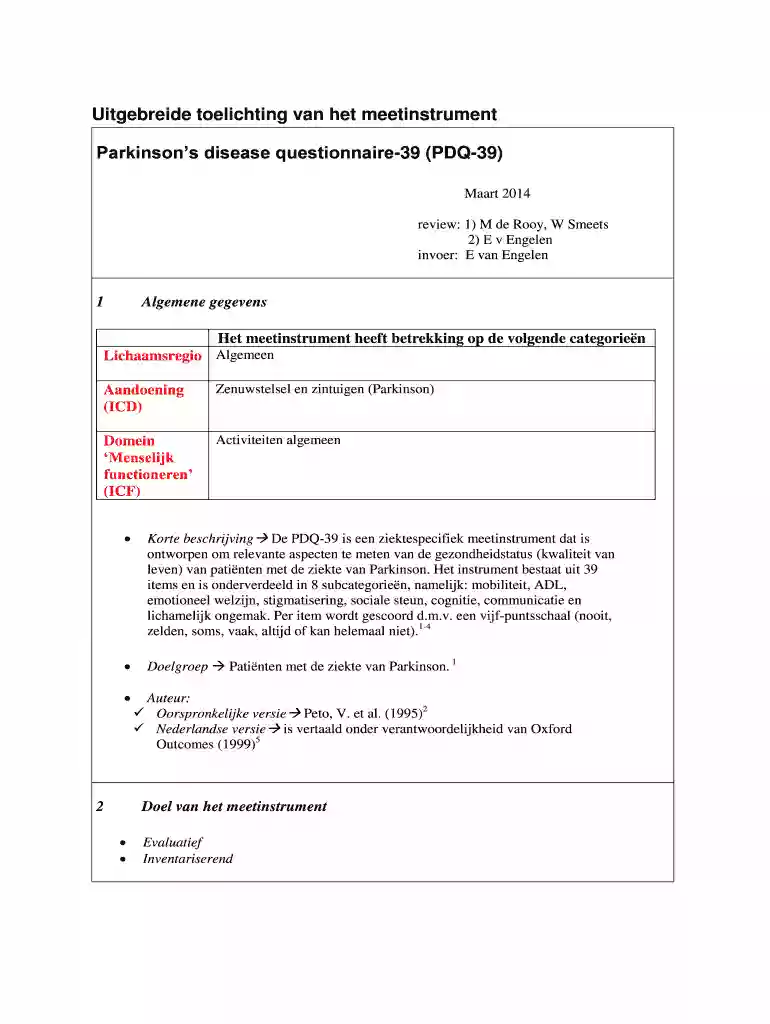
Parkinsons disease questionnaire-39 (PDQ-39) Preview on Page 1

Here's how it works

01. Edit your form online
Type text, add images, blackout confidential details, add comments, highlights and more.

02. Sign it in a few clicks
Draw your signature, type it, upload its image, or use your mobile device as a signature pad.

03. Share your form with others
Send it via email, link, or fax. You can also download it, export it or print it out.

Definition of the Parkinson’s Disease Questionnaire-39 (PDQ-39)

The Parkinson’s Disease Questionnaire-39 (PDQ-39) is a standardized tool used to assess the quality of life in individuals diagnosed with Parkinson's disease. This comprehensive instrument includes 39 items, each designed to evaluate particular aspects of living with Parkinson’s. These items are sorted into eight distinct categories, encompassing dimensions such as mobility, emotional well-being, and activities of daily living. By providing a detailed overview of a patient's health status, the PDQ-39 serves clinicians and researchers in identifying areas that may require targeted interventions or therapeutic focus.

How to Use the Parkinson’s Disease Questionnaire-39 (PDQ-39)

Using the PDQ-39 involves patients self-reporting their experiences across various facets of their condition. The questionnaire is structured to be user-friendly, prompting individuals to reflect on their health experiences in the preceding month. Responses are scored on a five-point scale, ranging from "never" to "always". This format ensures that results are both comprehensive and reflective of the patient’s overall wellbeing. Clinicians can analyze these scores to interpret which specific domains of the patient's life are most impacted by the disease.

Scoring and Interpretation

Scores from the PDQ-39 are calculated by summing the responses within each of the eight domains and converting them into percentages. This transformation helps in standardizing results across different patient populations. A higher percentage score indicates poorer quality of life or greater impact of Parkinson's symptoms. Healthcare providers often use these scores to tailor individualized management plans and measure treatment efficacy over time.

Key Elements of the Parkinson’s Disease Questionnaire-39 (PDQ-39)

The PDQ-39 is divided into eight key domains:

  • Mobility: Examines the patient’s ability to move around comfortably.
  • Activities of Daily Living: Assesses performance in daily tasks.
  • Emotional Well-being: Evaluates emotional health and psychological states.
  • Stigma: Concerns about perceived stigma associated with Parkinson’s.
  • Social Support: The degree of social support received by the patient.
  • Cognitive Impairment: Addresses memory and cognitive function issues.
  • Communication: Evaluates challenges in verbal interactions.
  • Bodily Discomfort: Measures physical discomfort and pain experiences.

Each domain provides insights into specific areas of impact, guiding clinicians in fine-tuning treatment approaches.

Steps to Complete the Parkinson’s Disease Questionnaire-39 (PDQ-39)

  1. Preparation: Patient receives the questionnaire, ideally in a quiet and comfortable environment.
  2. Understanding the Context: Patients should be informed of the purpose and importance of the exercise.
  3. Answering the Items: Respond to each of the 39 questions based on recent experiences.
  4. Scoring: Clinicians collect completed questionnaires and assign scores to responses.
  5. Analysis: Total scores are calculated for individual domains and interpreted to understand the symptom burden.
  6. Discussion: Review results with healthcare providers to discuss possible interventions or adjustments in treatment.

Who Typically Uses the Parkinson’s Disease Questionnaire-39 (PDQ-39)

The PDQ-39 is predominantly used by neurologists, researchers, and healthcare providers who specialize in managing Parkinson’s disease. Additionally, it can be employed by caregivers and family members who are involved in caregiving roles to better understand the specific challenges faced by the patient and facilitate more informed discussions with medical professionals.


decoration image ratings of Dochub

Legal Use of the Parkinson’s Disease Questionnaire-39 (PDQ-39)

The PDQ-39 is a legally recognized tool within healthcare systems and research contexts. It must be administered and interpreted by qualified professionals within the bounds of medical confidentiality and ethical guidelines. While the questionnaire itself does not dictate legal decisions, data derived can influence healthcare policies and coverage considerations for patients with Parkinson’s disease.

Digital versus Paper Version of the Parkinson’s Disease Questionnaire-39 (PDQ-39)

The PDQ-39 is available in both digital and paper formats, allowing flexibility in how it is administered:

  • Digital Version: Offers advantages in data management, with instant scoring and easier integration into electronic health records.
  • Paper Version: Useful in settings where technology access is limited or for patients who are unfamiliar with digital devices.

Healthcare facilities may choose one format over the other based on logistical considerations and patient preferences.

Examples of Using the Parkinson’s Disease Questionnaire-39 (PDQ-39)

  • Clinical setting: A neurologist uses the PDQ-39 scores to adjust a patient’s medication regimen, aiming to reduce symptoms in areas with high negative impact, such as mobility.
  • Research study: Investigators analyze pre- and post-treatment PDQ-39 scores to evaluate the efficacy of a new Parkinson’s therapy.
  • Rehabilitation program: Occupational therapists use the PDQ-39 to tailor interventions targeting activities of daily living, enhancing patient autonomy and quality of life.

Comprehensive Understanding of Important Terms Related to the PDQ-39

  • Five-Point Scale: Reference for patient responses, indicating the frequency or severity of symptoms.
  • Domains: Specific areas of life and health impacted by Parkinson’s disease, included in the PDQ-39 for detailed analysis.
  • Validated Tool: The PDQ-39 has undergone rigorous testing to ensure its reliability and validity in measuring Parkinson’s disease outcomes.

Each of these terms is integral to both the administration and interpretation of the PDQ-39, providing structure and clarity for users.

be ready to get more

Complete this form in 5 minutes or less

Get form

Got questions?

We have answers to the most popular questions from our customers. If you can't find an answer to your question, please contact us.
Contact us
Parkinsonism-specific screening questionnaires Questions ask about difficulty getting out of a chair, tremor, difficulty buttoning, smaller handwriting, softer voice, change in facial expression, lack of balance, freezing, and shuffling gait.
It is a 5-point scale for each of the 39 questions as follows: 0 = Never; 1 = Rarely; 2 = Sometimes; 3 = Often; and 4 = Always. The minimum score is 0 that means good health, while the maximum score is 100 that is bad health; a higher score indicates a lower QoL.
The PDQ-8 contains eight of the original 39 items of the PDQ-39; one item selected from each of the 8 scales. The PDQ-8 provides a reliable measure of overall health status and is ideal for studies in which a shorter questionnaire is preferred.
Based on results from exploratory factor analysis, a PDQ-39 summary index (PDQ-39SI) has been proposed [Jenkinson et al. 1997]. The PDQ-39SI is derived by the sum of the eight PDQ-39 scale scores divided by eight (the number of scales), which yields a score between 0 and 100 (100more health problems).
The Parkinsons Disease Questionnaire (PDQ-39) assesses how often people with Parkinsons experience difficulties across 8 dimensions of daily living including relationships, social situations and communication. It also assesses the impact of Parkinsons on specific dimensions of functioning and wellbeing.

Security and compliance

At DocHub, your data security is our priority. We follow HIPAA, SOC2, GDPR, and other standards, so you can work on your documents with confidence.


Learn more
ccpa2
pci-dss
gdpr-compliance
hipaa
soc-compliance
be ready to get more

Complete this form in 5 minutes or less

Get form