




01. Edit your form online
Type text, add images, blackout confidential details, add comments, highlights and more.

Type text, add images, blackout confidential details, add comments, highlights and more.

Draw your signature, type it, upload its image, or use your mobile device as a signature pad.

Send it via email, link, or fax. You can also download it, export it or print it out.
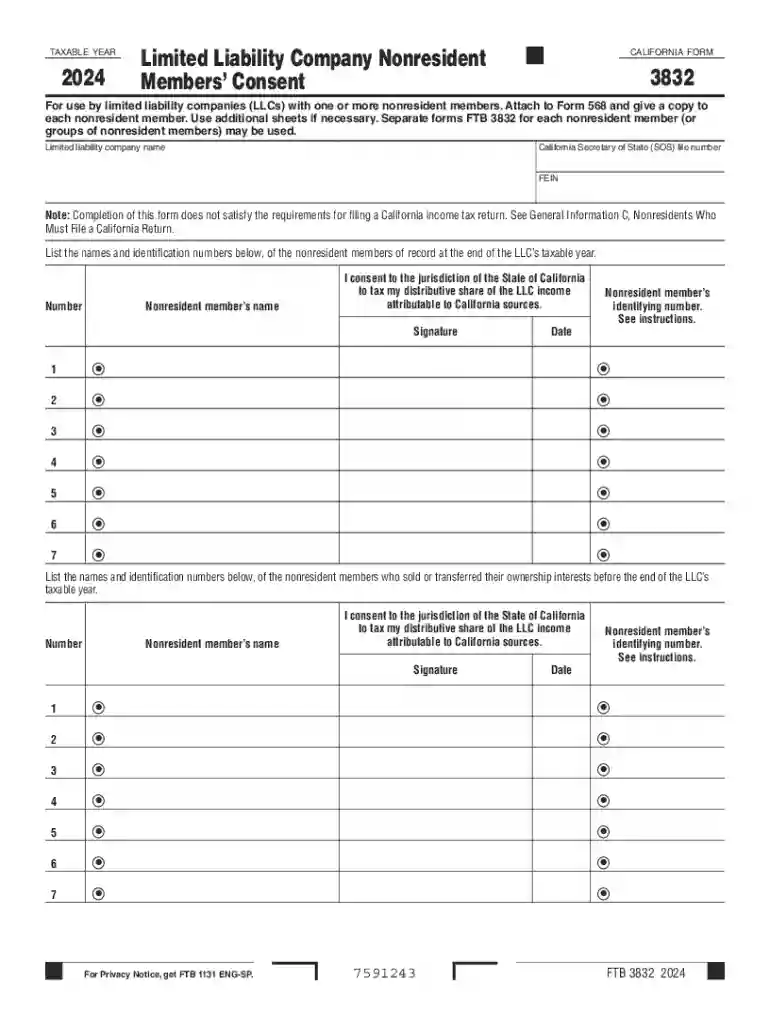
California Form 3832 is a mandatory document for limited liability companies (LLCs) with nonresident members. It signifies the nonresident members' consent to be taxed by the state of California on their distributive income from the LLC. This form is essential for ensuring tax compliance, as it helps the state maintain jurisdiction over income derived within its borders. The form must be filed with Form 568, the LLC's annual tax return, ensuring that all members acknowledge their tax responsibilities.
Identify Nonresident Members: Begin by listing all nonresident members of the LLC. This includes their full name, address, and tax identification number.
Consent Section: Each nonresident member must provide consent by signing and dating the form. This section verifies their agreement to California's taxation jurisdiction.
Attach to Form 568: Once the form is completed, it should be attached to the LLC's annual tax return (Form 568) for submission.
Review and Submission: Double-check all entries for accuracy. Ensure signatures are in place before submitting to the California Franchise Tax Board. Errors could lead to processing delays.
Filing Form 3832 is critical for legal and financial compliance with California state tax obligations. Non-compliance can result in penalties and interest charges. The form establishes a clear record that all nonresident members have been informed of, and consent to, their tax responsibilities, thereby protecting the LLC from potential disputes with tax authorities.
This form is primarily used by LLCs operating in California with nonresident members. These entities might involve businesses with investors residing outside California or LLCs conducting business in multiple states. Ensuring that all members consent to taxation by California is crucial for maintaining proper business operations and avoiding potential legal complications.
Form 3832 solidifies the legal standing of the state's right to tax income attributed to nonresident members. It is a procedural requirement that aligns with California's tax regulations, ensuring transparency and accountability in the collection of state taxes. This form underpins the state's ability to enforce tax laws pertinent to multi-member LLCs operating within its jurisdiction.
The deadline for submitting California Form 3832 aligns with the due date of Form 568, which is the 15th day of the fourth month after the end of the LLC’s taxable year. Timely submission is critical to avoid penalties. Extensions can be requested if needed, but ensuring on-time filing maintains compliance and avoids late fees.
Failure to file Form 3832 correctly or on time can result in significant penalties. This includes fines or fees for each member failing to consent to California’s taxation. Additionally, the LLC may face broader scrutiny from the California Franchise Tax Board, potentially leading to audits or enforced collection actions.
In addition to Form 3832, the completion process requires:
Ensure all related forms and documentation are accurately completed and compiled before submission. This preparation reduces the risk of errors and potential processing delays.
This detailed exploration of California Form 3832 provides LLCs operating within California a comprehensive guide to fulfilling their tax obligations effectively, ensuring clarity and compliance across all operational facets.
We've got more versions of the 2024 Form 3832 Limited Liability Company Nonresident Members Consent form. Select the right 2024 Form 3832 Limited Liability Company Nonresident Members Consent version from the list and start editing it straight away!
| Versions | Form popularity | Fillable & printable |
|---|---|---|
| 2024 | 4.9 Satisfied (25 Votes) | |
| 2023 | 4.1 Satisfied (20 Votes) | |
| 2022 | 4.4 Satisfied (22 Votes) | |
| 2021 | 4.8 Satisfied (125 Votes) | |
| 2020 | 4.3 Satisfied (144 Votes) | |
| 2019 | 4.3 Satisfied (126 Votes) | |
| 2018 | 4.3 Satisfied (110 Votes) | |
| 2017 | 4.4 Satisfied (133 Votes) | |
| 2016 | 4.2 Satisfied (53 Votes) | |
| 2014 | 4.2 Satisfied (53 Votes) |
At DocHub, your data security is our priority. We follow HIPAA, SOC2, GDPR, and other standards, so you can work on your documents with confidence.


Oct 17, 2024 In 2024, the Corporation wrote a medical professional tail liability policy with a per occurrence limit and an annual aggregate loss limitRead more
When a multiple member LLC has one or more members who are nonresidents of California, use form FTB 3832, Limited Liability Company Nonresident Members ConsentRead more


