




01. Edit your form online
Type text, add images, blackout confidential details, add comments, highlights and more.

Type text, add images, blackout confidential details, add comments, highlights and more.

Draw your signature, type it, upload its image, or use your mobile device as a signature pad.

Send it via email, link, or fax. You can also download it, export it or print it out.
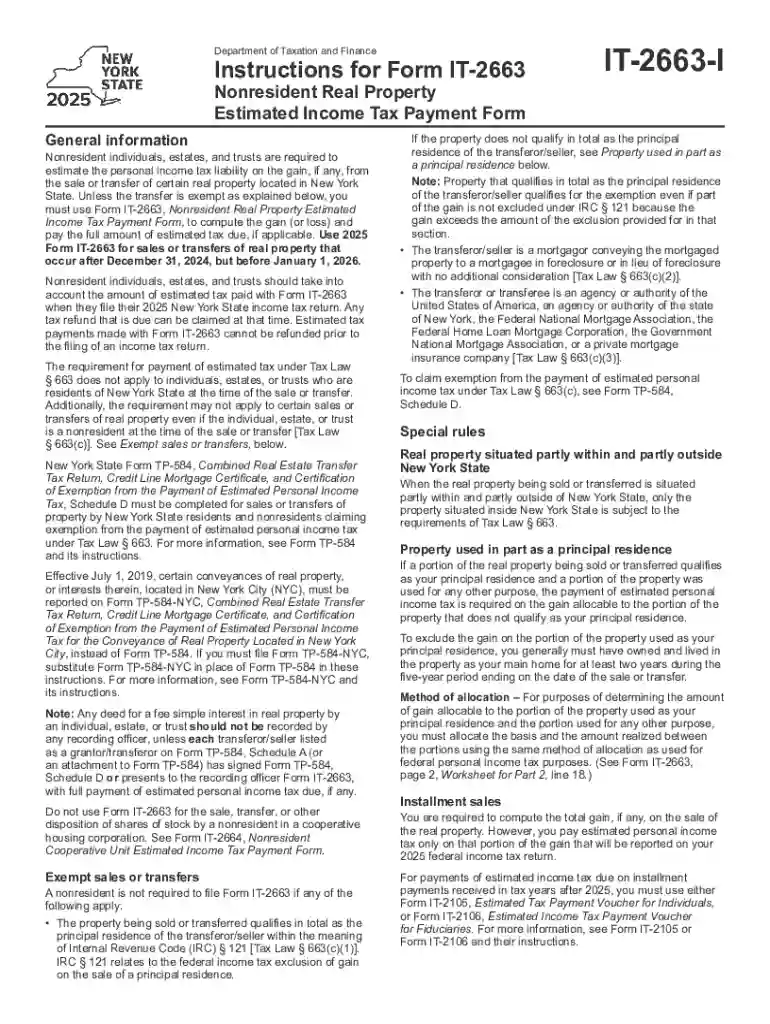
Form IT-2663, known as the Instructions for Nonresident Real Property Estimated Income Tax Payment Form: Tax Year 2, is used by nonresident individuals, estates, and trusts to calculate and submit estimated personal income tax related to gains from selling or transferring real property in New York State. This form ensures that nonresidents pay the proper tax amount on property sales, supporting tax compliance and transparency.
Completing Form IT-2663 involves several critical steps to ensure accurate submission and compliance with New York State tax laws.
Gather Required Information:
Calculate Estimated Tax:
Complete the Form Sections:
Review and Submit:
Filing Form IT-2663 requires specific documents to substantiate the reported transaction and ensure accurate tax estimation:
Ensuring compliance with legal stipulations is paramount when dealing with Form IT-2663. The form must adhere to New York State law and guidelines.
New York offers specific regulations impacting nonresident property sales and the corresponding tax requirements:
Meeting designated deadlines is essential to avoid penalties:
Failure to comply with Form IT-2663 requirements can result in financial penalties:
Real-world scenarios help illustrate Form IT-2663 applications:
Typical users of the form include:
Understanding the structure aids in accurate completion:
We've got more versions of the Instructions for Form IT-2663 Nonresident Real Property Estimated Income Tax Payment Form:Tax Year 2 form. Select the right Instructions for Form IT-2663 Nonresident Real Property Estimated Income Tax Payment Form:Tax Year 2 version from the list and start editing it straight away!
| Versions | Form popularity | Fillable & printable |
|---|---|---|
| 2025 | 4.3 Satisfied (21 Votes) | |
| 2024 | 4.6 Satisfied (48 Votes) | |
| 2023 | 4.7 Satisfied (30 Votes) | |
| 2021 | 4.2 Satisfied (24 Votes) | |
| 2020 | 4.3 Satisfied (64 Votes) | |
| 2019 | 4.3 Satisfied (163 Votes) | |
| 2018 | 4.4 Satisfied (176 Votes) | |
| 2016 | 4.3 Satisfied (175 Votes) | |
| 2015 | 4.1 Satisfied (55 Votes) | |
| 2014 | 4.3 Satisfied (65 Votes) | |
| 2013 | 4 Satisfied (39 Votes) |
At DocHub, your data security is our priority. We follow HIPAA, SOC2, GDPR, and other standards, so you can work on your documents with confidence.


Use Form IT-2663, Nonresident Real Property Estimated Income Tax Payment Form, to compute the gain (or loss) and pay the estimated personal income tax
Jan 6, 2026 IT-2663 (Fill-in) (2026) IT-2663-I (Instructions), Nonresident Real Property Estimated Income Tax Payment Form - valid for sales or transfersRead more


