2024 SCHEDULE D (540NR) California Capital Gain or Loss Adjustment-2026

Get Form
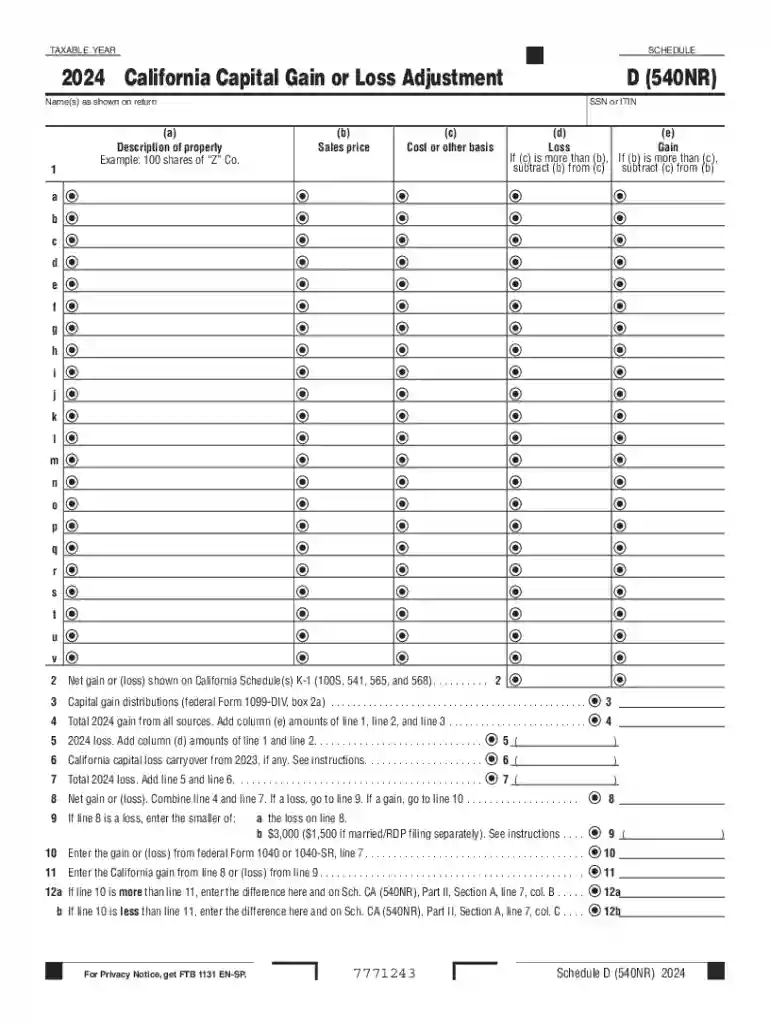
2024 SCHEDULE D (540NR) California Capital Gain or Loss Adjustment Preview on Page 1

Here's how it works

01. Edit your form online
Type text, add images, blackout confidential details, add comments, highlights and more.

02. Sign it in a few clicks
Draw your signature, type it, upload its image, or use your mobile device as a signature pad.

03. Share your form with others
Send it via email, link, or fax. You can also download it, export it or print it out.

Definition and Purpose

The 2024 Schedule D (540NR) is a tax form used by California residents to report capital gains and losses. It is a component of the state's nonresident or part-year resident income tax return. This form helps taxpayers determine the net capital gain or loss that will impact taxable income. Primarily, it is employed for reporting transactions related to property sales, securities, and other assets, enabling individuals to identify capital gain distributions and handle carryovers from past years.

How to Use the 2024 Schedule D (540NR)

To effectively utilize the 2024 Schedule D (540NR), taxpayers need to gather comprehensive records of their capital transactions. These include sale prices, acquisition costs, and dates of transaction. The form requires entering detailed descriptions of each asset, determining the holding period to classify gains as short-term or long-term, and calculating the respective gain or loss. Taxpayers should ensure accuracy in transcribing this data to comply with California regulations.

Key Elements of the Form

Several critical sections comprise the 2024 Schedule D (540NR):

  • Transaction Details: Each transaction must include a description, date of acquisition, and date of sale.
  • Calculation Sections: The form provides segments for computing short-term and long-term gains or losses separately.
  • Capital Gain Distributions: Any distributions from mutual funds or REITs must be included.
  • Carryover Provisions: Enter any carried over losses from previous years to offset current year gains.

Steps to Complete the Form

  1. Gather Documentation: Begin by collecting all necessary documentation, such as statements from brokers or property sale records.
  2. Record Transactions: Accurately input each transaction, including all details.
  3. Calculate Gains/Losses: Separate calculations for short-term and long-term, then proceed to aggregate them.
  4. Adjust with Distributions: Add capital gain distributions to the final results.
  5. Apply Carryovers: If applicable, adjust the net capital gain/loss using previous years' carryovers.
  6. Submit with Tax Return: Include the completed Schedule D (540NR) with the California 540NR tax return.

State-Specific Rules

California imposes several state-specific considerations for capital gains:

  • Tax Rates: The state's tax rates differ from federal rates, influencing the overall impact on taxable income.
  • Resident Status: Rules vary depending on nonresident or part-year resident status, affecting how gains are reported.
  • Community Property Laws: May require additional adjustments for married filers.

Who Typically Uses the Form

Nonresidents and part-year residents of California file this form. Individuals with income from investments, property sales, or assets that produce capital gains or losses within California's jurisdiction use it. Both individual taxpayers and certain business entities may need to refer to this form depending on their income sources.


decoration image ratings of Dochub

IRS Guidelines

While the form is state-specific, IRS guidelines still offer an essential framework:

  • Consistent Record-Keeping: Maintain consistent records as required federally to support all entries.
  • Alignment with Federal Forms: Data from federal returns like IRS Schedule D should align where applicable.
  • Federal Adjustments: Consider federal rules for any exemptions or credits that may cross over into state filings.

Filing Deadlines and Important Dates

For the 2024 tax year, typical deadlines include:

  • April 15, 2025: Regular filing deadline for California state returns, including Schedule D (540NR).
  • October 15, 2025: Extended deadline if an extension is granted.

Ensuring timely submissions is crucial to avoid penalties.

Digital vs. Paper Version

Both digital and paper versions of Schedule D (540NR) are available.

  • Digital Forms: Offer convenience and integration with tax software, facilitating error-checking and automatic calculations.
  • Paper Forms: Still accepted for traditional filing approaches but might necessitate more manual attention to detail.

Understanding whether to utilize digital or paper tools often depends on personal preference, access to resources, and comfort level with tax software.

Penalties for Non-Compliance

Neglecting to accurately file Schedule D (540NR) can result in penalties:

  • Late Filing: Taxpayers can face increased fines for missed due dates.
  • Inaccurate Reporting: Incorrectly reported data might prompt audits or re-assessments, causing additional financial liabilities.
  • Interest on Unpaid Taxes: Interest accrues on any unpaid tax stemming from undeclared capital gains.

Understanding these penalties underscores the importance of thorough preparation and submission of the form.

be ready to get more

Complete this form in 5 minutes or less

Get form

Got questions?

We have answers to the most popular questions from our customers. If you can't find an answer to your question, please contact us.
Contact us
California Capital Loss Carryover Worksheet Enter loss from Schedule D (540), line 11, as a positive number. Enter amount from Form 540, line 17. Enter amount from Form 540, line 18. Subtract line 3 from line 2. Combine line 1 and line 4. Enter loss from Schedule D (540), line 8, as a positive number.
Option 1: Sign into your eFile.com account, modify your Return and download/print your updated CA Form 540/540NR under My Account. Then, complete Schedule X (amended return explanation). Attach Schedule X to your updated Form 540/540NR, sign the amended return and mail it to one of the addresses listed below.
Purpose. Use Schedule CA (540NR) to determine California taxable income by doing the following: Identify the domiciles and current and past residency information. Enter the amounts of income and deductions reported on your federal tax return.
Your adjusted gross income (AGI) is your total (gross) income from all sources minus certain adjustments listed on Schedule 1 of Form 1040. Your AGI is calculated before you take your standard or itemized deduction on Form 1040.
Withholding requirements for a nonresident For every nonwage payment you make, you must: Calculate and withhold 7% of nonwage payment more than $1,500 in a calendar year. Make payments of tax withheld by the specific due date for each payment period: Payment period.

Security and compliance

At DocHub, your data security is our priority. We follow HIPAA, SOC2, GDPR, and other standards, so you can work on your documents with confidence.
Learn more
ccpa2
pci-dss
gdpr-compliance
hipaa
soc-compliance
be ready to get more

Complete this form in 5 minutes or less

Get form

People also ask

The capital gains inclusion rate (inclusion rate), which is the proportion of a capital gain that is taxable, was proposed to increase to 66.67% from 50% on June 25, 2024.
This schedule is used by all taxpayers who are required to apportion business income. Special instructions apply to individuals, partnerships and limited liability companies (LLCs).
Youll use Schedule D to report capital gains and losses from selling or trading certain assets during the year. Capital assets include personal items like stocks, bonds, homes, cars, artwork, collectibles, and cryptocurrency.

Related links