







Definition & Meaning
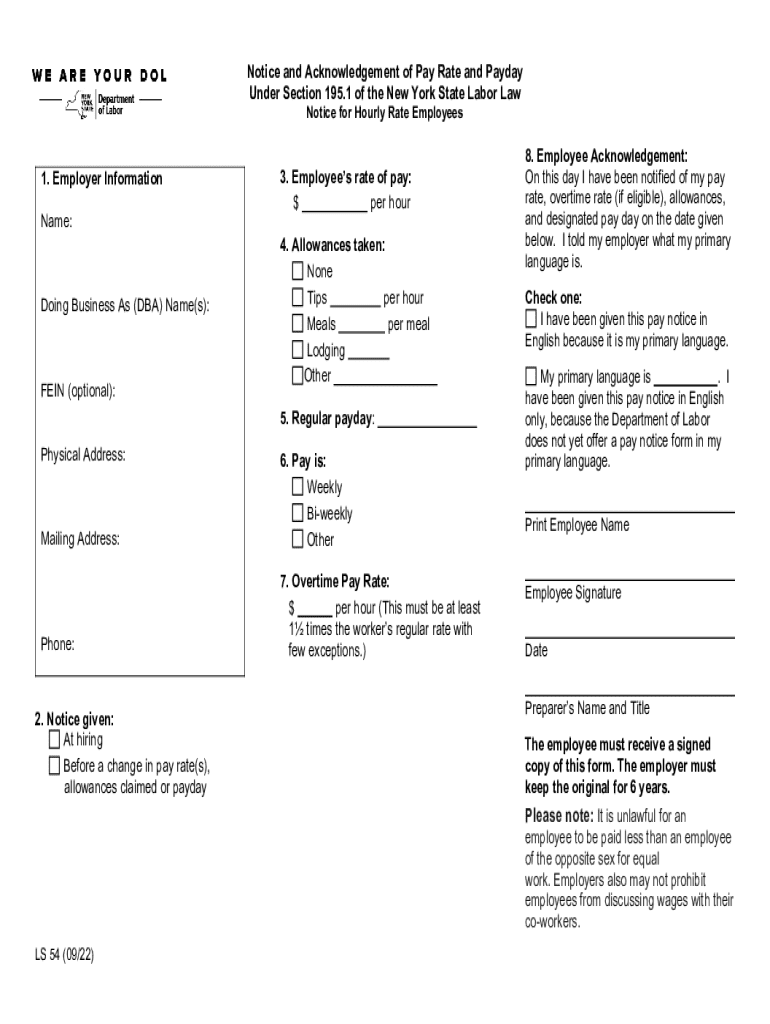
The "Notice and Acknowledgement of Pay Rate and Payday Under Section 195.1 of the New York State Labor Law" is a legal document mandated by New York State law that ensures transparency between employers and employees. This form serves to inform employees of their pay rate, overtime rates, paydays, and any allowances such as meals or lodging. Employers are required to provide this notice to every new hire, confirming that employees are aware of their compensation details and reporting mechanisms.
How to Use the Notice and Acknowledgement Form
Employers should integrate this form into their onboarding process. It must be presented to new employees before they start work. Employers should explain all components of the form, including regular pay rates, overtime rules, and any additional allowances or deductions. After completing and reviewing the form, both the employer and employee should sign it, ensuring mutual understanding. The original should be retained by the employer for six years, with a copy given to the employee.
Steps to Complete the Notice and Acknowledgement Form
-
Employer Information: Enter the employer's name, address, and phone number.
-
Employee Information: Include the employee's full name and job title.
-
Pay Rate and Allowances: Detail the regular hourly rate, overtime rate, allowances (e.g., tip, meal), and deductions.
-
Payday Schedule: Clearly define the regular payday (e.g., bi-weekly, monthly).
-
Acknowledge Receipt: Both parties should verify the accuracy of information before signing.
Who Typically Uses the Form
The form is used by employers operating in New York State who hire employees paid hourly or who receive tips, commissions, or other forms of compensation. This includes businesses in various sectors such as hospitality, retail, healthcare, and construction, contributing to compliance with state labor laws. Employees receiving the form include full-time, part-time, and temporary workers.


Key Elements of the Form
- Employer and Employee Details: Includes contact information and job title.
- Pay Details: Regular and overtime pay rates, including any allowances.
- Pay Schedule: Clearly stated regular payday.
- Language of the Employee: Must state the employee's primary language, with forms provided in that language if available.
- Signature Acknowledgment: Includes dated signatures from both employer and employee.
Penalties for Non-Compliance
Failure to provide this form can result in significant fines and legal repercussions for the employer. Penalties include fines ranging from $50 to $500 per week of wage law violation, emphasizing the importance of labor law compliance. Employers may also face additional consequences if disputes arise concerning the accuracy of payment details or miscommunication concerning payroll.
Legal Use of the Form
The document is legally required by the New York State Labor Law. It serves as evidence that the employer has communicated essential payroll information to the employee, making it crucial for resolving any potential disputes. The form must be maintained accurately and up to date, reflecting any changes to the employee's pay rate or position, ensuring ongoing compliance.
State-specific Rules
New York State has specific requirements that affect how this form must be utilized. Employers must use translated versions of the form if they are available in the employee's primary language. Additionally, updates or changes to pay must be communicated in writing at least seven days before they take effect, necessitating a new acknowledgment.
Digital vs. Paper Version
Employers can choose to distribute and store this form in paper or digital format, provided that the method complies with state law regarding record-keeping and employee access to records. Electronic signatures are acceptable, streamlining the process and allowing easier integration into digital systems that manage employee records.
Business Types That Benefit Most
Industries with high turnover rates such as hospitality, retail, and food services benefit significantly from consistent use of this form, as it ensures new employees understand their compensation package and schedules, helping to avoid disputes and potential legal issues. Additionally, startups and small businesses can mitigate risks by adhering to labor laws through proper documentation.


