







Definition & Meaning
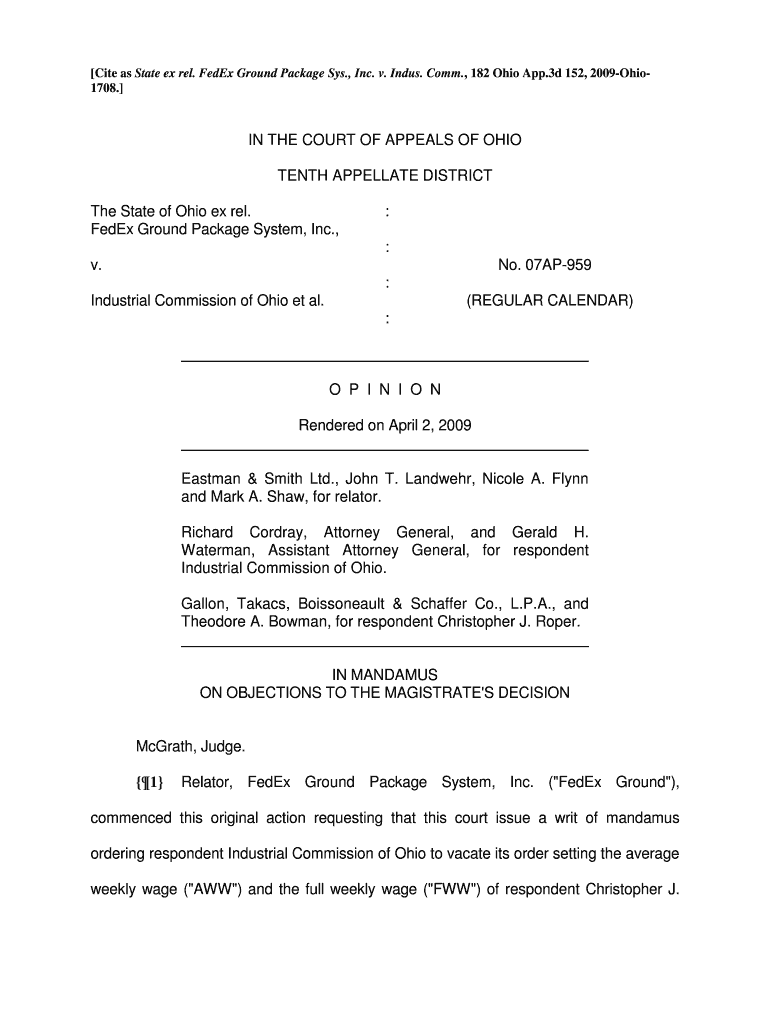
The case "State ex rel FedEx Package Sys, Inc v Indus" involves a mandamus action where FedEx Ground Package System, Inc. contested a decision made by the Industrial Commission of Ohio. The dispute centered on the average weekly wage (AWW) and full weekly wage (FWW) calculations for an employee, Christopher J. Roper. FedEx argued against including earnings from concurrent employment in these calculations. This case highlights the legal nuances and interpretations within Ohio's workers' compensation system, reflecting broader implications for employment law and wage determinations.
How to Use the Court Opinion
This court opinion serves as a reference for employers, legal professionals, and individuals navigating similar workers' compensation issues in Ohio. By studying the court’s rationale and conclusions, users can better understand how wage calculations are interpreted and applied in specific scenarios. This document can be especially useful for preparing legal arguments, understanding policy impacts, and ensuring compliance with Ohio workers' compensation statutes.
Steps to Complete the Court Analysis
- Understand the Facts: Familiarize yourself with the facts of the case, including the employment and wage details concerning Christopher J. Roper.
- Identify Legal Issues: Determine the key legal questions, such as the inclusion of concurrent employment earnings in wage calculations.
- Review Court's Analysis: Analyze the court’s reasoning in addressing the Industrial Commission’s discretion and special circumstances affecting wage determinations.
- Consider the Outcome: Examine the final decision denying FedEx's request for a writ of mandamus and the implications for similar cases.
- Apply the Learnings: Use insights from the case to guide future legal strategies or policy formulations related to wage and employment law.
Key Elements of the Court Opinion
- Employment and Wage Calculations: The focus on average weekly wage (AWW) and full weekly wage (FWW) assessments.
- Concurrent Employment: Discussion on the relevance of including concurrent job earnings in wage calculations.
- Judicial Reasoning: The court’s interpretation of Ohio workers' compensation laws and its limits on commission discretion.
Legal Use of the Court Opinion
Legal professionals can use this opinion as precedent in cases involving similar disputes about wage determination and workers' compensation. It offers a basis for challenging or defending commission decisions and illustrates the standards for judicial review in mandamus proceedings under Ohio law. Legal teams should extract reasoning patterns and precedent language when crafting arguments or advising clients involved in wage calculation disputes.
Important Terms Related to the Court Case
- Mandamus: A judicial mandate to a government officer to perform a duty that is required by law.
- Average Weekly Wage (AWW): A calculation used to determine compensation benefits, reflecting an employee's average earnings.
- Full Weekly Wage (FWW): Represents full earnings based on a specific time period, used in benefits determination.
Forms of the Court Opinion
Court opinions like this can be obtained through legal databases, including LexisNexis or Westlaw, or via the Ohio Supreme Court's official website. They may be available in both digital PDF and print formats, suitable for detailed analysis and referencing.
State-Specific Rules and Implications
Ohio's particular rules on including concurrent employment in wage calculations are central to this case. Ohio courts adhere to specific interpretations of workers' compensation laws, which may differ from other states. Understanding these nuances helps navigate the legal landscape effectively and ensures compliance with jurisdictional idiosyncrasies.
Business Types That Benefit
Employers, particularly those in logistics and multi-employment sectors like FedEx, will find this case critical for advising on compensatory practices and aligning business operations with legal obligations. Understanding the implications helps avoid legal disputes and ensures fair employee compensation practices in accordance with state law.




