01. Edit your ky state tax withholding form 2025 online
Type text, add images, blackout confidential details, add comments, highlights and more.

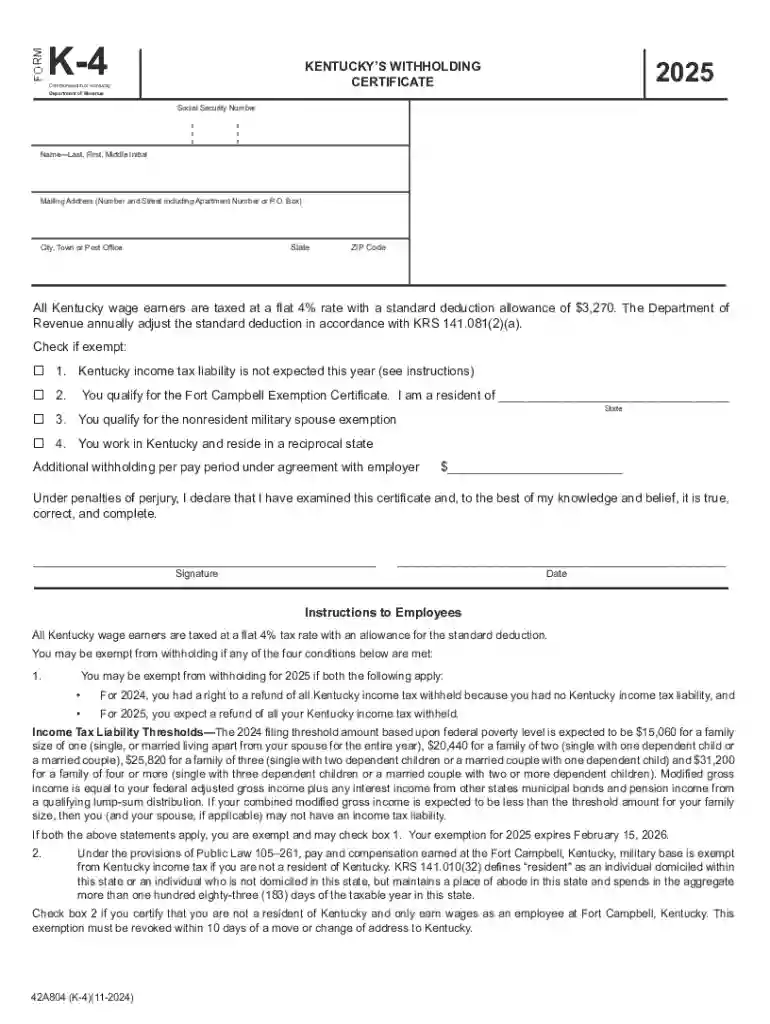
Type text, add images, blackout confidential details, add comments, highlights and more.

Draw your signature, type it, upload its image, or use your mobile device as a signature pad.

Send ky 4 via email, link, or fax. You can also download it, export it or print it out.
A Post Office Box, commonly referred to as a P.O. Box, is a secure and private mailbox service offered by the United States Postal Service (USPS). Customers can rent a P.O. Box at their local post office to receive mail in a central location, separate from their residential or business address. Adding an apartment number to a P.O. Box address can be confusing for postal services, as P.O. Boxes are intended to function as independent and unique addresses. Including additional address information like an apartment number may not effectively redirect mail or provide additional delivery instructions.
Including an apartment number after the P.O. Box in an address is not a conventional practice, as P.O. Box addresses are self-sufficient. Here’s how you can handle mailing to both:
Ensuring the correct delivery and handling of mail requires adhering to standard address formats:
P.O. Boxes are generally employed by individuals and businesses requiring secure and reliable mailing solutions:
When using P.O. Box addresses, consider aspects such as:
Although non-standard, here are some hypothetical examples illustrating potential issues:
USPS sets out specific guidelines for the use of P.O. Boxes:
Understanding state-by-state mailing regulations can impact address formatting:
For both recipients and businesses, utilizing digital tools can ease address management challenges:
We've got more versions of the ky state tax withholding form 2025 form. Select the right ky state tax withholding form 2025 version from the list and start editing it straight away!
| Versions | Form popularity | Fillable & printable |
|---|---|---|
| 2025 | 4.8 Satisfied (23 Votes) | |
| 2024 | 4.6 Satisfied (57 Votes) | |
| 2022 | 4.5 Satisfied (59 Votes) | |
| 2021 | 4.9 Satisfied (44 Votes) | |
| 2020 | 4.3 Satisfied (184 Votes) | |
| 2019 | 4.4 Satisfied (73 Votes) | |
| 2013 | 4.2 Satisfied (68 Votes) | |
| 2010 | 4.1 Satisfied (31 Votes) | |
| 2005 | 4.3 Satisfied (54 Votes) | |
| 1999 | 4.8 Satisfied (48 Votes) |
At DocHub, your data security is our priority. We follow HIPAA, SOC2, GDPR, and other standards, so you can work on your documents with confidence.