01. Edit your form online
Type text, add images, blackout confidential details, add comments, highlights and more.

Type text, add images, blackout confidential details, add comments, highlights and more.

Draw your signature, type it, upload its image, or use your mobile device as a signature pad.

Send it via email, link, or fax. You can also download it, export it or print it out.
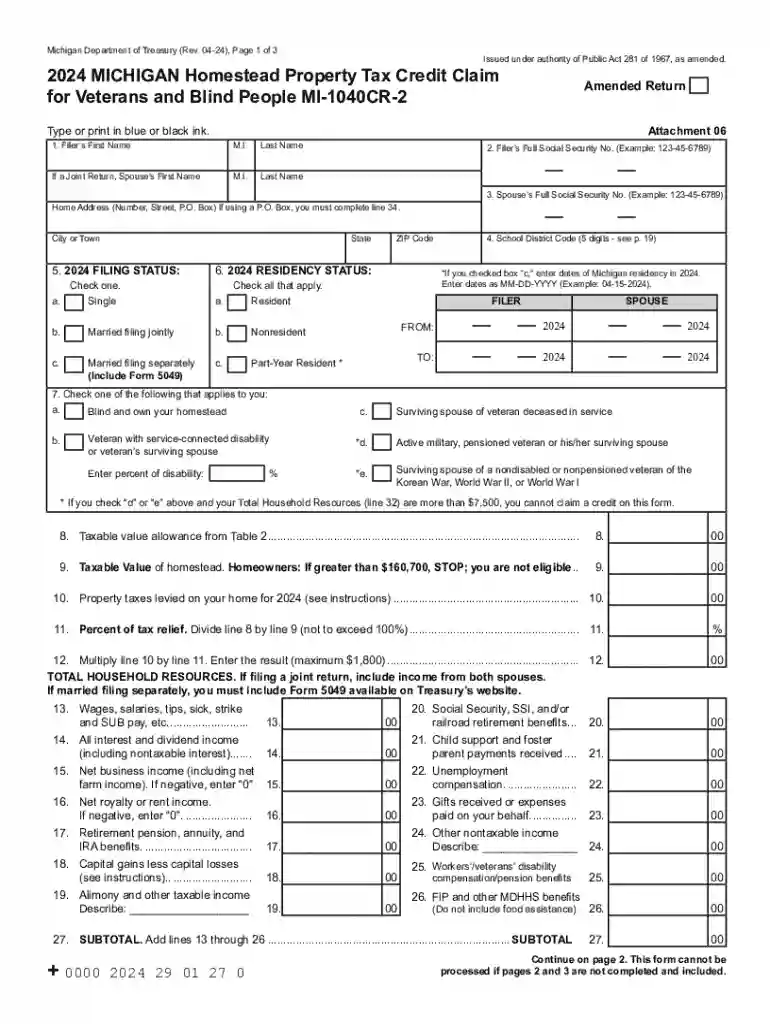
The 2024 Michigan Homestead Property Tax Credit Claim for Veterans and Blind People, also known as MI-1040CR-2, is a tax form used by eligible residents in Michigan to claim a credit on their property taxes. Designed specifically for veterans and blind individuals, this form aims to provide financial relief through tax credits. By submitting this form, eligible individuals can lower their property tax liabilities, making homeownership more affordable.
To effectively use the MI-1040CR-2 form, applicants must follow a series of steps and provide specific information to ensure proper calculation and approval of the property tax credit.
Completing the MI-1040CR-2 involves assembling a variety of documents to substantiate your claim and the information provided within the form.
The MI-1040CR-2 lays out specific criteria that applicants must meet to qualify for the homestead property tax credit.


Adhering to the filing schedule is critical for ensuring your tax credit is processed in a timely manner.
To complete the MI-1040CR-2, follow a structured procedure that involves gathering paperwork, completing the form, and submitting it correctly.
Understanding state-specific nuances is key to successfully applying for the Michigan property tax credit.
This form is specially designed for a select group of individuals, enabling them to secure financial benefits.

The form holds legal significance in documenting and requesting state-backed financial assistance.
We've got more versions of the 2024 Michigan Homestead Property Tax Credit Claim for Veterans and Blind People MI-1040CR-2 form. Select the right 2024 Michigan Homestead Property Tax Credit Claim for Veterans and Blind People MI-1040CR-2 version from the list and start editing it straight away!
| Versions | Form popularity | Fillable & printable |
|---|---|---|
| 2025 | 4.1 Satisfied (31 Votes) | |
| 2024 | 4.4 Satisfied (51 Votes) | |
| 2023 | 4.4 Satisfied (46 Votes) | |
| 2022 | 4.3 Satisfied (50 Votes) | |
| 2021 | 4.8 Satisfied (116 Votes) | |
| 2020 | 4.3 Satisfied (180 Votes) | |
| 2019 | 4.1 Satisfied (44 Votes) | |
| 2018 | 4.4 Satisfied (175 Votes) | |
| 2017 | 4.3 Satisfied (112 Votes) | |
| 2016 | 4.2 Satisfied (71 Votes) | |
| 2014 | 4.4 Satisfied (421 Votes) | |
| 2013 | 4.2 Satisfied (37 Votes) | |
| 1999 | 4 Satisfied (58 Votes) |
At DocHub, your data security is our priority. We follow HIPAA, SOC2, GDPR, and other standards, so you can work on your documents with confidence.