







Definition and Purpose of the 4976, 2024 Michigan Home Heating Credit Claim
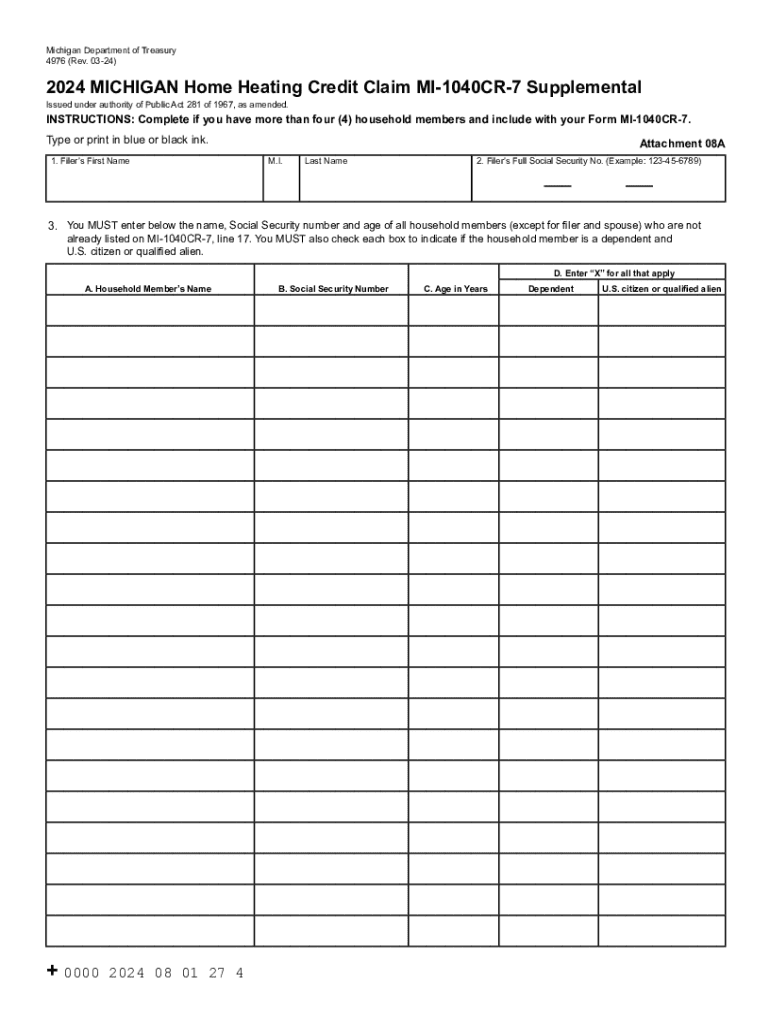
The 4976, 2024 Michigan Home Heating Credit Claim, specifically the MI-1040CR-7 Supplemental form, is designed to help households with higher family counts that exceed four members. This supplemental form assists in providing additional information required for accurately processing claims related to the Michigan Home Heating Credit. Filers need to report detailed information regarding household members, including their names, ages, Social Security numbers, and whether they are dependents or qualify as U.S. citizens or qualified aliens.
The primary goal of this credit is to alleviate the burden of home heating expenses for eligible Michigan residents, ensuring financial support during the colder months. The supplement specifically addresses households that surpass the standard household member count covered by the basic form.
Obtaining the MI-1040CR-7 Supplemental Form
To access the MI-1040CR-7 Supplemental form, residents of Michigan can visit the official Michigan Department of Treasury website, where forms are available for download. Alternatively, the form can often be obtained through tax preparation software that includes state tax form support, or from tax professionals familiar with Michigan state taxes.
Ensure the availability of necessary documents when downloading: Social Security cards for all household members, and any proof of residency or eligibility status, as these will be critical in completing the form correctly.
Steps for Completing the MI-1040CR-7 Supplemental
-
Gather Required Information: Collect the essential personal data for each household member, including Social Security numbers, ages, and their relationship to the filer.
-
Verify Eligibility: Confirm that every household member qualifies as either a dependent or a U.S. citizen/qualified alien, as this determines their inclusion on the form.
-
Fill in Household Member Details: Enter the names, Social Security numbers, and ages in the designated fields of the form, ensuring accuracy to avoid processing delays.
-
Double-Check Entries: Make sure all fields are completed correctly and that no necessary sections are left blank.
-
Consider Professional Review: If uncertain about the accuracy of your input, it may be beneficial to consult with a tax professional or use tax software for verification.
Importance of Filing the Supplemental Form
Filing the MI-1040CR-7 Supplemental is crucial for households larger than four members looking to claim the Michigan Home Heating Credit. It ensures that all family members are accounted for, providing a complete picture of the household that affects the calculation of the heating credit.
Not filing this supplemental form when necessary can result in an inaccurate credit calculation, potentially leading to less financial aid than deserved, or delays in form processing.
Typical Users of the MI-1040CR-7 Supplemental Form
This form is predominantly used by Michigan residents with large families or households, often including those who have extended family living under the same roof or in blended family situations.
The form caters to diverse family structures, including multi-generational households, those with adopted children, or living arrangements with legal dependents, highlighting its broad applicability across various family dynamics.
Key Terms in the MI-1040CR-7 Supplemental
- Dependent: An individual who relies on the filer for financial support and qualifies under the IRS dependency guidelines.
- Qualified Alien: A non-citizen who meets specific eligibility criteria for federal public benefits.
- Household Member: Any person living with the filer, whose details need inclusion in the supplemental form for a complete claim.
Understanding these terms ensures that filers accurately complete the form, facilitating correct credit allocation based on family size and composition.
Legal Compliance in Filling the MI-1040CR-7 Supplemental
Compliance with Michigan state tax laws is vital when filling out the MI-1040CR-7 Supplemental. Misrepresentation or omission of household information can result in penalties and potentially jeopardize the eligibility for the home heating credit.
It is recommended to cross-check all entries with legal guidance, especially if claiming complex family scenarios, to safeguard against any unintentional errors and maintain legal conformity.
Relevance of the Supplemental Form in Different Tax Years
Each tax year might bring modifications to credit amounts or eligibility criteria based on legislative changes, so it's crucial to use the correct year’s form, in this case, the 2024 edition.
Utilizing outdated forms might lead to discrepancies in submissions, incorrect claims, or delays in processing. Ensure to verify form years on official websites or through validated tax software that updates its form libraries annually.
Filing Procedures and Important Dates
-
Submission Methods: Forms can be submitted digitally via the Michigan Department of Treasury portal, mailed to their designated address, or delivered in person to ensure timely filing.
-
Deadlines: The deadline for submitting the 4976 form aligns with Michigan state tax deadlines. Mark this on your calendar to ensure ample time for gathering documents, completing forms, and allowing for postal lead times if mailing.
Meeting these critical deadlines is vital to prevent late filing penalties, thereby securing timely heating credit application processing and approval.
Example Scenarios for Using the MI-1040CR-7 Supplemental
Consider a family of six living in Detroit, requiring heating credit assistance. The primary form allows submission for up to four members, necessitating the supplemental form for complete household representation.
Another scenario includes a multi-generational household with two grandparents, parents, and three children. Accurate documentation across the basic and supplemental forms allows for a comprehensive claim and optimized credit calculation.
By examining such examples, it becomes clear how different family compositions utilize this form to access necessary financial support effectively.


