01. Edit your home mortgage interest deduction online
Type text, add images, blackout confidential details, add comments, highlights and more.

Type text, add images, blackout confidential details, add comments, highlights and more.

Draw your signature, type it, upload its image, or use your mobile device as a signature pad.

Send irs home mortgage interest deduction via email, link, or fax. You can also download it, export it or print it out.
The mortgage interest deduction allows taxpayers to reduce their taxable income based on the interest paid on a qualified home loan. This benefit is designed to ease the financial burden of homeownership by lowering the annual tax liability. It applies to interest paid on loans secured by a primary or secondary residence, with certain conditions and limits set by the IRS.
A qualified home can be a house, condominium, cooperative apartment, mobile home, house trailer, or boat that provides basic living accommodations, such as sleeping, cooking, and toilet facilities.
The deduction functions as an itemized deduction on your federal tax return, providing taxpayers with a reduction in taxable income equivalent to the mortgage interest paid within a given tax year.
Report the deductible interest on Schedule A (Form 1040), detailing the total mortgage interest per Form 1098 issued by your lender.
To claim the mortgage interest deduction, specific criteria must be met according to IRS rules:


The debt must be secured by the home, meaning if the borrower defaults, the lender can take the property as collateral.
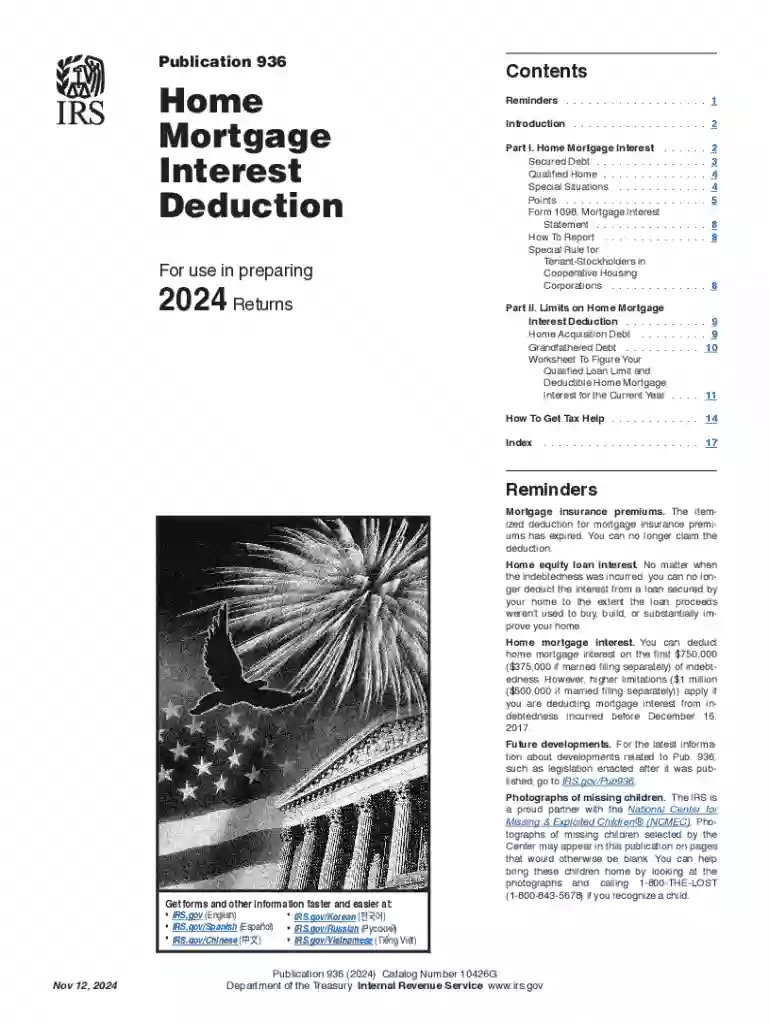
Publication 936 is the primary document outlining the rules for mortgage interest deduction:
The limits may change annually. It's crucial to refer to the current year guidelines for accurate deduction amounts.
Understanding the following terms is essential for navigating the mortgage interest deduction:
To properly claim the deduction, certain documentation is necessary:
Ensure accurate recordkeeping of all mortgage-related payments to support your deduction claim in case of an audit.
Taxpayers need to be aware of significant dates:
Taxpayers can submit the mortgage interest deduction in two primary ways:
Offers faster processing time and immediate confirmation of receipt, reducing the chances of processing errors.
We've got more versions of the home mortgage interest deduction form. Select the right home mortgage interest deduction version from the list and start editing it straight away!
| Versions | Form popularity | Fillable & printable |
|---|---|---|
| 2025 | 4.2 Satisfied (57 Votes) | |
| 2024 | 4.2 Satisfied (55 Votes) | |
| 2023 | 4.7 Satisfied (28 Votes) | |
| 2022 | 4.4 Satisfied (40 Votes) | |
| 2021 | 4.8 Satisfied (131 Votes) | |
| 2020 | 4.4 Satisfied (252 Votes) | |
| 2019 | 4.2 Satisfied (77 Votes) | |
| 2018 | 4.4 Satisfied (99 Votes) | |
| 2017 | 4.4 Satisfied (156 Votes) | |
| 2016 | 4.3 Satisfied (81 Votes) | |
| 2015 | 4.4 Satisfied (341 Votes) | |
| 2011 | 4.4 Satisfied (284 Votes) | |
| 2010 | 4.2 Satisfied (29 Votes) |
At DocHub, your data security is our priority. We follow HIPAA, SOC2, GDPR, and other standards, so you can work on your documents with confidence.