




01. Edit your form online
Type text, add images, blackout confidential details, add comments, highlights and more.

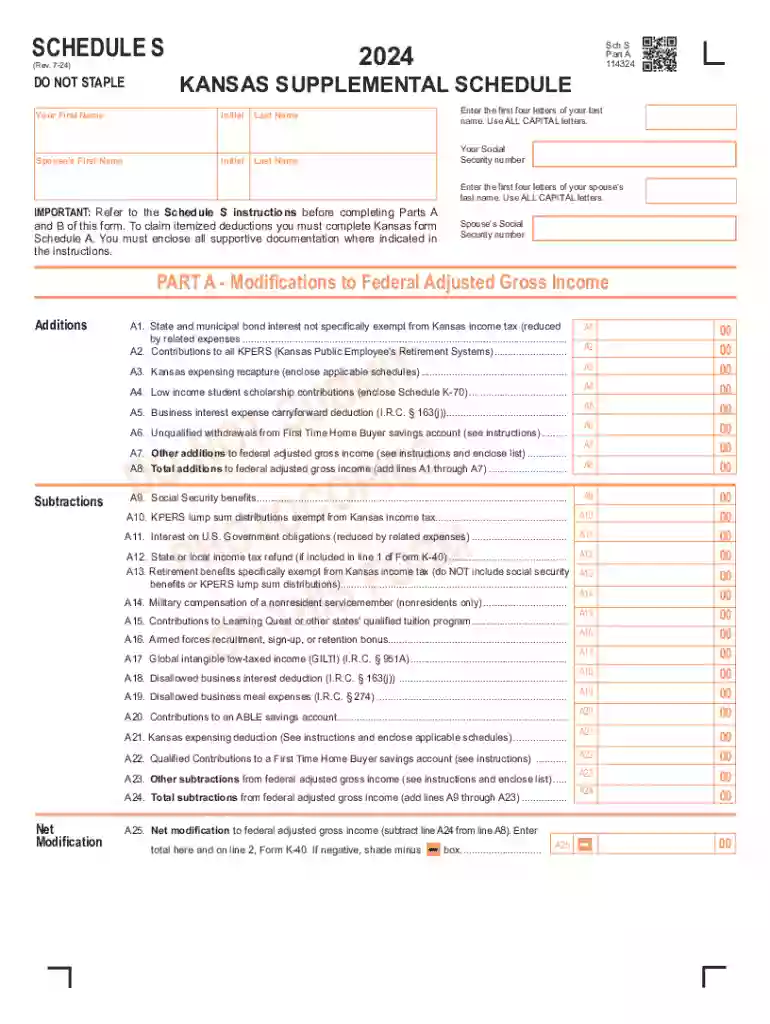
Type text, add images, blackout confidential details, add comments, highlights and more.

Draw your signature, type it, upload its image, or use your mobile device as a signature pad.

Send it via email, link, or fax. You can also download it, export it or print it out.
The Schedule S - 2024 - Kansas Supplemental Schedule - Revised 7-24 is an essential document for taxpayer reporting, especially for modifications to the federal adjusted gross income and for income allocation among nonresidents and part-year residents. It includes various sections detailing itemized deductions, income additions and subtractions, and encompasses specific instructions for accurate form completion. This form is integral for those who require precision in documenting income that might differ state by state or due to specific residency requirements.
Understand Purpose: This document is vital for individuals who need to report income details that differ from their federal tax filing due to the state-specific requirements. It aims at adjusting the federal adjusted gross income to suit Kansas tax codes.
Collect Necessary Information: Gather all relevant financial documents that detail your federal adjusted gross income, deductions, and any state-specific income elements.
Follow Instructions: Carefully go through each section of the Schedule S, ensuring you understand which elements apply to your financial situation and how they impact your state income reporting.
Review Federal Adjustments: Begin by closely reviewing how your federal adjusted gross income aligns with Kansas tax rules. This involves recognizing any additions or subtractions specific to Kansas.
Complete Itemized Deductions: Itemize any deductions applicable under Kansas law, considering different categories such as medical expenses or mortgage interest.
Address Allocations for Nonresidents: If you're a nonresident or part-year resident, carefully complete sections that allocate income earned both inside and outside of Kansas.
Finalize the Form: Double-check each section for accuracy, ensuring no required fields are omitted or incorrectly filled out, ensuring all information is correct before submission.
Using the Schedule S - 2024 complies with state-specific tax laws. Legal adherence ensures compliance with Kansas Department of Revenue requirements and prevents penalties. Ensure detailed attention to legal definitions and required disclosures to maintain the integrity of your filing.


We've got more versions of the Schedule S - 2024 - Kansas Supplemental Schedule - Revised 7-24 form. Select the right Schedule S - 2024 - Kansas Supplemental Schedule - Revised 7-24 version from the list and start editing it straight away!
At DocHub, your data security is our priority. We follow HIPAA, SOC2, GDPR, and other standards, so you can work on your documents with confidence.


This is a complete listing of changes made to the University Handbook since 1995. K-State must be compliant with this new policy by July 1, 2024. Appendix S (
You may download Schedule K-26 to claim the Aviation and Aerospace tax credit. This schedule must be completed and submitted with the income return.


