






Definition and Purpose of K-40SVR
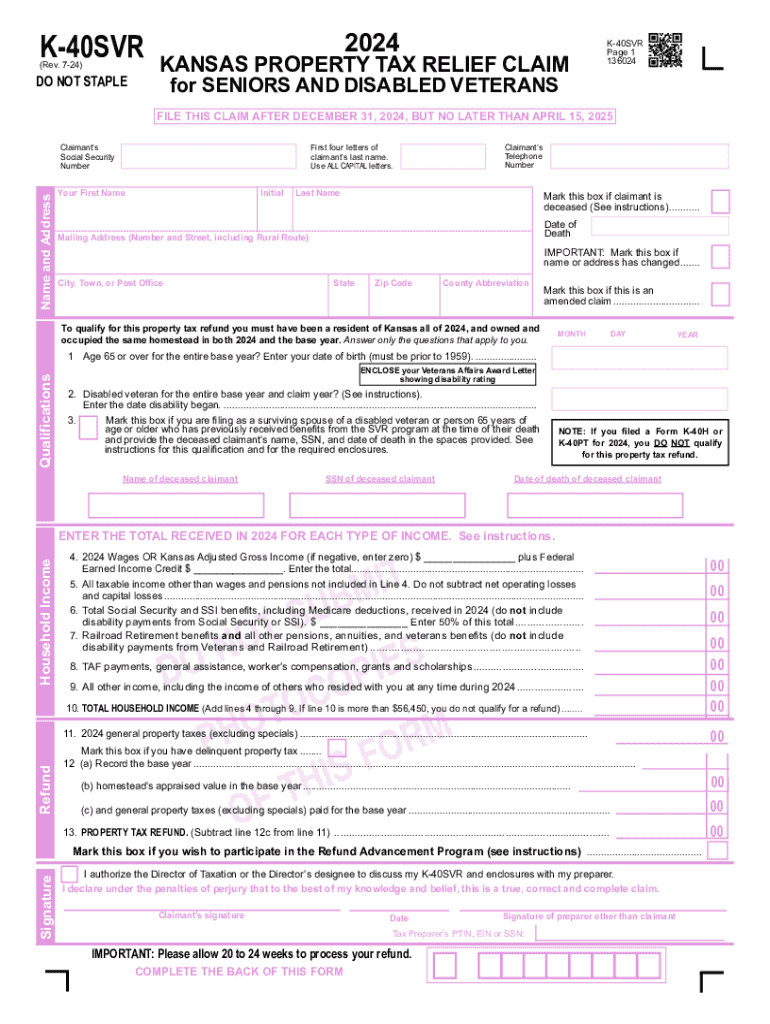
The K-40SVR form is designed to assist seniors and disabled veterans in Kansas by allowing them to claim property tax relief. It serves as a tool for eligible individuals to apply for property tax refunds based on specific eligibility criteria such as age, disability status, and income level. This form is crucial for those who qualify, as it can provide substantial financial relief by reducing the burden of property taxes. Users must provide detailed information to ensure accuracy and compliance with state regulations.
Eligibility Criteria for K-40SVR
Eligibility for the K-40SVR form requires individuals to meet specific criteria:
- Age Requirement: Applicants must be senior citizens or qualifying veterans.
- Disability Status: Verification of disability is necessary for veterans claiming this relief.
- Income Limits: There are predefined income thresholds that applicants must not exceed to qualify.
- Residency: Claimants must be residents of Kansas to apply for property tax relief using this form.


How to Obtain the K-40SVR
The K-40SVR form can be obtained through various channels:
- Online Access: Download the form from official Kansas state or local government websites.
- Tax Offices: Available at local tax agencies and municipal centers across Kansas.
- Mail Requests: Request a mailed copy from the Kansas Department of Revenue for those without internet access or unable to visit an office.
Steps to Complete the K-40SVR
Filing the K-40SVR form involves a detailed process to ensure all required information is accurately presented:
- Gather Required Documents: Collect federal tax returns, proof of income, disability status (if applicable), and any other documentation supporting eligibility.
- Form Filling: Accurately complete all sections, providing necessary personal information, income details, and property data.
- Review and Corrections: Double-check all entered data to avoid errors that could lead to delays or denials.
- Submission: Submit the form by mail or through the designated online portal before the deadline.
Required Documents
To successfully complete the K-40SVR, the following documentation is essential:
- Prior year's federal and state tax returns
- Proof of age, such as a birth certificate or government-issued ID
- Documentation of disability status, where applicable
- Income statements, including pensions, social security, or other relevant financial information
Important Dates for Filing
Timely submission of the K-40SVR is crucial. The form must be filed after December 31, 2024, and no later than April 15, 2025. Late submissions could result in the loss of property tax relief benefits for that tax year.
Penalties for Non-Compliance
Failure to file the K-40SVR by the set deadline or providing incorrect information can lead to penalties:
- Missed Tax Relief: Ineligible to receive the refund for the specified tax year.
- Fines and Interest: Possible imposition of fines or interest on overdue taxes if applicable.
- Revoked Eligibility: Continuous non-compliance may result in future disqualifications.
Use Cases and Examples of K-40SVR
Consider the following scenarios to understand the diverse applications of the K-40SVR:
- Scenario 1: A 70-year-old retired veteran living solely on social security and a small pension who uses the K-40SVR to reduce property taxes on their home.
- Scenario 2: A disabled veteran with limited income applying to relieve tax burdens while residing in a high-tax district within Kansas.
Software Compatibility and Submission Methods
Digital vs. Paper Version
The K-40SVR form can be processed through both digital and paper methods, accommodating different preferences:
- Online Submission: Filling out and submitting the form electronically via a secured platform.
- Paper Submission: Completing a physical copy and mailing it to the appropriate Kansas tax office.
Software Compatibility
For those preferring digital filing:
- Integrated Platforms: Compatible with tax software like TurboTax and QuickBooks, enabling streamlined digital integration for those who handle taxes electronically.
- Manual Entry Systems: Simple systems for manually inputting form data collected physically.
State-Specific Rules for the K-40SVR
Kansas has unique regulations governing the K-40SVR form, differentiating it from federal tax forms and other states’ relief programs:
- Property Eligibility: Only primary residences situated in Kansas are eligible for tax relief under this program.
- Documentation Standards: Strict adherence to documentation guidelines specific to Kansas requirements.
Key Takeaways
- Financial Relief: Essential tool for easing property tax burdens on eligible Kansas seniors and veterans.
- Accurate Completion: Detailed and accurate form filling skyrockets successful applications.
- Timely Filing: Observing deadlines is critical to maintain eligibility and benefit realization.
By understanding these elements, users can effectively navigate the K-40SVR application process, ensuring they leverage all available benefits and comply with state-specific requirements.