




01. Edit your form online
Type text, add images, blackout confidential details, add comments, highlights and more.

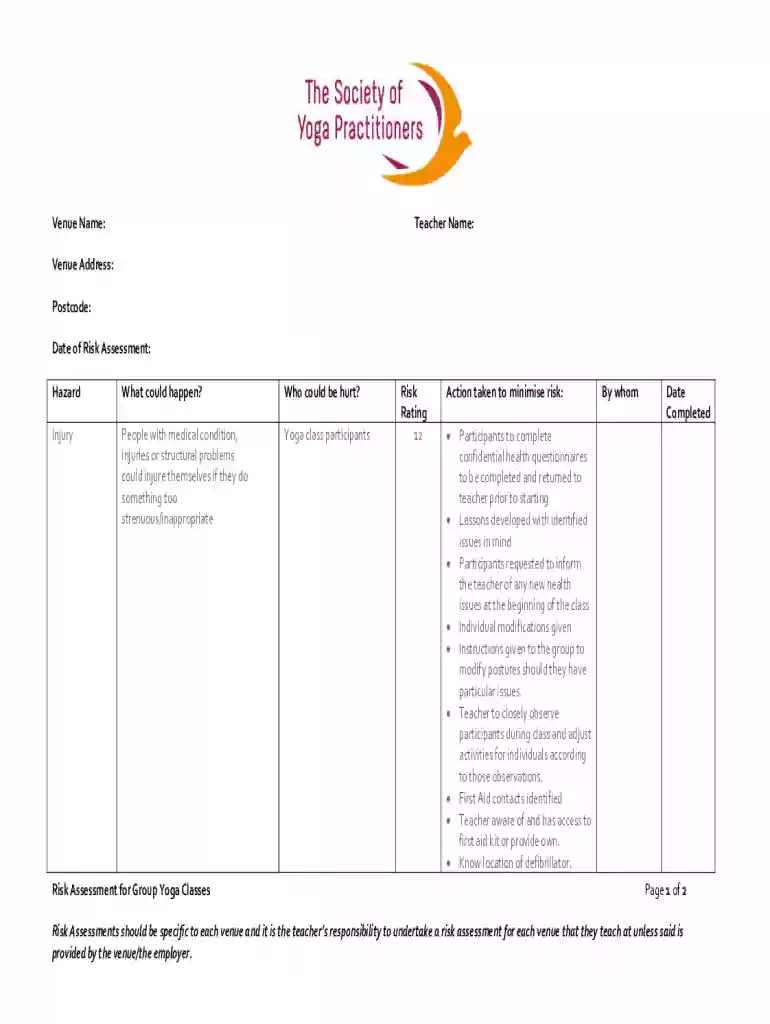
Type text, add images, blackout confidential details, add comments, highlights and more.

Draw your signature, type it, upload its image, or use your mobile device as a signature pad.

Send it via email, link, or fax. You can also download it, export it or print it out.
A risk assessment for group yoga classes is a systematic process employed to identify, analyze, and evaluate potential hazards associated with conducting yoga sessions. Its primary purpose is to ensure the safety of participants by minimizing or eliminating risks that could lead to accidents or injuries during classes. This document includes various elements such as identifying possible hazards, determining who might be harmed, and developing strategies to control or mitigate these risks. By highlighting specific dangers and planning corrective measures, facilitators can create a safe and conducive environment for yoga students.
Using the risk assessment document involves several critical steps.
Identify Hazards: Begin by reviewing the different aspects of the yoga class environment to identify potential hazards. These may include physical space, equipment, and participant activities.
Assess Risks: Evaluate the likelihood and consequences of each identified hazard. Consider who might be harmed, including students, instructors, or other individuals present.
Implement Control Measures: Develop and implement strategies to mitigate identified risks. This may involve rearranging the layout to prevent clutter, ensuring equipment is in good condition, or providing instructor training on safety protocols.
Review and Update: Regularly review and update the risk assessment document to account for changes in the environment, class dynamics, or new hazards that arise.
Completing a risk assessment involves a thorough and detailed approach.
Data Gathering: Collect necessary data through surveys, observations, or feedback from previous classes. Use this information to inform the risk identification process.
Documentation: Clearly document identified risks and associated factors such as their location, potential harm, and impact magnitude.
Controls Design: For each risk, design specific control measures. These may include modifying existing protocols or introducing new safety equipment.
Implementation Timeline: Develop a timeline for implementing risk control measures, noting immediate actions and long-term strategies.
Verification: Ensure that implemented measures effectively mitigate risks through monitoring and feedback mechanisms.
A comprehensive risk assessment for group yoga classes includes several key components.
Conducting a risk assessment for group yoga classes also holds legal significance.
Practical scenarios provide insight into how risk assessments function in real-world settings.
Cluttered Space: An identified risk might be a cluttered yoga space, leading to tripping hazards. Measures such as reorganizing the room and using signage to keep pathways clear can mitigate this risk.
Faulty Equipment: An example of a specific hazard might include malfunctioning yoga equipment, such as mats or blocks. Enhancing equipment checks before each class is a proactive measure.
Instructor Preparedness: Instructor training to handle health emergencies—such as fainting or injuries—adds another layer of preparedness, ensuring quick and effective responses.
The risk assessment document is vital for various stakeholders involved in yoga instruction and management.


State-specific regulations impact how risk assessments are conducted and applied.
Understanding these variances ensures compliance with local laws and enhances the overall safety and usability of the yoga space.
At DocHub, your data security is our priority. We follow HIPAA, SOC2, GDPR, and other standards, so you can work on your documents with confidence.



This fact sheet provides a general overview of yoga and suggests sources for more information.
This includes an analysis of the safety, effectiveness and potential risks of kaempferol and GABA. Only by passing this rigorous safety assessment and obtainingRead more
by H Li 2025 Cited by 1 This study aims to identify and analyze the risk factors contributing to knee injuries among yoga practitioners by leveraging medical big data


