




01. Edit your form online
Type text, add images, blackout confidential details, add comments, highlights and more.

Type text, add images, blackout confidential details, add comments, highlights and more.

Draw your signature, type it, upload its image, or use your mobile device as a signature pad.

Send it via email, link, or fax. You can also download it, export it or print it out.
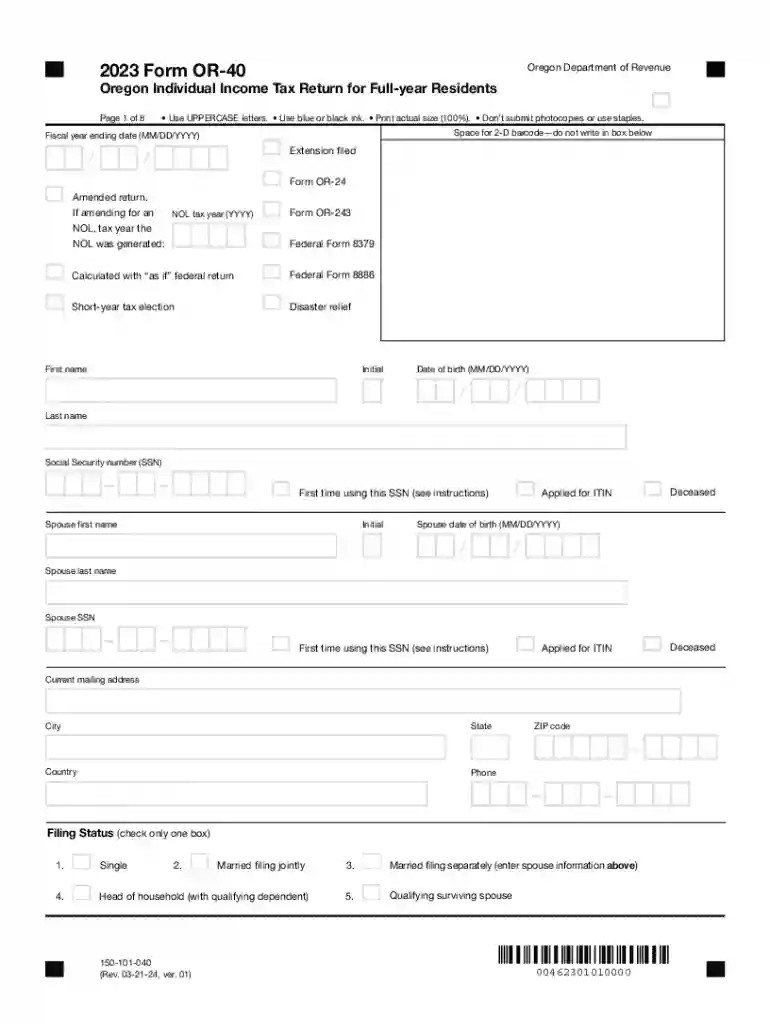
The 2023 Form OR-40, Oregon Individual Income Tax Return for full-year residents, serves as an official document for Oregon residents to report their annual income, deductions, and tax liabilities to the state. It is essential for residents to understand that this form is specific to Oregon's tax code and rules. It contains sections for personal details, income, exemptions, adjustments, and credits, making it a comprehensive tool for accurately calculating tax obligations. By completing this form, residents fulfill their duty to report taxable income and pay any due state taxes.
This section is crucial for accurately determining the amount of tax owed:
Accurate completion of the 2023 Form OR-40 requires careful attention to detail:
Understanding key terms is vital for accurate form completion:
Adhering to deadlines ensures compliance and avoids penalties:
Specific documents are needed to complete the form accurately:
Proper legal use of the form ensures compliance with state tax laws:
Crucial sections have significant implications on the filing outcomes:
Various submission methods cater to different preferences:
We've got more versions of the 2023 Form OR-40, Oregon Individual Income Tax Return for Full-year Residents, 150-101-040 form. Select the right 2023 Form OR-40, Oregon Individual Income Tax Return for Full-year Residents, 150-101-040 version from the list and start editing it straight away!
| Versions | Form popularity | Fillable & printable |
|---|---|---|
| 2025 | 4.5 Satisfied (37 Votes) | |
| 2024 | 4.8 Satisfied (29 Votes) | |
| 2023 | 4.7 Satisfied (24 Votes) | |
| 2023 | 4.8 Satisfied (30 Votes) | |
| 2022 | 4.6 Satisfied (39 Votes) | |
| 2021 | 4.8 Satisfied (161 Votes) | |
| 2020 | 4.3 Satisfied (86 Votes) | |
| 2019 | 4.3 Satisfied (57 Votes) | |
| 2018 | 4.1 Satisfied (39 Votes) | |
| 2017 | 4.3 Satisfied (197 Votes) | |
| 2015 | 4.4 Satisfied (187 Votes) | |
| 2014 | 4.2 Satisfied (57 Votes) | |
| 2006 | 4 Satisfied (47 Votes) |
At DocHub, your data security is our priority. We follow HIPAA, SOC2, GDPR, and other standards, so you can work on your documents with confidence.





Form OR-40, Oregon Individual Income Tax Return for Full-year Residents, 150-101-040 Form OR-CER, Oregon Combined Employers Registration, 150-211-055Read more
Form OR-40, Oregon Individual Income Tax Return for Full-year Residents, 150-101-040. Fiscal filers only: Year-end. Oregon Department of Revenue Amended return.


