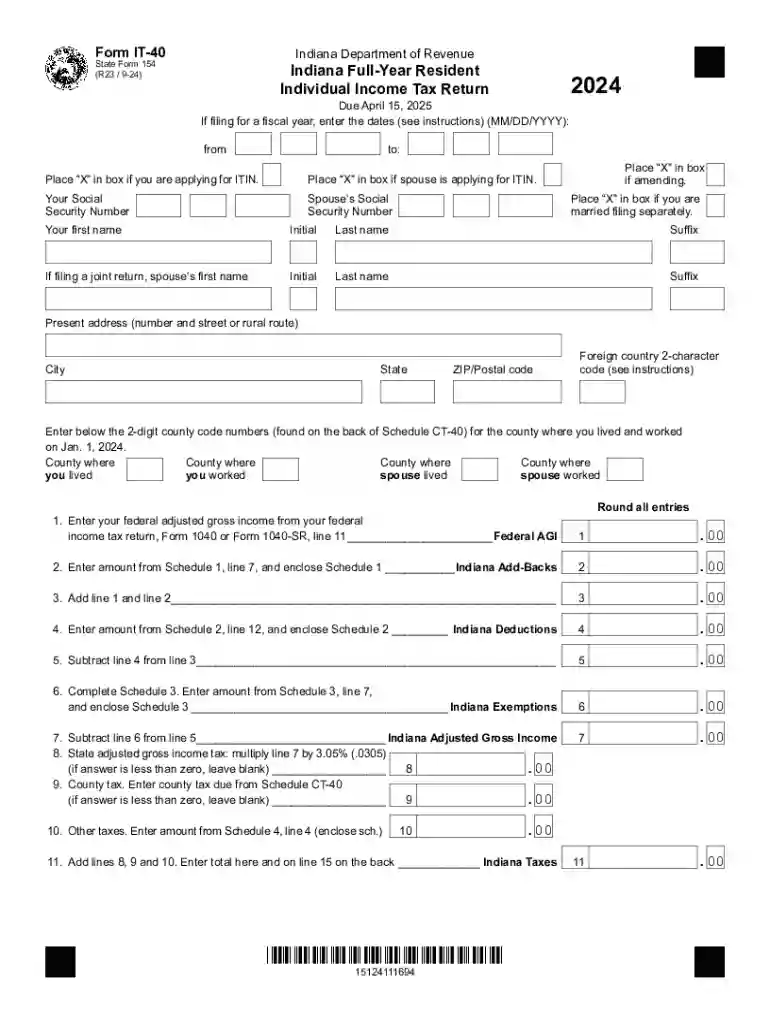
IT-40 2026

Get Form
IT-40 Preview on Page 1

Here's how it works

01. Edit your form online
Type text, add images, blackout confidential details, add comments, highlights and more.

02. Sign it in a few clicks
Draw your signature, type it, upload its image, or use your mobile device as a signature pad.

03. Share your form with others
Send it via email, link, or fax. You can also download it, export it or print it out.

Definition & Meaning of IT-40

The IT-40 form is the official state individual income tax return for full-year residents of Indiana. It is used by individuals to report their income, deductions, and credits to determine the state taxes owed or any refund due. The form is an essential tool for taxpayers to communicate their financial situation to the state's tax authorities and ensure compliance with Indiana tax laws.

Key Elements of the IT-40

  • Personal Information: This section requires filers to provide essential details such as name, address, Social Security number, and filing status.
  • Income Reporting: Report state-specific income, including wages, business income, and other sources.
  • Deductions & Credits: Apply for applicable tax deductions and credits to reduce taxable income.
  • Tax Calculation: Determine the state tax obligation after adjustments.
  • Refunds or Balances Due: Calculate if a refund is expected or if additional taxes are owed.

How to Use the IT-40

Steps to Complete the IT-40

  1. Gather Required Documents: Collect all necessary documentation, including W-2s, 1099s, and records of other income.
  2. Fill Personal Details: Begin by entering your personal information accurately to ensure correct processing.
  3. Report Income: Use your federal adjusted gross income as a starting point and note state-specific modifications.
  4. Apply Deductions and Credits: Identify eligible deductions or credits, such as for dependent care or education.
  5. Calculate Tax Owed: Utilize the instructions to compute taxes due based on Indiana's tax tables.
  6. Review and Sign: Before submission, double-check for accuracy and affix your signature.

Filing Deadlines / Important Dates

  • Deadline: The IT-40 must be submitted by April 15, 2025, aligning with federal tax deadlines.
  • Extensions: Request an extension if more time is needed, but note that this doesn’t delay tax payment obligations.

How to Obtain the IT-40

Form Submission Methods

  • Online: Use the Indiana Department of Revenue's electronic filing system to file and submit the form.
  • Mail: Print and mail a completed paper form to the appropriate state tax address.
  • In-Person: Some taxpayers may submit forms directly at designated Revenue Department offices.

Required Documents

  • Income Statements: Include all W-2 and 1099 forms.
  • Documentation for Deductions/Credits: Gather receipts or certificates for claimed credits or deductions.
  • Previous Year’s Tax Return: For reference and comparison.

Who Typically Uses the IT-40

The IT-40 is typically used by Indiana residents who have lived in the state for the entire tax year. Individuals in the following scenarios generally file this form:


  • Full-Year Residents: Those who maintained a legal residence in Indiana throughout the year.
  • Employees: Individuals employed and paid within the state.
  • Students and Retirees: Including those with income from Indiana sources.
  • Self-Employed Individuals: Capturing income from personal business activities within the state.
decoration image ratings of Dochub

State-Specific Rules for the IT-40

Indiana Taxpayer Scenarios

  • Self-Employed Residents: Must report all business income and expenses.
  • Retired Individuals: Report pensions or retirement income relevant to state regulations.
  • Students: Those who earn income from internships or part-time jobs within the state.
decoration image

Legal Use and Compliance

  • Penalties for Non-Compliance: Failure to file or fraudulent information can result in penalties, including interest charges and other legal consequences.
  • Disclosure Requirements: Transparency is essential; disclose all relevant financial activities affecting taxes.

Important Terms Related to the IT-40

  • Adjusted Gross Income: A pivotal term defining the taxpayer’s total income minus specific deductions.
  • Exemptions and Credits: Provisions allowing taxpayers to reduce taxed income.
  • Withholding: The portion of income held by employers to cover anticipated tax obligations.

Examples of Using the IT-40

Practical Scenarios

  • Full-Year Employment: A taxpayer working throughout the year reports salary, claims a standard deduction, and checks for eligible credits.
  • Retired Individual: Reports pension income, deducts health-related expenses, and checks property tax benefits.
  • Student Employment: Reports part-time job income and reviews educational credits.

Real-World Applications

  • Individuals use their previous year's return for guidance on navigating current tax obligations.
  • Tax preparation software compatibility, such as TurboTax and QuickBooks, assists in simplifying the IT-40 filing process and ensures accuracy.

Software Compatibility for Filing IT-40

Digital vs. Paper Versions

  • Software Options: Programs like TurboTax and H&R Block can help automate calculations and verify information accuracy.
  • Electronic Filing Benefits: Speed and efficiency with immediate system verification upon form submission.

IRS Guidelines and Compliance

Ensuring Accurate Reporting

  • Adherence to Federal Guidelines: Use federal forms and information as a baseline for state reporting.
  • Audit Preparedness: Maintain thorough records to substantiate claims and deductions in the event of an audit.

Penalties for Non-Compliance with IT-40

Filing inaccuracies or delays can result in punitive measures:

  • Late Payment Fees: Interest accumulates on unpaid taxes post-deadline.
  • Fines for Incorrect Information: Intentional under-reporting or false claims attract fines.
be ready to get more

Complete this form in 5 minutes or less

Get form

Got questions?

We have answers to the most popular questions from our customers. If you can't find an answer to your question, please contact us.
Contact us
The D40 tax form requires individuals to report their total income, including wages, salaries, interest, dividends, capital gains, and other sources of income.
Is Form 1040 the Same As a W-2? Form 1040 is different from a W-2. A W-2 is a wage and tax statement that an employee receives from a company they worked for during the tax year. The information listed on the W-2 is used to fill out Form 1040.
Income tax rates The Indiana Individual adjusted gross income tax rate for 2024 is 3.05% and will adjust in 2025 to 3.00%.
Form D-40 is the individual income tax return used by residents of the District of Columbia (DC) to report their income and pay taxes to the District. Its similar to the federal Form 1040, but specific to DC tax laws.
IT-40 is the full-year resident individual state tax return for Indiana. IT-40PNR is the part-year or full-year nonresident individual state tax return for Indiana. Indiana Schedule IN-OCC Other Certified Credits may be removed if the form is not needed in your tax return.

Security and compliance

At DocHub, your data security is our priority. We follow HIPAA, SOC2, GDPR, and other standards, so you can work on your documents with confidence.

Learn more
ccpa2
pci-dss
gdpr-compliance
hipaa
soc-compliance
be ready to get more

Complete this form in 5 minutes or less

Get form

People also ask

Practically every taxpayer will be expected to complete a Form 1040, so long as they earn above a certain income threshold. However, if a person earns non-employee income, they may also be expected to fill out a 1099. The income reported on the 1099 form will eventually be added to a line on the 1040 form.
Form D-400, also known as the North Carolina Individual Income Tax Return, is an official document used by residents of North Carolina to report their annual taxable income and calculate their state income tax liability for the preceding year.

Related links