




01. Edit your form online
Type text, add images, blackout confidential details, add comments, highlights and more.

Type text, add images, blackout confidential details, add comments, highlights and more.

Draw your signature, type it, upload its image, or use your mobile device as a signature pad.

Send it via email, link, or fax. You can also download it, export it or print it out.
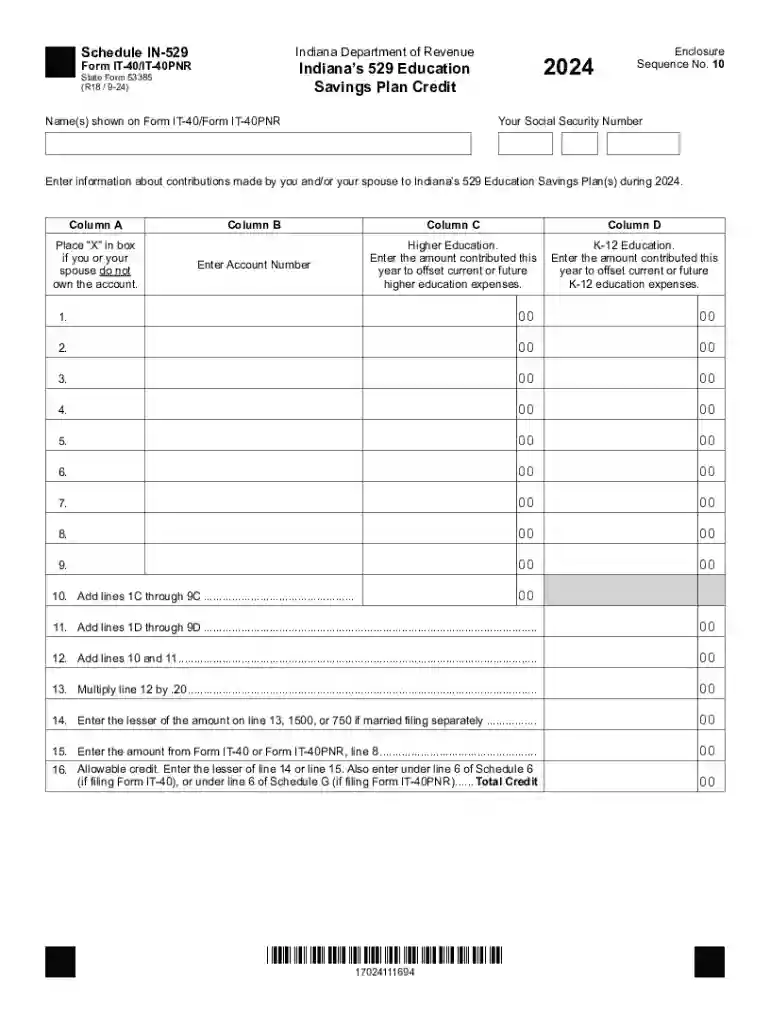
Schedule IN-529 is a tax form used by residents of Indiana to claim a tax credit for contributions made to the state's 529 Education Savings Plan. The 529 Plans were established to help families save for future educational expenses in a tax-advantaged manner. By contributing to an Indiana 529 Plan, donors may be eligible for a state income tax credit, thereby incentivizing investment in educational savings. The form is essential for accurately reporting these contributions and claiming the associated tax benefits.
Using Schedule IN-529 involves documenting your contributions to Indiana's 529 Education Savings Plan during the tax year. Taxpayers should use the form to calculate the allowable tax credit, which is typically a percentage of the total contributions up to a specified limit. This credit directly reduces the state income tax liability, potentially resulting in tax savings. Familiarizing yourself with the instructions and detailed completion steps on the form will ensure accurate reporting and maximize your tax benefits.
Completing Schedule IN-529 requires some careful data entry and calculation. Start by reviewing your contribution records and confirming the correct amounts. Calculate the tax credit you anticipate claiming by multiplying your eligible contributions by the prescribed rate. You are advised to consult the form's instructions for specific guidance on each section. After filling out the form, ensure all data inputs are accurate before attaching it to your state tax return.
To qualify for the tax credits offered via Schedule IN-529, certain conditions must be met. You must be a resident of Indiana and have made contributions to the state's 529 Plan. Contributions must remain within the maximum allowable limits to be eligible for tax credits. Additionally, the contributed funds must be used for qualifying educational expenses, which typically include college tuition, certain K-12 expenses, books, and necessary supplies.


The Schedule IN-529 form includes several key elements that must be accurately completed for a successful tax credit claim. These elements include personal identification data, specifics on the 529 Plan contributions, instructions on tax credit calculations, and a signature section. Ensuring the accurate completion of these elements is vital to claiming the tax benefits associated with your 529 Plan contributions.
The Schedule IN-529 form adheres to state-specific regulations unique to Indiana taxpayers. These rules include a cap on the maximum credit that can be claimed and detailed definitions of what constitutes qualified educational expenses. Indiana residents need to familiarize themselves with these rules to make informed decisions about their educational savings plans and associated tax benefits.
To accurately fill out Schedule IN-529, taxpayers should prepare and organize necessary documentation beforehand. Required documents typically include contribution statements from your 529 Plan provider, Indiana state tax forms, and previous tax returns for reference. Having these documents readily accessible will help cross-check information, enhancing accuracy and reducing errors.
Schedule IN-529 serves as a legally recognized document for claiming state tax credits related to education savings contributions in Indiana. It’s essential for residents who seek to offset their tax liabilities through such contributions. The form ensures that participants accurately report their financial activity and claim the legal benefits provided by state law.
We've got more versions of the Schedule IN-529 form. Select the right Schedule IN-529 version from the list and start editing it straight away!
At DocHub, your data security is our priority. We follow HIPAA, SOC2, GDPR, and other standards, so you can work on your documents with confidence.







Anyone who makes a contribution to a qualified plan and claims this credit must include Schedule IN-529 when filing their tax return.
Many 529 plans now offer a digital distribution option, allowing funds to be sent directly to IU via electronic ACH. This method is faster, offers real-timeRead more


