01. Edit your maryland income tax return form online
Type text, add images, blackout confidential details, add comments, highlights and more.

Type text, add images, blackout confidential details, add comments, highlights and more.

Draw your signature, type it, upload its image, or use your mobile device as a signature pad.

Send maryland income tax return via email, link, or fax. You can also download it, export it or print it out.
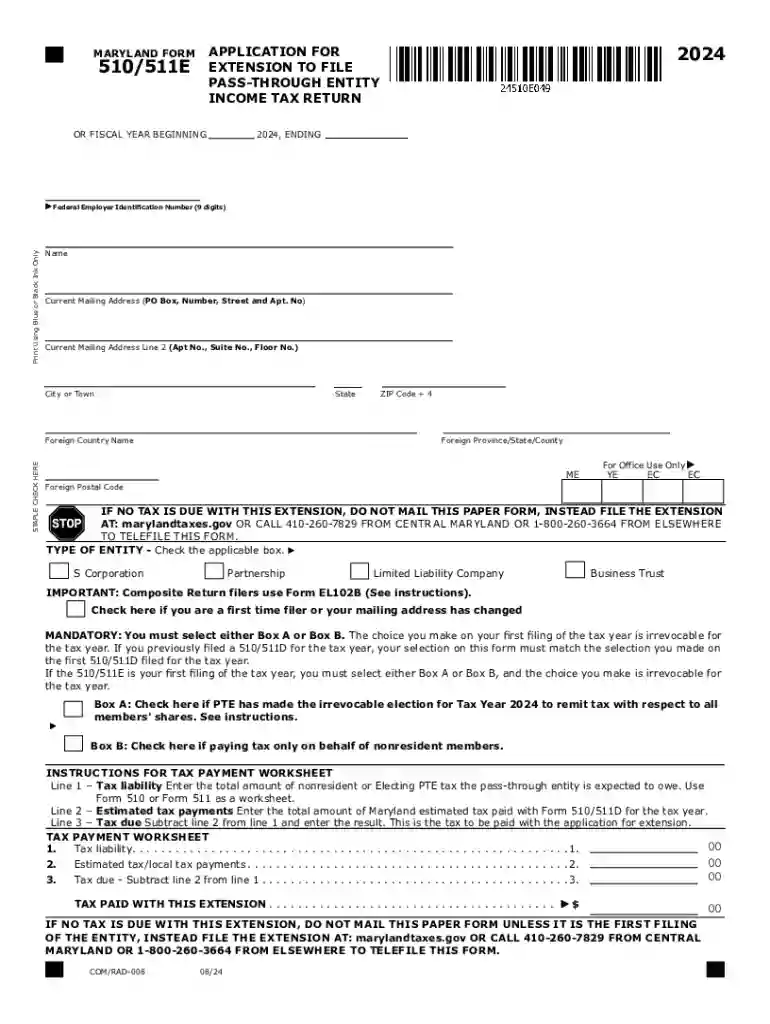
The 2024 Maryland Form 510/511E is designed for pass-through entities seeking an extension to file their income tax returns. These entities include partnerships, S corporations, and limited liability companies treated as pass-throughs for tax purposes. The form provides a structured means to request more time to compile the necessary financial information and ensure accurate reporting to the Maryland Comptroller.
To use the Maryland Form 510/511E effectively, entities must first ascertain their eligibility for an extension. The form requires essential information such as the entity’s name, address, and federal identification number. Users must also calculate any estimated tax payments due. If no tax is owed, the submission is generally unnecessary unless it is the entity's inaugural filing. Completing this form allows businesses to extend their filing deadline and avoid late fees and penalties.
Gather Necessary Information:
Calculate Estimated Tax Liability:
Complete the Form:
Payment (if applicable):
Submit the Form:
The form is mainly used by pass-through entities operating in Maryland. This includes entities such as partnerships, S corporations, and LLCs that elect to be treated as pass-through entities for taxation. These businesses often require additional time to gather financial data and file accurate returns, making the Form 510/511E a crucial tool in their tax management process.


The extension granted by the Maryland Form 510/511E does not extend the payment due date. All estimated taxes must be paid by the original due date of the return to avoid penalties. The form must be submitted by the original tax return due date, typically the 15th day of the fourth month following the entity’s year-end. This ensures that late filing penalties are avoided while allowing additional time for filing the return itself.
Failure to file for an extension using the Maryland Form 510/511E or not meeting the payment requirements by the original due date can result in significant penalties. Late filing incurs a penalty of five percent of the due tax per month, up to a maximum of 25 percent. Additionally, interest accrues on unpaid taxes from the original due date until payment is made.
The Maryland Form 510/511E is available in both digital and paper formats. The digital version facilitates easier editing, submission, and tracking, particularly beneficial for those utilizing platforms like DocHub. Electronic submission significantly reduces processing time and minimizes the risk of errors that can occur with paper forms.
Different taxpayer scenarios can impact the need for and use of Form 510/511E:

Maryland Form 510/511E is specifically designed for pass-through entities, which include:
Understanding the specific requirements and benefits for each type ensures accurate usage of the form. This form acts as a critical compliance tool, allowing businesses to maintain good standing with state tax requirements without the pressure of approaching deadlines.
We've got more versions of the maryland income tax return form form. Select the right maryland income tax return form version from the list and start editing it straight away!
At DocHub, your data security is our priority. We follow HIPAA, SOC2, GDPR, and other standards, so you can work on your documents with confidence.