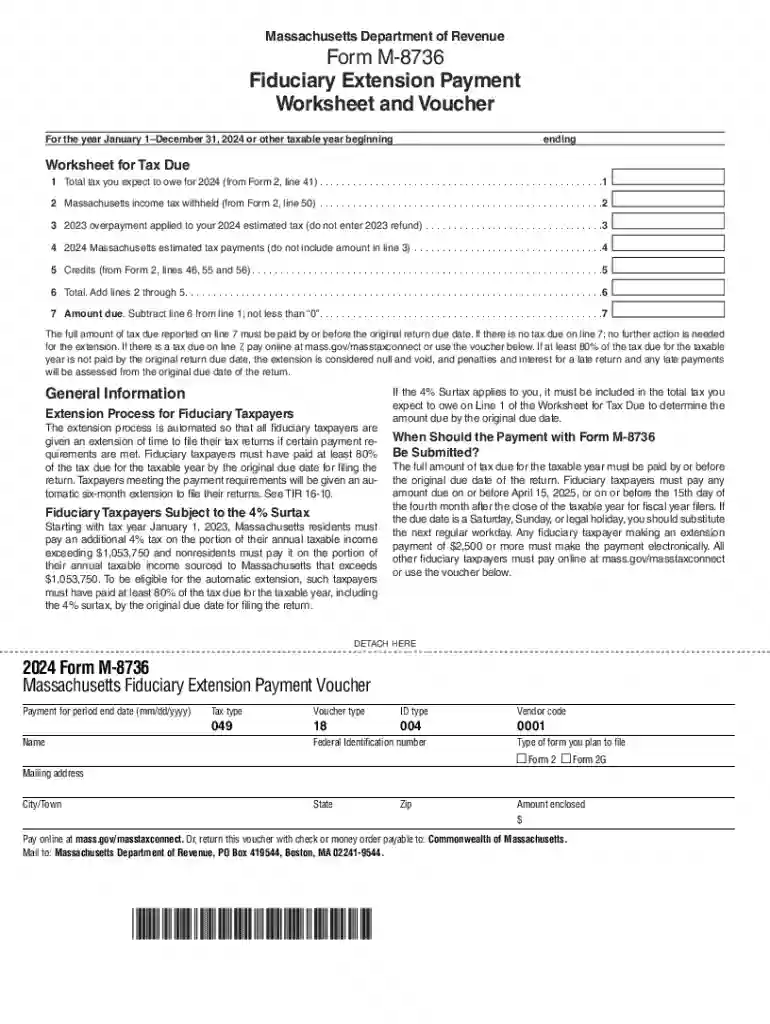
Massachusetts m 8736 form-2026

Get Form
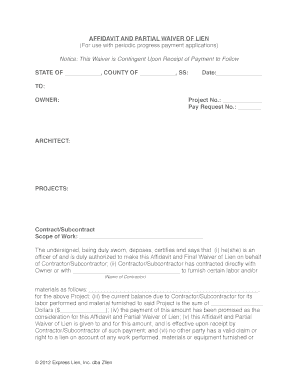
massachusetts m 8736 form Preview on Page 1

Here's how it works

01. Edit your massachusetts m 8736 form online
Type text, add images, blackout confidential details, add comments, highlights and more.

02. Sign it in a few clicks
Draw your signature, type it, upload its image, or use your mobile device as a signature pad.

03. Share your form with others
Send m 8736 via email, link, or fax. You can also download it, export it or print it out.

Definition and Meaning

The Massachusetts M-8736 Form is an essential worksheet and voucher crafted by the Massachusetts Department of Revenue. It serves fiduciary taxpayers as a tool to calculate and remit their extension payments related to state taxes. The form outlines procedures for obtaining a six-month automatic filing extension, stipulating that at least 80 percent of the expected tax liability is paid on or before the original deadline. Understanding its definition and purpose is crucial for taxpayers to effectively manage their tax obligations in a timely fashion.

How to Use the Massachusetts M-8736 Form

To use the Massachusetts M-8736 Form effectively, taxpayers should follow a structured approach to ensure compliance and accuracy:

  1. Calculate Total Tax Due: Determine the total tax liability by analyzing your financial data for the relevant tax year.
  2. Assess Extension Payment: Validate that 80 percent of the estimated tax is paid by the original due date to qualify for the extension.
  3. Complete the Form: Fill out the form with accurate information, focusing on sections that verify your tax calculations and payment intentions.
  4. Submit Payment: Ensure that payment accompanies the form submission, using acceptable methods outlined in the form instructions.

This systematic usage prevents late fees and penalization, fostering efficient tax management.

Steps to Complete the Massachusetts M-8736 Form

Completing the Massachusetts M-8736 Form follows a detailed step-by-step process:

  1. Gather Necessary Information: Collect all financial records, previous tax returns, and any other documentation that influences your tax situation.
  2. Fill Personal Details: Enter your name, address, taxpayer identification number, and any specific fiduciary identifiers.
  3. Calculate Extension Payment: Use the worksheet provided in the form to compute the payment required for the extension.
  4. Review and Finalize Details: Carefully review all entries for accuracy, ensuring alignment with financial records.
  5. Submit Form and Payment: Finalize by submitting both the form and extension payment, adhering to the prescribed submission method.

Following these steps closely guarantees a comprehensive completion, meeting all regulatory expectations.

Key Elements of the Massachusetts M-8736 Form

The Massachusetts M-8736 Form comprises several critical elements vital for a successful extension request:

  • Taxpayer Information: Basic details such as name, address, and taxpayer ID.
  • Payment Calculation: A section for calculating estimated taxes due.
  • Extension Request: Information to validate the need for an automatic extension.
  • Payment Details: Fields to verify the payment amount and method used for submission.

These components form the backbone of the form, each requiring careful consideration to avoid errors.

IRS Guidelines

While the M-8736 is a state form, understanding IRS guidelines is vital for better tax planning:

  • Federal Extension Correlation: Differentiating between state and federal requirements for extensions.
  • Estimated Payments: IRS guidelines should be consulted for accurately estimating tax payments, ensuring they are in harmony with state rules.
  • Documentation: The IRS necessitates keeping comprehensive records, facilitating easier reconciliation with state forms.

Balancing both IRS and state guidelines is crucial for ensuring compliant and stress-free tax management.

Filing Deadlines and Important Dates

Knowledge of the filing timelines is crucial:

  • Original Tax Due Date: Generally April 15, aligning with the federal schedule.
  • Extension Deadline: To qualify, ensure form and payments are submitted by April 15.
  • Six-Month Extension: Typically, extends the filing deadline to October 15, providing additional time to file the return.

Meeting these deadlines guarantees the form’s validity and prevents penalty impositions related to late filings.

Penalties for Non-Compliance

Failure to comply with the requirements of the Massachusetts M-8736 Form can lead to several penalties:

  • Late Payment Fees: Inadequate payment of the tax delinquency, either before or post-extension, attracts fines.
  • Interest Charges: Added to taxes due if not settled on time.
  • Invalidated Extensions: Extensions may be voided, requiring immediate filing of returns, should prerequisites not be met.

Awareness and adherence to these compliance requirements help avoid unnecessary financial repercussions.

Required Documents

Proper documentation is essential for completing the M-8736 form:

  • Financial Statements: Current year earnings and anticipated projections.
  • Previous Year Tax Returns: Offer insight into ongoing liabilities and extension requirement verifications.
  • Payment Evidence: Proof that requisite payments align with expectations and requirements.

Having precise documents ready supports accurate form completion and submission, enhancing overall process efficiency.

be ready to get more

Complete this form in 5 minutes or less

Get form

Got questions?

We have answers to the most popular questions from our customers. If you can't find an answer to your question, please contact us.
Contact us
Overview. The estate tax is a transfer tax on the value of the decedents estate before distribution to any beneficiary. For estates of decedents dying in 2006 or after, the applicable exclusion amount is $1,000,000. For estates of decedents dying in 2023 or after, the applicable exclusion amount is $2,000,000.
Very few do. You only file a return if your estate is over the applicable estate exemption in the year of death which, in 2021, is 11.7 million dollars. The estate tax return also looks at prior lifetime gifts.
Federal and/or state estate tax returns are required whenever the total value of the decedents assets exceeds the applicable filing thresholds. The present exemptions as of 2025 are $2,000,000 in Massachusetts and $13,990,000 per person, federally.
You should claim the total number of exemptions to which you are entitled to prevent excessive over-withholding, unless you have a docHub amount of other income. If you expect to owe more income tax than will be withheld, you may either claim a smaller number of exemptions or have additional amounts withheld.
2024, c. 206. First, on October 4, 2023, a new law amended the estate tax by providing a credit of up to $99,600, thereby eliminating the tax for estates valued at $2 million or less and reducing the tax for estates valued at more than $2 million.

Security and compliance

At DocHub, your data security is our priority. We follow HIPAA, SOC2, GDPR, and other standards, so you can work on your documents with confidence.

Learn more
ccpa2
pci-dss
gdpr-compliance
hipaa
soc-compliance

People also ask

Every executor, administrator, trustee, guardian, conservator, trustee in a noncorporate bankruptcy or receiver of a trust or estate that received income in excess of $100 that is taxable under MGL ch 62 at the entity level or to a beneficiary(ies) and that is subject to Massachusetts jurisdiction must file a Form 2.
Use Form M-2848, Power of Attorney and Declaration of Representative, for this purpose if you choose. You may fle a POA without using Form M-2848, but it must contain the same information as Form M-2848 would.

8736