




01. Edit your guidestar charity check online
Type text, add images, blackout confidential details, add comments, highlights and more.

Type text, add images, blackout confidential details, add comments, highlights and more.

Draw your signature, type it, upload its image, or use your mobile device as a signature pad.

Send schedule ged test via email, link, or fax. You can also download it, export it or print it out.
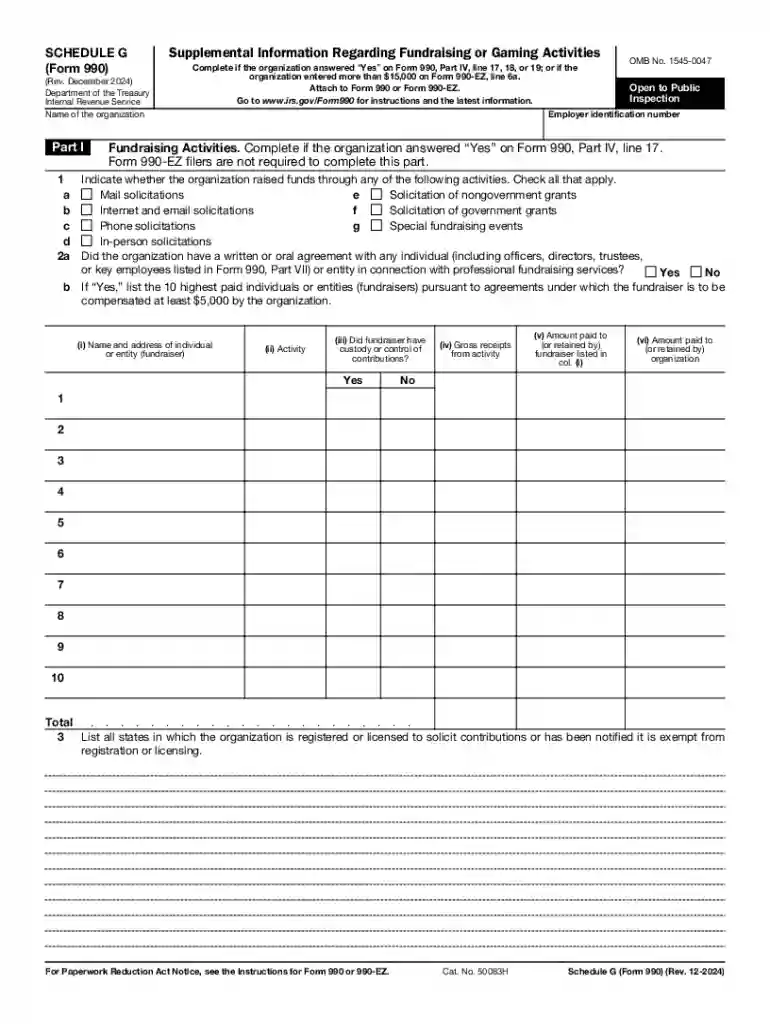
The form titled "Complete if the organization answered Yes on Form 990, Part IV, line 17, 18, or 19; or if the" is a crucial document primarily used by non-profit organizations. It serves as a supplement to the Form 990, which is a comprehensive tax form required by the Internal Revenue Service (IRS) for tax-exempt entities. Organizations must complete this part if they have engaged in specific financial activities or answered affirmatively to key questions in Part IV of Form 990. This form ensures transparency in financial dealings and aids in monitoring regulatory compliance.
Accurately Review Instructions: Begin by carefully reading the instructions provided by the IRS for understanding specific line references and requirements pertinent to Form 990, Part IV.
Gather Necessary Financial Records: Collect comprehensive financial documents, including contracts, agreements, and detailed records of transactions or activities relevant to lines 17, 18, or 19 of Form 990, Part IV. This includes details about loans, compensated officers, and unusual transactions.
Focus on Specific Questions: Address each question requiring a 'yes' answer with sufficient detail. For instance:
Use IRS Guidelines for Specific Disclosures: Ensure each section is filled out according to IRS guidelines, explicitly answering how the organization’s activities relate to the responses given in Part IV. Accuracy is critical to avoid penalties.
Verification and Review: Once completed, the form must be reviewed thoroughly for any inconsistencies or errors. Consult a tax professional if needed to ensure compliance standards are met.
The completion of this supplement form is incredibly significant to maintain organizational accountability and transparency. It reveals to the IRS and the public how non-profit organizations earn and utilize their funds, providing insight into their operational legitimacy. This transparency strengthens public trust and enhances the organization's ability for legal compliance.
Typically, non-profit organizations across various sectors that file Form 990 use this document. Particularly, it involves organizations that have significant financial or business transactions, loans, or financial engagements that trigger a 'yes' response in Part IV. It is often used by accounting departments within an organization or external auditors contracted to ensure the accurate filing of tax-related documents.
Disclosure of Financial Engagements: Detailed descriptions and documentation of any loans provided or received, inclusive of terms and amounts.
Operational Insights: Information related to unusual or non-standard financial transactions, including their purpose and parties involved.
Compensated Parties: Disclosure of any officers or employees who receive compensation for their involvement exceeds IRS-stipulated limits.
The IRS provides comprehensive guidelines for completing this supplement form, which specify:
The necessity to document comprehensive details of financial transactions.
Ensuring entries correspond to designated sections of Form 990 intended for more detailed disclosures.
Utilizing IRS instructions for Part IV to clarify uncertainties.
Failure to accurately complete and submit this form can result in significant penalties ranging from monetary fines to revocation of tax-exempt status. Ensuring correct submission mitigates against these risks and helps preserve organizational integrity.
Organizations must submit this form in alignment with the annual filing deadline for Form 990, typically by the 15th day of the 5th month following the organization's fiscal year-end. Submissions can be made electronically, ensuring prompt receipt and easier IRS processing, reducing potential delays and errors associated with paper filing.
Many organizations use tax preparation software such as TurboTax or QuickBooks, which have integrated capabilities to assist in completing IRS forms relevant to Form 990, increasing efficiency and accuracy. Proper configuration of these programs can streamline the filing process, ensuring compliance through systematic checks and guidance based on government standards.
Non-profit corporations, including those involved in educational, religious, or charitable activities, benefit greatly from effectively managing their form submissions. Engaging in compliance promotes not only legal adherence but also fosters a responsive and trust-based relationship with stakeholders and donors.
We've got more versions of the guidestar charity check form. Select the right guidestar charity check version from the list and start editing it straight away!
| Versions | Form popularity | Fillable & printable |
|---|---|---|
| 2024 | 4.2 Satisfied (23 Votes) | |
| 2023 | 4.8 Satisfied (29 Votes) | |
| 2022 | 4.7 Satisfied (29 Votes) | |
| 2021 | 4.8 Satisfied (80 Votes) | |
| 2020 | 4.3 Satisfied (106 Votes) | |
| 2019 | 4.3 Satisfied (139 Votes) | |
| 2018 | 4.4 Satisfied (153 Votes) | |
| 2017 | 4.4 Satisfied (276 Votes) | |
| 2016 | 4.4 Satisfied (141 Votes) | |
| 2015 | 4.3 Satisfied (24 Votes) | |
| 2014 | 4 Satisfied (21 Votes) | |
| 2013 | 4 Satisfied (50 Votes) | |
| 2012 | 4.3 Satisfied (72 Votes) | |
| 2011 | 4 Satisfied (41 Votes) | |
| 2010 | 4.3 Satisfied (45 Votes) |
At DocHub, your data security is our priority. We follow HIPAA, SOC2, GDPR, and other standards, so you can work on your documents with confidence.




Part I. Fundraising Activities. Complete if the organization answered Yes on Form 990, Part IV, line 17. Form 990-EZ filers are not required to complete thisRead more
Cited by 1 Complete if the organization answered Yes on Form 990, Part IV, line 17, 18, or 19, or if the organization entered more than $15,000 on Form 990-EZ, line 6a.Read more


