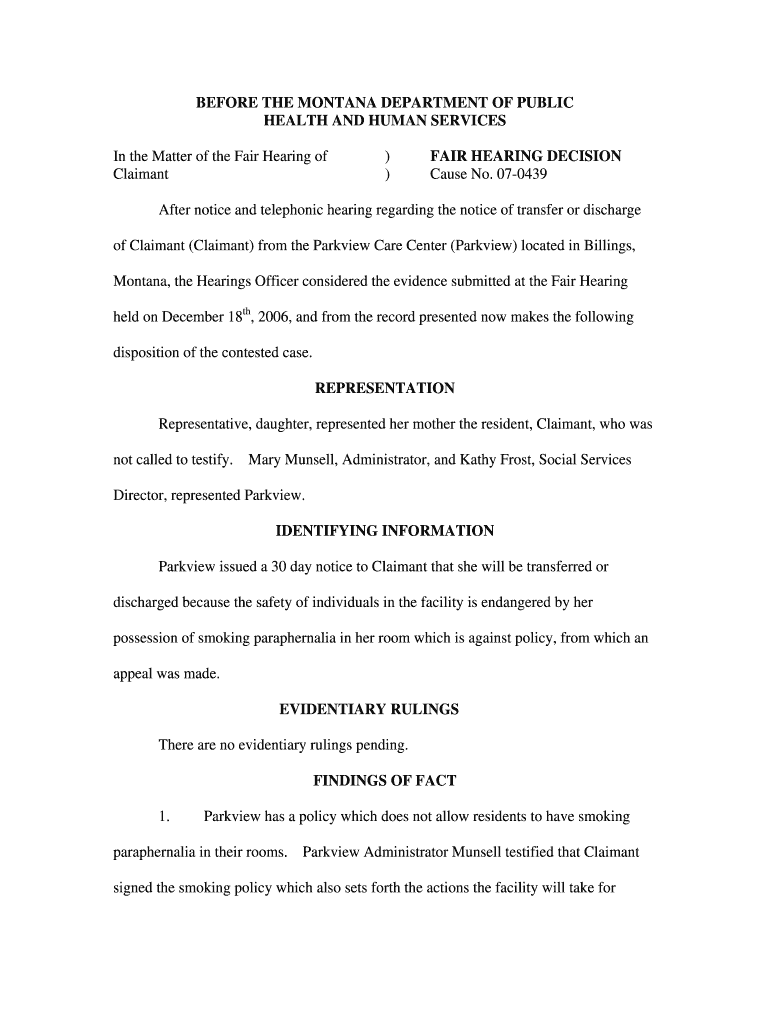
After notice and telephonic hearing regarding the notice of transfer or discharge of Claimant (Claim 2026

Get Form
After notice and telephonic hearing regarding the notice of transfer or discharge of Claimant (Claim Preview on Page 1

Here's how it works

01. Edit your form online
Type text, add images, blackout confidential details, add comments, highlights and more.
02. Sign it in a few clicks
Draw your signature, type it, upload its image, or use your mobile device as a signature pad.
03. Share your form with others
Send it via email, link, or fax. You can also download it, export it or print it out.

How to use or fill out After notice and telephonic hearing regarding the notice of transfer or discharge of Claimant (Claim with our platform

Form edit decoration
9.5
Ease of Setup
DocHub User Ratings on G2
9.0
Ease of Use
DocHub User Ratings on G2
  1. Click ‘Get Form’ to open it in the editor.
  2. Begin by filling in the identifying information section. Ensure you accurately enter the Claimant's name and details regarding the facility, including Parkview Care Center.
  3. In the representation section, indicate who is representing the Claimant. This could be a family member or legal representative. Provide their relationship to the Claimant.
  4. Proceed to the findings of fact section. Here, summarize key points from the hearing, ensuring clarity on incidents leading to the notice of transfer or discharge.
  5. Complete the conclusions of law section by referencing relevant regulations that apply to this case. Make sure to highlight any lack of evidence presented by Parkview.
  6. Finally, review all sections for accuracy and completeness before saving your document. Utilize our platform’s features for easy editing and signing.

Start using our platform today for free to streamline your document editing and ensure a smooth process!

be ready to get more

Complete this form in 5 minutes or less

Get form

Got questions?

We have answers to the most popular questions from our customers. If you can't find an answer to your question, please contact us.
Contact us
Resident Rights dignity, respect and a comfortable living environment. quality of care and treatment without discrimination. freedom of choice to make your own, independent decisions. be informed in writing about services and fees before you enter the nursing home. Your Rights as a Nursing Home Resident in New York State New York State Department of Health - NY.gov facilities nursing rights New York State Department of Health - NY.gov facilities nursing rights
The DoLS provides authority for your relative to remain in the care home named on the paperwork, but that does mean that they cant move. If you think your relative would be better placed in a different care home then you should discuss this with the local authority, and a social worker if your relative has one.
A nursing home resident can be involuntarily transferred legally if the nursing home cannot meet their needs. However, a nursing home may claim they cannot meet a residents needs, but in reality, do have the capability to meet their needs. If this is the case, an involuntary transfer is illegal.
When can I switch nursing homes? Federal and state law protects you from being unfairly discharged or transferred from a nursing home. According to Medicare.gov, you generally cant be transferred to a different skilled nursing facility or discharged unless: The nursing home is closing. Will Medicare Let Me Switch Nursing Homes? - eHealth eHealth medicare coverage eHealth medicare coverage
Federal rules allow only 6 reasons for transfer-discharge: The nursing home cannot provide adequate care for the resident; The residents health has improved to the point that he or she no longer needs nursing home care; Safety of individuals in the facility is endangered; The resident has failed to pay for care;

People also ask

The nursing home facility provides the resident with a written explanation of the reasons for the discharge and the residents rights and responsibilities. The resident has the right to appeal the discharge decision to the California Department of Public Health (CDPH) and the California Department of Aging (CDA).
Notify the Facility You might be required to notify the nursing home when you remove your loved one. Depending on the facility, you might have to follow specific discharge procedures or submit paperwork. How to Remove a Loved One from a Nursing Home Nursing Home Justice blog how-to-re Nursing Home Justice blog how-to-re

Related links