






Definition and Meaning
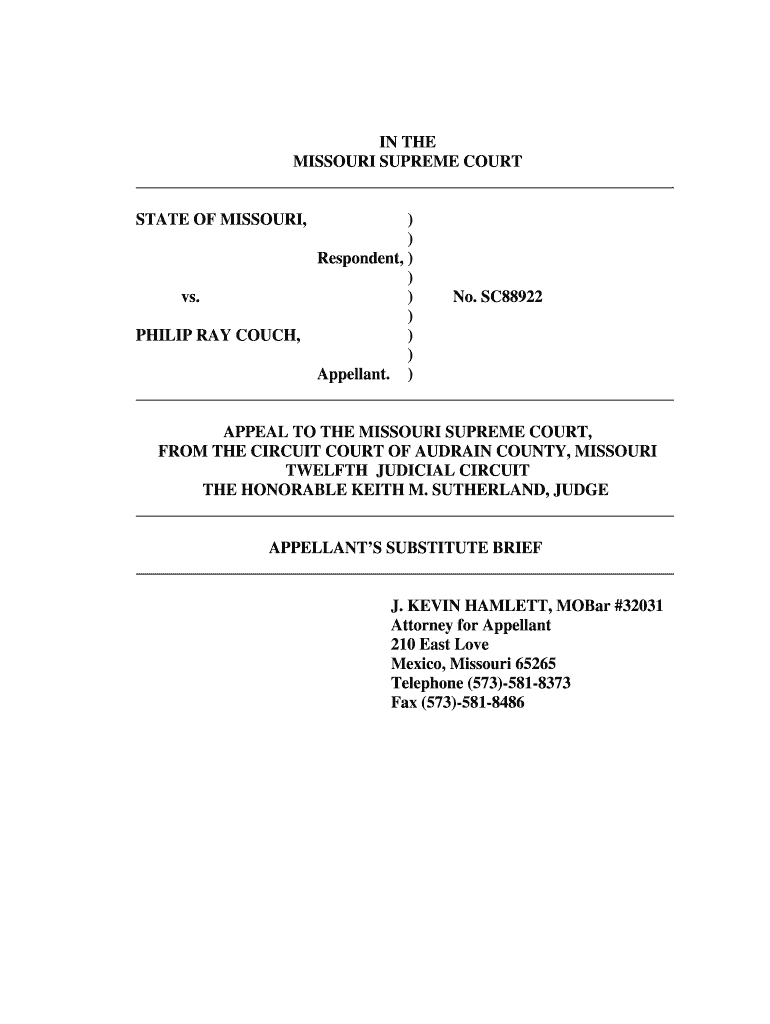
The "In the Missouri Supreme Court State of Missouri, Respondent, vs" is a designation used for legal documents in which the State of Missouri is involved in appellate cases. This typically indicates that the State of Missouri, represented by a public prosecutor, is the respondent in a case where the appellant, often an individual or entity, challenges a prior court decision within the state. These documents are crucial as they outline the legal arguments, pertinent evidence, and the basis for the appeal. Within the broader legal context, the term "respondent" refers to the party that must answer the claims brought forth in the appeal.
Steps to Complete the Form
-
Gather Necessary Case Information: Begin by collecting all relevant details from your prior court decisions and transcripts. This includes evidence presented during the trial, witness testimonies, and any legal documents filed.
-
Outline Legal Grounds for Appeal: Clearly delineate the reasons for your appeal. This generally involves legal errors that occurred during the trial, such as improper judge instructions, misrepresentation of evidence, or procedural issues.
-
Draft A Legal Brief: Prepare a comprehensive document detailing your argument. This brief should cite applicable statutory laws, precedents set by other cases, and any procedural errors you believe occurred.
-
Review and Edit Thoroughly: Legal documents must be free of errors and articulately present your case. A thorough review by a legal expert can enhance the quality of your submission.
-
Submit to the Appropriate Court: Once completed, file the final document with the Missouri Supreme Court. Ensure compliance with filing deadlines and submission procedures, which can vary between jurisdictions.
Who Typically Uses This Form
This form is primarily utilized by attorneys representing appellants in the State of Missouri. Appellants may include individuals, organizations, or corporations seeking to overturn a lower court's ruling. Legal professionals specializing in appellate law are often engaged to navigate the complexities of these documents. Additionally, the respondent, often the State represented by attorneys, uses this form to reply to the appellant's arguments with counterpoints supporting the original ruling.
How to Obtain the Form
-
Court Clerk Office: Visit the Clerk of the Missouri Supreme Court's office to obtain the necessary forms and documentation needed for submission.
-
Online Resources: Access the Missouri Courts official website, which may provide downloadable versions of forms, guidelines, and instructions necessary for filing an appeal.
-
Legal Representation: Engaging with a qualified attorney often streamlines the process as they can directly access and prepare the required forms.
Importance of This Form in Legal Use
This form serves as a crucial component in the appellate process, permitting parties to challenge rulings they perceive as unjust. It ensures due process by allowing for judicial review of lower court decisions. Its proper utilization affirms the rights of the appellant to seek legal redress, contributing to the checks and balances foundational to the judicial system.
Key Elements of the Form
-
Case Identification: Includes the case number, names of the appellant and respondent, and the lower court's judgment being appealed.
-
Legal Arguments: Clearly structured arguments outlining alleged errors in law or procedure, supported by relevant legal citations.
-
Evidence and Exhibits: Section for including specific references to trial evidence, witness lists, and exhibits deemed crucial for the appeal.
-
Relief Sought: Explicit description of the desired outcome, such as reversal of the previous decision, retrial, or other applicable remedies.
State-Specific Rules for Missouri
Missouri-specific appellate procedures require adherence to defined timelines and formats. This includes filing within prescribed deadlines post-judgment, using state-sanctioned documentation formats, and ensuring that the content complies with Missouri appellate practice standards. Missouri's legal framework mandates that all appeals address specific questions of law rather than rehear facts, reinforcing the necessity for a legally substantive argumentation approach.
Digital vs. Paper Version
Missouri courts allow both digital and paper submissions of appellate documents, with digital submissions often being preferred for ease and efficiency. The digital process typically involves secure uploads via the Missouri appellate court’s electronic filing system, which guarantees document integrity and expedites the review process. Paper versions still hold validity for those who prefer traditional filing methods but may entail longer processing times.
Software Compatibility with DocHub
Documents for the Missouri Supreme Court can be prepared digitally using platforms like DocHub, which integrates seamlessly with other document management systems. The software’s functionalities facilitate editing, signing, and sharing of legal documents, greatly simplifying the review process. DocHub supports various file formats and ensures documents meet formatting requirements through robust editing and collaboration tools.
Penalties for Non-Compliance
Failure to comply with appellate rules can result in the dismissal of an appeal. Penalties include rejection due to untimely submissions, improperly formatted documents, or insufficient legal grounds. Non-compliance can also affect the appellant’s standing in future proceedings, underscoring the need for precision and adherence to procedural mandates.
Examples of Using the Form
-
Case Overturn: An appellant uses the form to argue that a crucial piece of evidence was improperly excluded, leading to a retrial order.
-
Procedural Errors: An appeal challenging the fairness of jury instructions, claiming they misled the jury on legal standards, and resulting in a court-ordered amendment.
-
Legal Precedent Conflicts: Cases where prior rulings conflict with existing statutory interpretations, potentially leading to a review and necessary clarification or change in applied law.