







Definition & Meaning
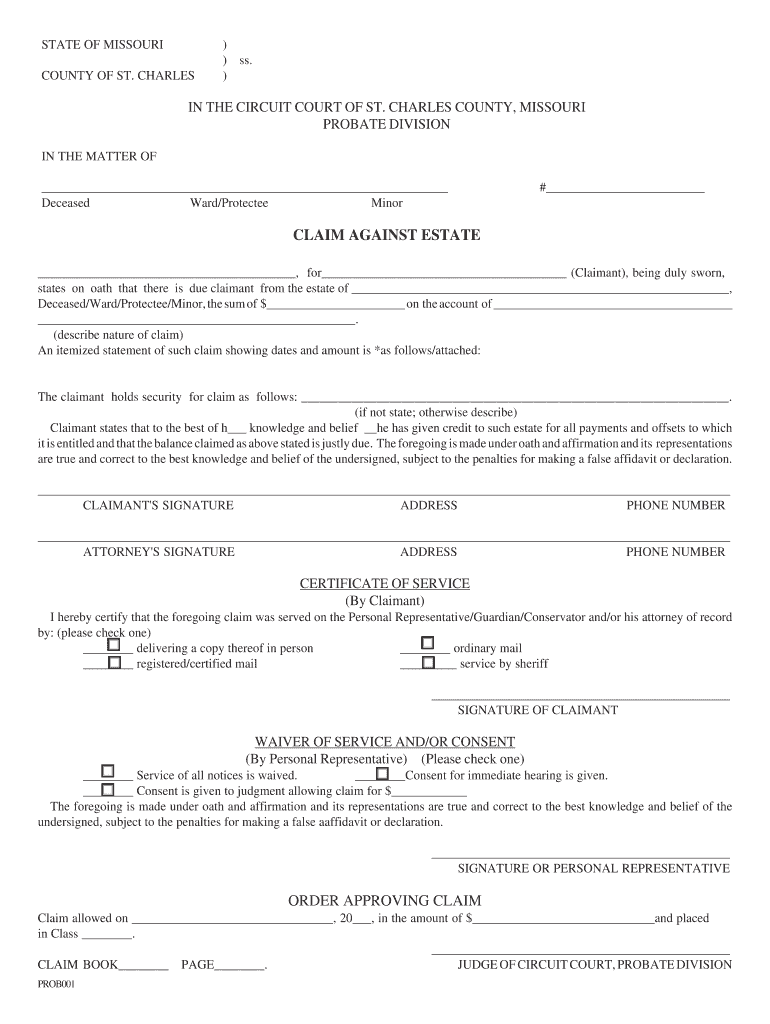
The "Claim Against Estate Order Approving Claim" is a legally binding document utilized within the Probate Division of the Circuit Court of St. Charles County, Missouri. This form is essential for individuals or entities wishing to file a claim against the estate of a deceased person or minor. It serves as an official record detailing the claimant's demand for any owed debts or obligations from the decedent's estate. Key aspects of this form include the specification of the claim amount, a detailed description of the claim's nature, and providing an itemized statement of the claim. It also involves judicial approval, where a judge reviews and validates the legitimacy of the claim.
Steps to Complete the CLAIM AGAINST ESTATE ORDER APPROVING CLAIM
-
Gather Necessary Information: Before filling out the form, ensure you have all relevant details about the deceased's estate, including debts or contracts that support your claim.
-
Fill Out Claim Details: Accurately record the amount being claimed and the nature of the claim on the form. This section requires precision, as errors may delay the processing of your claim.
-
Provide Documentation: Attach an itemized statement that supports your claim. Include any contracts, invoices, or correspondence that validate the amount and nature of the debt or obligation.
-
Serve Notice: Certify that notification of your claim has been appropriately served to relevant parties. This is crucial for legal transparency and process adherence.
-
Waiver of Service: If applicable, complete the waiver of service section to expedite the process, especially when there's an agreement between involved parties to forego this step.
-
Submit the Form: Submit the completed form and supporting documents to the appropriate Probate Division in St. Charles County.
-
Await Judicial Approval: The final step involves a judge reviewing your submission and approving the claim if deemed valid.
Required Documents
- Completed Claim Form: Ensure all sections of the Claim Against Estate Order Approving Claim are thoroughly filled out.
- Supporting Documentation: Attach all relevant financial documents such as contracts, invoices, and agreements that substantiate the claim.
- Proof of Notification: Documentation showing that all necessary parties have been informed about the claim.
- Identification Documents: A copy of a government-issued ID may be required to authenticate the claimant's identity.
Key Elements of the CLAIM AGAINST ESTATE ORDER APPROVING CLAIM
- Claimant Information: Details of the individual or entity making the claim, including contact information.
- Nature of Claim: A concise description and amount of the claim being made against the estate.
- Itemized Statement: A detailed breakdown of the claim amount, with each item specified for clarity and validation purposes.
- Service Certification: A section confirming that all relevant parties have been duly notified about the claim.
- Order Approval: Space for a judge to write and sign an order approving or denying the claim based on the provided information and supporting documents.
How to Obtain the CLAIM AGAINST ESTATE ORDER APPROVING CLAIM
To acquire this form, individuals may either visit the Probate Division office of the Circuit Court of St. Charles County, Missouri, or access their website for downloadable forms. Online access provides convenience, while in-person visits offer the chance to ask preliminary questions and receive guidance on completing the form.
Legal Use of the CLAIM AGAINST ESTATE ORDER APPROVING CLAIM
This form is legally utilized to formalize a claim against an estate in Missouri. Legal practitioners often use it to protect the financial interests of their clients by ensuring any outstanding debts or obligations owed by the deceased are settled through the decedent’s estate. Its significance lies in its ability to serve as an official court document that mandates a review and decision by a judiciary authority.
Who Typically Uses the CLAIM AGAINST ESTATE ORDER APPROVING CLAIM
This form is primarily used by creditors, beneficiaries, or any party with a legitimate financial claim against the decedent's estate. It is not uncommon for businesses, such as financial institutions or service providers, to use this form to claim unpaid debts owed by the deceased. Legal representatives or estate attorneys may also file this form on behalf of their clients to ensure rightful claims are considered in estate settlements.


Filing Deadlines / Important Dates
Timely filing of the Claim Against Estate Order Approving Claim is crucial. Typically, claims should be submitted within a specific time frame following the decedent's death to be considered valid. Delays could jeopardize the acceptance of the claim, depending on Missouri's statutory deadlines related to probate proceedings. It's advisable to confirm specific deadlines with the Probate Division to avoid any compliance issues.
State-Specific Rules for the CLAIM AGAINST ESTATE ORDER APPROVING CLAIM
In Missouri, specific laws dictate the administration of estate claims. Local probate regulations influence the form's requirements and process. For instance, Missouri law mandates specific notification procedures to creditors and defines allowable claims, influencing how this form needs to be completed and filed. Engaging with a legal professional familiar with Missouri probate law can be beneficial in ensuring compliance with state-specific mandates.




