







Definition & Meaning
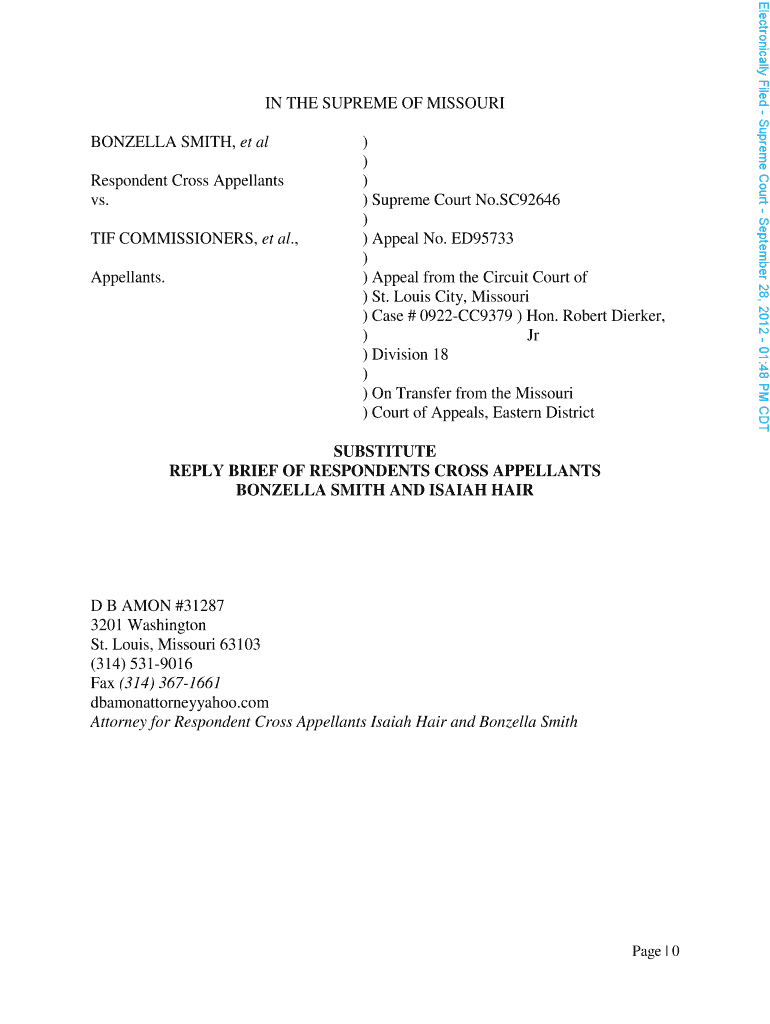
In the context of "IN THE SUPREME OF MISSOURI BONZELLA SMITH, et al," this refers to a legal document submitted to the Supreme Court of Missouri. It is specifically a substitute reply brief authored by Bonzella Smith and Isaiah Hair, addressing issues related to redevelopment ordinances under the Tax Increment Financing (TIF) Act. This legal submission plays a crucial role in highlighting procedural and interpretative errors made by the trial court, aiming to provide clarity and argue for a particular legal interpretation in the course of adjudication.
Key Elements of the IN THE SUPREME OF MISSOURI BONZELLA SMITH, et al
- Redevelopment Project Definition: The document argues against the trial court's interpretation of what constitutes a redevelopment project, a central issue under the TIF Act.
- Compliance with TIF Act Requirements: Emphasizes the necessity for projects to meet specific criteria including cost-benefit analyses and public hearings.
- Adoption Process: Stresses that any redevelopment project must first be presented to the TIF Commission prior to the adoption of relevant ordinances.
- Error Correction in Legal Proceedings: The brief seeks to correct perceived errors made by lower courts regarding legal definitions and procedural requirements.
Legal Use of the IN THE SUPREME OF MISSOURI BONZELLA SMITH, et al
This document is critically utilized during appellate procedures within the legal system, particularly in cases concerning municipal development and financial legislation like the TIF Act. The submission is a vital record for arguing appellate positions, challenging lower court decisions, and providing legal arguments that adhere to statutory requirements for redevelopment ordinances.
Important Terms Related to IN THE SUPREME OF MISSOURI BONZELLA SMITH, et al
- TIF Act: Legislation aimed at encouraging public-private partnerships for redevelopment projects through tax increment financing strategies.
- Ordinance: A law or regulation set by governmental authority, particularly relevant in municipal governance and development.
Who Typically Uses the IN THE SUPREME OF MISSOURI BONZELLA SMITH, et al
This document is predominantly utilized by legal professionals, including attorneys representing parties in real estate development disputes, governmental bodies involved in urban planning, and judicial officials assessing compliance with redevelopment laws. It also holds relevance for entities directly involved in projects regulated by the TIF Act.


Examples of Using the IN THE SUPREME OF MISSOURI BONZELLA SMITH, et al
Legal precedents involving disputes over municipal development ordinances frequently cite documents like the IN THE SUPREME OF MISSOURI BONZELLA SMITH, et al. Examples include litigation aiming to contest or affirm developments initiated under TIF provisions, where both procedural adherence and legal interpretation of statutes are contested.
State-Specific Rules for the IN THE SUPREME OF MISSOURI BONZELLA SMITH, et al
The application and adjudication of the IN THE SUPREME OF MISSOURI BONZELLA SMITH, et al, such as compliance with state-specific TIF regulations, underscore the importance of adhering to Missouri's legislative requirements. Each state's interpretation of similar redevelopment ordinances may slightly differ, highlighting the necessity for contextual understanding of state laws.
Required Documents
- Substitute Reply Brief: Includes detailed arguments and evidence supporting the appellant's case.
- Legal Citations: References to prior case law and statutory provisions are essential for supporting arguments.
- Affidavits or Declarations: When relevant, these documents provide sworn testimony or statements to support the factual assertions within the brief.
Form Submission Methods (Online / Mail / In-Person)
While legal documents like the IN THE SUPREME OF MISSOURI BONZELLA SMITH, et al can be submitted through various means, the specific requirements of the Supreme Court of Missouri must be met. Typically, legal documents are submitted in hard copy to ensure compliance with court protocols, although electronic filings may also be permissible following specific court orders or digital submission guidelines.




