
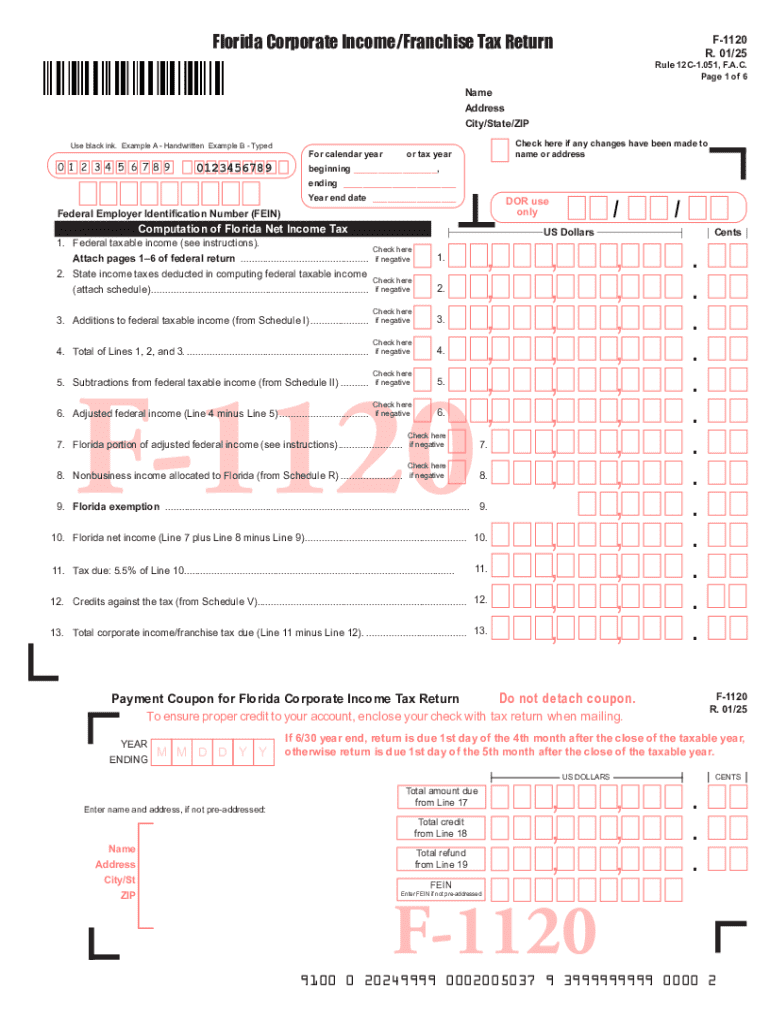







Definition & Purpose of the Florida Corporate Income/Franchise Tax Form F-1120
The Florida Corporate Income/Franchise Tax Return, commonly known as Form F-1120, is a crucial document for corporations operating within the state. This form serves the dual purpose of reporting a corporation's income and calculating the taxes owed to the state of Florida. It is an essential component of financial compliance, ensuring that corporations fulfill their state tax obligations accurately.
Key Features of the Form
- Tax Reporting: The form requires corporations to report their federal taxable income, adjusted as per Florida's tax laws.
- Franchise Taxes: It also includes sections for calculating Florida's franchise taxes, which apply to corporations based on their net income.
- Adjustments and Credits: Corporations must detail any adjustments to their federal taxable income and claim available tax credits.
Example Scenario
Consider a corporation with multiple branches in different states, including Florida. The company uses Form F-1120 to report income sourced within Florida by adjusting the total federal taxable income according to state-specific guidelines.
Steps to Complete Form F-1120
Navigating the F-1120 involves understanding various sections and accurately filling out the necessary fields. Here's a step-by-step guide to assist corporations in completing the form thoroughly.
- Gather Documentation: Start by gathering all relevant financial records, including federal tax returns, as basis information.
- Identify Income: Enter the corporation’s federal taxable income, then proceed with any state-specific adjustments.
- Calculate Apportionment: Complete the section on income apportionment if the business operates in multiple states. Florida uses an apportionment factor to determine the share of income attributable to Florida.
- Apply Tax Credits: Review available tax credits within Florida and apply them where applicable.
- Fill in the Franchise Tax Section: Use the state's guidelines to complete this part accurately.
- Review and Sign: Ensure all sections are filled correctly, then sign and date the form to validate submission.
Real-World Example
A corporation headquartering in Florida but with outlets across the U.S. would carefully ensure that their income apportionment accurately reflects Florida's percentage to avoid over-or under-reporting their taxable income.
Who Typically Uses Form F-1120
Form F-1120 is predominantly used by corporations, including both domestic entities incorporated in Florida and foreign corporations that derive income from sources within Florida.
Corporations Required to File
- Domestic Corporations: All entities incorporated under Florida laws.
- Foreign Corporations: Businesses not based in Florida but earning income from Florida operations.
- Affiliated Groups: Corporations with subsidiaries or affiliates operating within Florida.
Case Study
A tech company incorporated in California but operating a Florida-based office must file Form F-1120 to declare and pay taxes on the income earned within Florida’s jurisdiction.
Important Terms Related to F-1120
Understanding key terms associated with Form F-1120 is imperative for accurate completion.
Terminology Breakdown
- Apportionment Factor: The percentage used to allocate a portion of the corporation's total income to Florida to calculate tax liability.
- Federal Taxable Income: The corporation's income as calculated for federal tax purposes before adjustments.
- Adjustments: Modifications made to federal taxable income to reflect Florida's tax regulations.
Practical Application
When completing the form, corporations must carefully adjust their federal taxable income to properly calculate the apportionment percentage, ensuring compliance with Florida tax laws.
Legal Use of the F-1120
Form F-1120 plays a significant legal role in the tax compliance framework for corporations operating in Florida. Filing this form correctly is not only a statutory requirement but also a safeguard against potential legal complications arising from non-compliance.
Legal Implications
- Compliance: Filing correctly and promptly ensures compliance with Florida's corporate income tax laws.
- Penalties: Failure to submit Form F-1120 or errors in the filing process can lead to penalties, including fines or increased scrutiny by tax regulators.
Legal Advice Example
Corporations are advised to consult with tax professionals to ensure all aspects of the form are correctly addressed, minimizing the risk of filing errors.
Key Elements of Form F-1120
Several core elements must be precisely addressed when completing Form F-1120 to ensure its validity.
Core Elements Explained
- Federal Adjustments: Proper documentation and inclusion of any variations from the federal tax form.
- State Adjustments: Detailed entries reflecting state-specific income and taxes.
- Signature: The form must be signed by an authorized officer of the corporation to validate it legally.
Example of Key Element
A corporation must ensure they include necessary state tax adjustments to avoid underreporting their Florida-specific income, resulting in inaccurate tax dues.
Required Documents for Filing Form F-1120
To complete and file Form F-1120, corporations need a set of supporting documents, ensuring all relevant financial information is included to substantiate the entries on the form.
Essential Supporting Documents
- Federal Tax Return: The original tax return filed with the IRS serves as the base for F-1120 adjustments.
- Income Statements: Detailed records of income generated within Florida.
- Expense Reports: Comprehensive records supporting deductions claimed.
Practical Filing Example
A retail chain with several locations across the U.S. maintains detailed financial documentation for each state to ensure accurate apportionment calculations and tax credit applications for their Florida operations.




