




01. Edit your south carolina annual report online
Type text, add images, blackout confidential details, add comments, highlights and more.

Type text, add images, blackout confidential details, add comments, highlights and more.

Draw your signature, type it, upload its image, or use your mobile device as a signature pad.

Send sc annual report via email, link, or fax. You can also download it, export it or print it out.
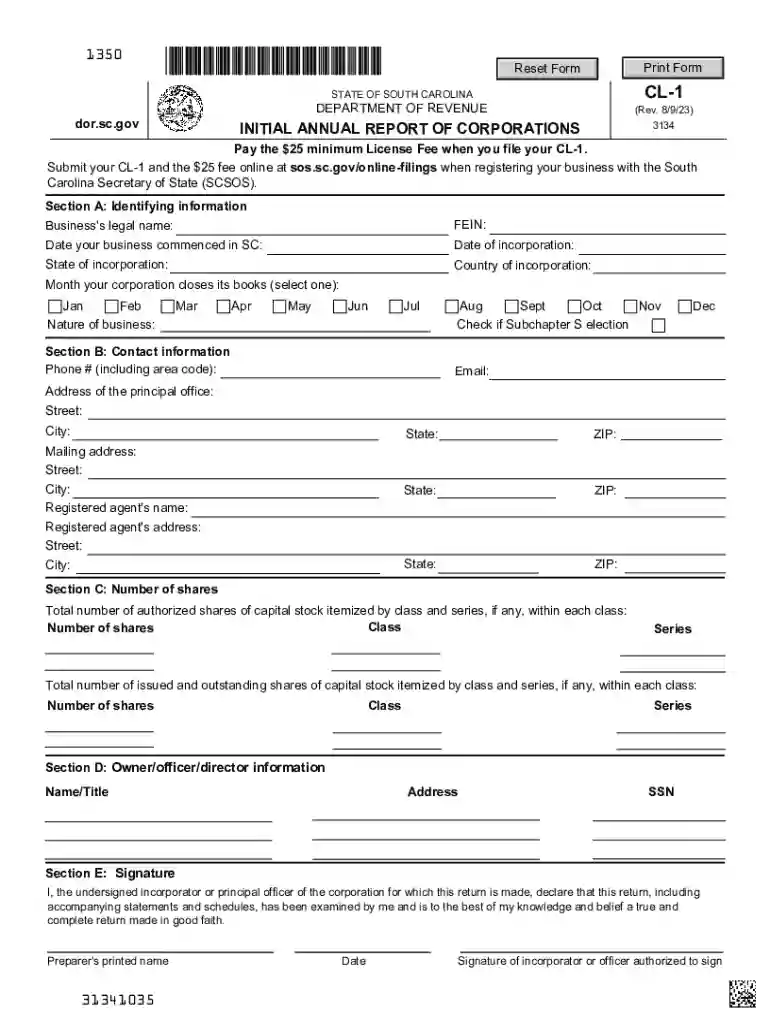
The South Carolina Annual Report, specifically referred to in some contexts as the CL-1 form, is a mandatory document used to file an Initial Annual Report of Corporations in the state. It is essential for both domestic and foreign corporations that are establishing their operations or seeking to comply with regulatory requirements in South Carolina. This form serves as a primary tool for corporations to submit their Articles of Incorporation or an Application for a Certificate of Authority. It includes critical business details such as contact information, share structure, and the identification of owners or officers. A key feature of the South Carolina Annual Report is the collection of a minimum License Fee, which is currently set at $25, underscoring its financial requisite.
Acquiring the South Carolina Annual Report is a straightforward process. Corporations can visit the official South Carolina Secretary of State's website to access the form. Alternatively, entities can obtain physical copies from the state office if necessary. It's advisable to download the latest version from the online portal to ensure compliance with current regulations. The form is readily available in digital formats, which facilitates easy integration with various document management software tools, such as DocHub, for seamless completion and submission.
Completing the South Carolina Annual Report involves a series of systematic steps:
Gather Necessary Information: Ensure you have detailed information about the corporation, including the legal name, contact details, and Federal Employer Identification Number (FEIN).
Fill Out the Form: Enter all relevant data regarding the share structure, including the classification of shares and any voting rights if applicable.
Include Ownership Details: Provide comprehensive details of the owners or officers associated with the corporation, emphasizing accuracy in names and positions.
Calculate and Pay License Fee: Calculate the appropriate License Fee based on the corporation's authorized capital stock and ensure it meets the $25 minimum requirement.
Review and Submit: Conduct a thorough review to verify all information is correct before submission through mail or online portals.
Several critical elements must be accurately completed when dealing with the South Carolina Annual Report:
Business Entity Information: Incorporate comprehensive details about the corporation’s name, address, and registered agent.
Officer and Director Information: List the names and addresses of principal officers and directors as required by the state guidelines.
Capital Stock Details: Define the number and class of shares issued, along with any changes in the share structure since the last report.
Financial Aspects: Complete the financial particulars associated with the corporation's operations, including the calculation of the License Fee.
Also, ensure that all signatures are duly authorized, as incomplete or unauthorized documents can lead to processing delays or penalties.
Failure to comply with the filing requirements of the South Carolina Annual Report can result in several penalties:
Fines and Penalties: Corporations may incur late filing fees that increase based on the extent of the delay.
Loss of Good Standing: Continued non-compliance can lead to the revocation of a corporation’s good standing status, affecting legal operations.
Administrative Dissolution: Persistent failure to file may lead the state to dissolve the corporation administratively, terminating its right to operate within South Carolina.
Corporations are urged to adhere to submission deadlines diligently to avoid such disadvantages.
The South Carolina Annual Report can be submitted through various channels:
Online Submission: This is the most efficient method, allowing corporations to file through the Secretary of State's secure portal, which ensures instant processing and receipting.
Mail Submission: Corporations preferring physical records can send their completed forms and fee payments via USPS or courier services.
In-Person: Direct submission at the state office is also available for businesses located nearby or for those requiring immediate confirmation of receipt.
The primary users of the South Carolina Annual Report include:
Domestic Corporations: Newly formed entities within South Carolina needing to report their initial operational setup.
Foreign Corporations: Companies situated outside but conducting business within the state, facilitating cross-state operational compliance.
Corporate Officers and Accountants: Individuals responsible for ensuring that all corporate filings and legal requirements are diligently met on behalf of the corporation.


South Carolina imposes unique state-specific rules regarding the Annual Report:
Specific Filing Deadlines: The due date is aligned with the anniversary of the corporation’s formation, requiring awareness and precision in tracking for timely compliance.
Variations in Fee Structure: The License Fee calculation may vary based on the business’s authorized capital structure, distinct from other states, necessitating specialized attention.
Understanding these state-specific nuances is crucial for maintaining corporate compliance and ensuring accurate reporting.
Submitting the South Carolina Annual Report requires an assortment of supporting documents:
Articles of Incorporation or Certificate of Authority: Necessary for confirming the legal establishment of a business.
Corporate Officer's List: Up-to-date records of current corporate officers to accompany the report.
Financial Statements: Supplementary documents detailing the financial condition as it relates to share structures and capital stock.
Ensuring these documents are ready and accurate is a vital component of a successful filing process.
We've got more versions of the south carolina annual report form. Select the right south carolina annual report version from the list and start editing it straight away!
| Versions | Form popularity | Fillable & printable |
|---|---|---|
| 2023 | 4.6 Satisfied (27 Votes) | |
| 2023 | 4.1 Satisfied (33 Votes) | |
| 2021 | 4.8 Satisfied (84 Votes) | |
| 2019 | 4.3 Satisfied (102 Votes) | |
| 2016 | 4.4 Satisfied (274 Votes) | |
| 2014 | 4 Satisfied (36 Votes) | |
| 2010 | 4 Satisfied (25 Votes) | |
| 2007 | 4.3 Satisfied (34 Votes) | |
| 2006 | 4.4 Satisfied (465 Votes) | |
| 1999 | 4.2 Satisfied (68 Votes) |
At DocHub, your data security is our priority. We follow HIPAA, SOC2, GDPR, and other standards, so you can work on your documents with confidence.
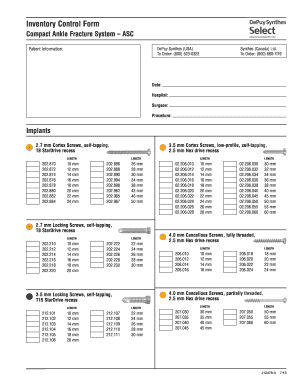


The Secretary of States Office offers many of its filings to the public online. search UCC filings, file financial statements and other UCC documents,
In the 2010 annual report filed with the U.S. Securities and Exchange Commission, SCANA stated that coal is obtained through long-term supply contracts andRead more
Annual Reports 2016-17 Annual Report 2017-18 Annual Report 2018-19 Annual Report 2019-20 Annual Report 2020-21 Annual Report 2021-22 Annual Report.Read more


