




01. Edit your form online
Type text, add images, blackout confidential details, add comments, highlights and more.

Type text, add images, blackout confidential details, add comments, highlights and more.

Draw your signature, type it, upload its image, or use your mobile device as a signature pad.

Send it via email, link, or fax. You can also download it, export it or print it out.
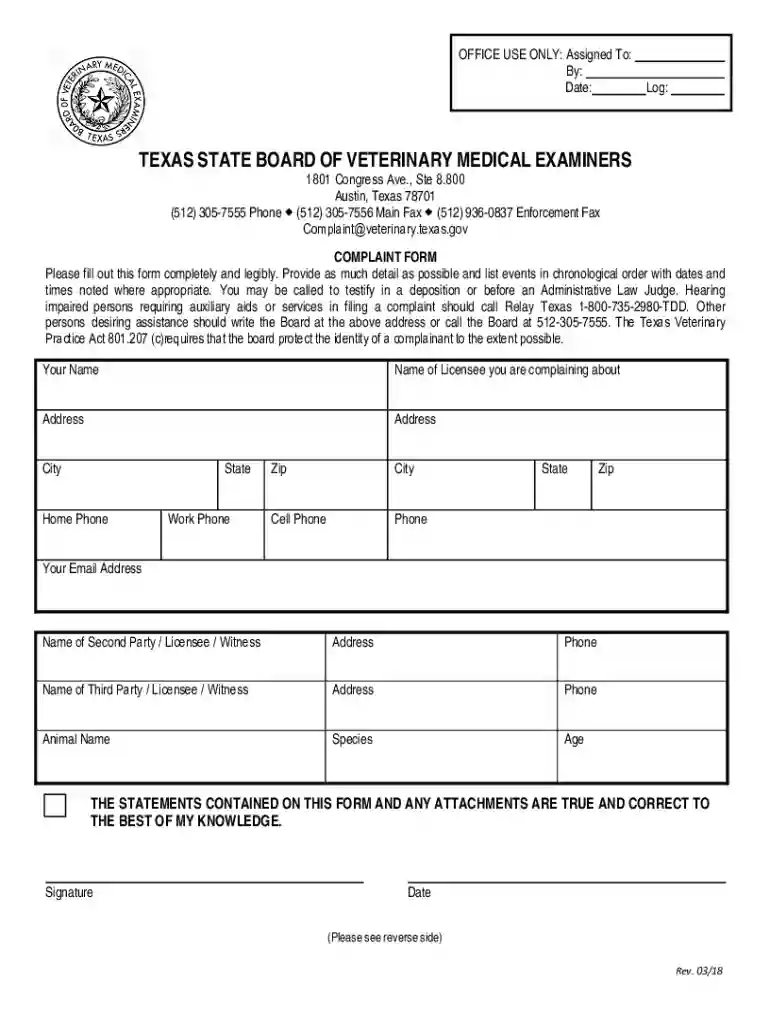
The "Veterinary Medical Examiners, Texas Board of" form is specifically designed for individuals to lodge complaints against licensed veterinarians in Texas. It serves as an official document to report alleged misconduct or breaches of professional standards by veterinarians who are licensed under the Texas Board of Veterinary Medical Examiners. This form is crucial for maintaining professional accountability and ensuring that veterinarians adhere to the ethical and professional standards required by the board.
The form requires detailed information about the complaint, ensuring that the Texas Board of Veterinary Medical Examiners has sufficient data to initiate a thorough investigation. It includes segments for personal details of the complainant, a comprehensive description of the alleged incident, and any supporting documentation that might help substantiate the claims.
To effectively use the "Veterinary Medical Examiners, Texas Board of" form, individuals need to follow specific steps:
Obtain the Form: Access the complaint form from the Texas Board of Veterinary Medical Examiners' website or request it via mail.
Fill Out Personal Information: Provide your full name, contact information, and any relevant professional affiliations.
Detail the Complaint: Clearly describe the incident involving the veterinarian, including dates, locations, and specific actions that prompted the complaint.
Attach Supporting Documents: If available, include evidence such as emails, photographs, or witness statements to corroborate the complaint.
Submit the Form: The completed form can be submitted via the recommended channels, typically either online through the board's website or through physical mail.
By following these steps, complainants ensure that their submission is complete and ready for review by the board.
Completion of this form involves several important steps:
Preparation: Before starting, gather all necessary information and documentation related to the incident. This might include dates, times, and detailed descriptions of the events.
Section-by-Section Filling: Begin by entering personal information accurately. Proceed to fill in the narrative of the incident, being as specific and fact-based as possible.
Review and Attach Documents: Recheck all entered data for accuracy and completeness. Attach any supporting documents that can verify the claims or provide additional context.
Final Review: Go over the entire form to ensure all necessary sections have been filled out correctly and that there are no omissions.
Submission: Submit the form following the guidelines provided by the Texas Board of Veterinary Medical Examiners.
Through methodical completion of each component, the complaint will be primed for processing.
The primary users of this form are individuals who believe they have witnessed or been affected by a veterinarian's unprofessional conduct or violation of practice standards in Texas. Common users include:
These users leverage the form to hold veterinarians accountable and uphold industry standards.


The form is structured to capture several crucial elements for an effective complaint:
These elements ensure the board has a comprehensive overview to investigate the complaint thoroughly.
Legally, this form is a formal mechanism to report ethical or professional discrepancies in veterinary practices. It functions within the framework of the Texas State regulations to ensure that veterinarians operate in compliance with their professional standards. Complaints filed through this form must be genuine and supported by evidence, as submitting false information can have legal repercussions.
The Texas Board of Veterinary Medical Examiners acts on valid complaints by initiating investigations that might lead to warnings, fines, license suspension, or revocation, depending on the severity of the misconduct.
When dealing with this form, understanding certain terms can be beneficial:
Grasping these terms aids in accurately filling out the complaint form and understanding the investigation process that follows.
The form can be submitted through various methods to cater to different preferences and accessibilities:
Each submission method is designed to accommodate various user needs while maintaining the integrity of the complaint process.
We've got more versions of the Veterinary Medical Examiners, Texas Board of form. Select the right Veterinary Medical Examiners, Texas Board of version from the list and start editing it straight away!
At DocHub, your data security is our priority. We follow HIPAA, SOC2, GDPR, and other standards, so you can work on your documents with confidence.


The Texas Board of Veterinary Medical Examiners (TBVME) regulates veterinarians, licensed veterinary technicians and equine dental providers.
The Texas State Board of Veterinary Medical Examiners issues licenses for Veterinarians (DVM), Licensed Veterinary Technicians (LVT), and Equine DentalRead more


