




01. Edit your form online
Type text, add images, blackout confidential details, add comments, highlights and more.

Type text, add images, blackout confidential details, add comments, highlights and more.

Draw your signature, type it, upload its image, or use your mobile device as a signature pad.

Send it via email, link, or fax. You can also download it, export it or print it out.
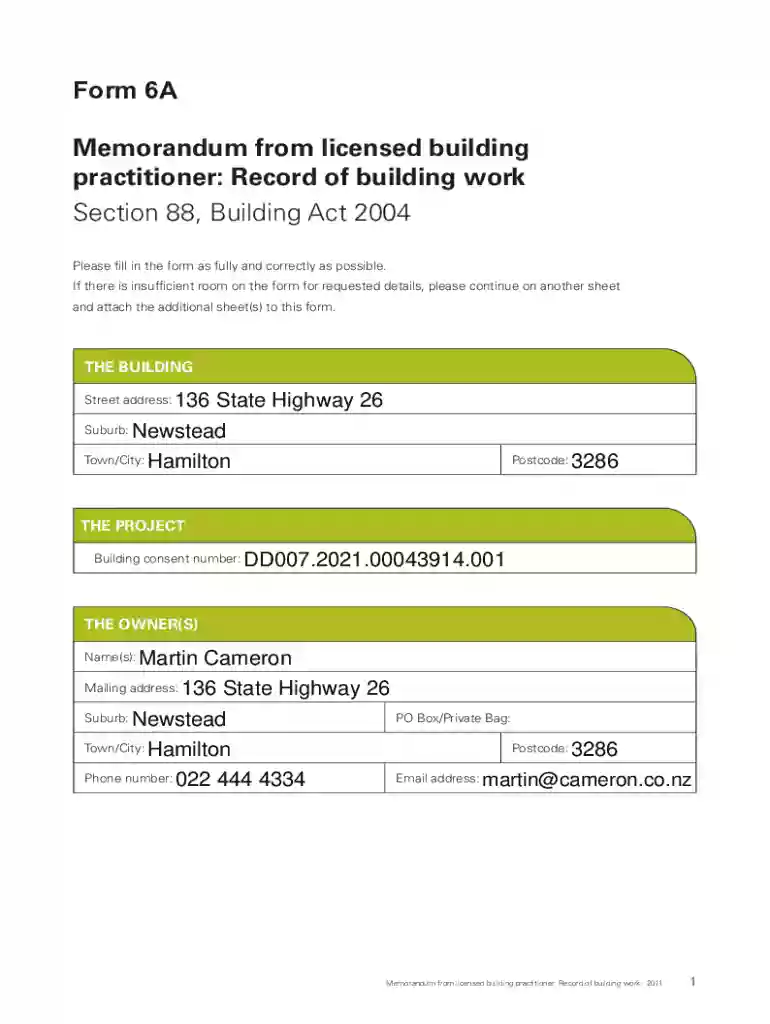
The RECORD OF BUILDING WORK (FORM 6A) is an official document created by a licensed building practitioner to detail construction projects involving restricted building work. This form is vital for providing an accurate account of the project, including the nature and specifics of the work carried out or overseen by the practitioner. It acts as a reliable record for both regulatory purposes and future reference, ensuring that all building work adheres to national standards and regulations.
Using the RECORD OF BUILDING WORK (FORM 6A) involves several steps. First, practitioners must complete the form by detailing the building work undertaken. This includes describing the type of work, such as foundation installation or roofing, and identifying the specific materials and methods used. The form requires concise and accurate information to ensure compliance with building regulations. Once completed, it is submitted to the relevant building authority to confirm that the work meets required standards.
Completing the RECORD OF BUILDING WORK (FORM 6A) involves the following steps:
Gather Information: Collect all necessary project details, including plans, specifications, and practitioner credentials.
Document Work Conducted: Detail the specific work performed, focusing on restricted building work elements like structural integrity, moisture management, and safety systems.
Review Compliance Requirements: Ensure the work meets regional and national building standards.
Complete the Declaration: The practitioner must sign a declaration stating that the work complies with the applicable building codes.
Submit the Form: Submit the completed form to the appropriate local authority or building control office for validation.
The RECORD OF BUILDING WORK (FORM 6A) is crucial for several reasons. It provides a comprehensive record of the building project, which can be essential for future renovations or sales. The form ensures transparency in construction activities, allowing all parties involved, including homeowners, contractors, and regulatory bodies, to verify the quality and compliance of the work. It also serves as a legal safeguard, documenting that the construction adheres to all necessary regulations and standards.
This form is primarily used by licensed building practitioners, such as contractors and architects, who are responsible for overseeing restricted building work. It is also relevant for property owners who need to ensure that their construction projects comply with building regulations. Regulatory authorities use the form to monitor and confirm that building work in their jurisdiction meets established safety and performance standards.


The form consists of several key components:
Different states in the U.S. may have variations in how the RECORD OF BUILDING WORK (FORM 6A) is utilized or submitted. Some states might have additional requirements for specific types of building work or demand supplementary documentation. It is critical for practitioners to be aware of their state's specific statutes and submission processes to ensure full compliance. Checking with the local building authority can provide the necessary guidance on state-specific requirements.
The legal significance of the RECORD OF BUILDING WORK (FORM 6A) is substantial, as it provides a documented trail of compliance with building laws and regulations. It serves as an official record that can be used in legal proceedings to demonstrate that construction work was performed in accordance with standards. This aspect not only protects practitioners against liability but also reassures property owners of the lawful execution of their projects.
At DocHub, your data security is our priority. We follow HIPAA, SOC2, GDPR, and other standards, so you can work on your documents with confidence.

6A-Environmental Impact we comprehensively record the details of the construction of engineering bacteria, fermentation process parameters, test results, etc
It shall be the responsibility of the Contractor to determine the Notice required by the State pursuant to Building Inspection Record for the Project,
This form is to be used to report and confirm the journey-level work experience requirement. to notify CSLB about unlicensed activity, contractors working


