
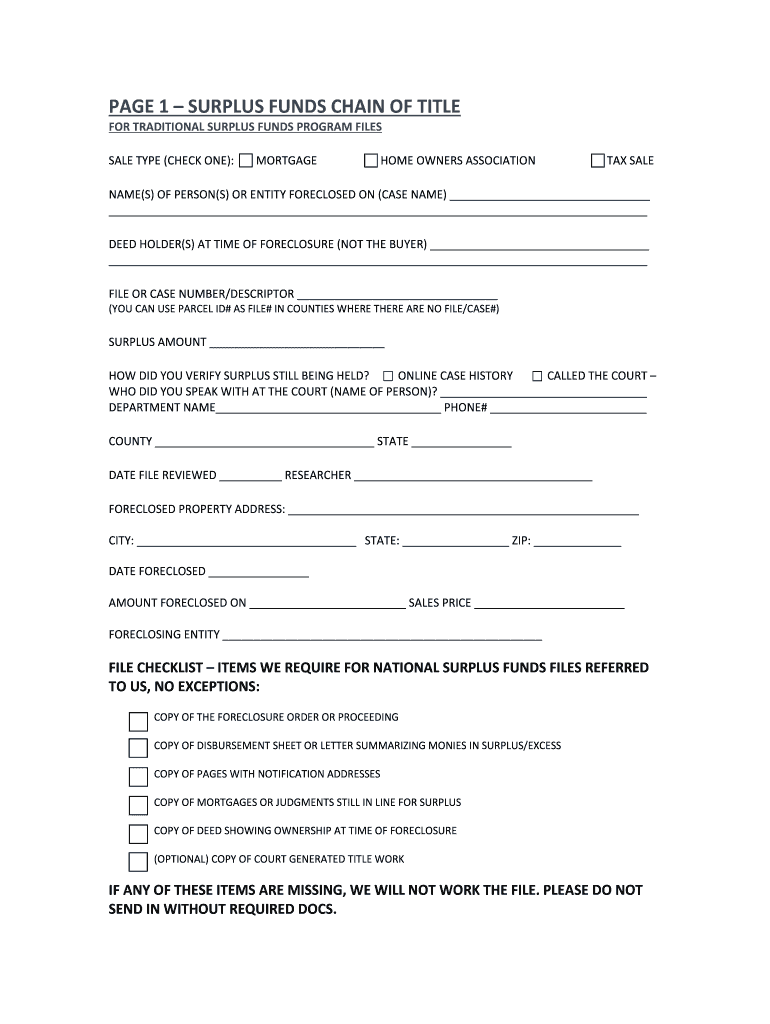







Definition and Meaning of Surplus Funds Chain of Title
The "Surplus Funds Chain of Title" is a detailed document used primarily in the context of foreclosure proceedings to track and manage surplus funds resulting from the sale of a foreclosed property. When a property is sold during a foreclosure, sometimes the sale price exceeds the debts owed to the lender, resulting in surplus funds. This document helps establish the rightful claimants by documenting the ownership history, liens, and other related financial obligations tied to the property. It serves as a vital tool for ensuring that any surplus funds are distributed to eligible parties in accordance with legal and contractual obligations.
How to Use the Surplus Funds Chain of Title
Effectively using the Surplus Funds Chain of Title involves several steps:
- Review Ownership History: Start by thoroughly examining the documented ownership transfers for the property. This helps in understanding who has a historically verifiable interest.
- Identify Liens and Encumbrances: Carefully check for any liens, such as mortgage or tax liens, that may affect the distribution of the surplus funds.
- Verify Documentation: Ensure all documentation is accurate and up-to-date. Missing or incorrect information can lead to delays or legal disputes.
- Contact Relevant Parties: Reach out to all parties listed in the chain of title who may have a potential claim to the surplus funds. Use documented addresses or contact info to ensure proper communication.
- Submit Claims: Eligible parties should formally submit their claims through the required legal channels, providing all necessary documentation for verification.
Steps to Complete the Surplus Funds Chain of Title
- Gather Documentation: Collect relevant documents such as deeds, mortgage statements, and prior property sale records.
- Fill Out the Form: Accurately complete the chain of title form with the property details, including previous and current owners.
- Verify Legal Descriptions: Ensure all legal descriptions of the property are current and match official records.
- Authenticate Signatures: Obtain signatures from appropriate parties where required, and have them notarized if necessary to fulfill legal stipulations.
- Submit for Approval: Once completed, submit the form to the relevant legal or financial body for approval and processing. Maintain copies for your records.
Key Elements of the Surplus Funds Chain of Title
- Ownership Details: Records of current and prior ownership.
- Lien Information: Detailed accounts of any liens against the property.
- Transfer Dates: Accurate dates when ownership changes occurred.
- Legal Property Description: Precise legal depiction of the property.
- Notarized Signatures: Signatures authenticated by a notary might be required for valid legal compliance.
Required Documents for Filing
To file the Surplus Funds Chain of Title successfully, ensure you have:
- Recent Property Deed: The latest deed showing current property ownership.
- Lien Releases: Documents indicating the fulfillment or removal of any existing liens.
- Sales Transaction Records: Proof of property sale details if the property was recently sold.
- Identification: Valid ID of the person or entity making the claim, to establish legitimacy.
State-Specific Rules for Surplus Funds Chain of Title
Rules and regulations governing surplus funds can vary significantly by state:
- Residence Rights: Some states provide additional protections or rights of redemption to previous homeowners.
- Timeline for Claims: The period in which claims must be submitted can differ, ranging from a few months to several years post-sale.
- Proof of Notification: Certain states necessitate documented evidence that all potential claimants have been notified of the surplus funds.
Legal Use of the Surplus Funds Chain of Title
The legal application of the Surplus Funds Chain of Title involves:
- Establishing Entitlement: Legally determining who is entitled to the surplus funds based on priorities like mortgage liens or judgment creditors.
- Avoiding Fraud: Preventing fraudulent claims by providing a comprehensive, verifiable record of the property's financial obligations and ownership history.
- Ensuring Compliance: Aligning the distribution process with state and federal laws applicable to foreclosure surpluses.
Examples of Using the Surplus Funds Chain of Title
Consider these scenarios:
- Mortgage Fulfillment: A bank uses the document to ascertain that, after satisfying the mortgage, all surplus belongs to the homeowner.
- Lien Prioritization: An individual discovers that a second lienholder is entitled to funds before any can be claimed personally.
- Dispute Resolution: A court reviews the chain of title to resolve a dispute among claimants over the remaining surplus funds.




