







Definition and Meaning of Double Jeopardy in the Case
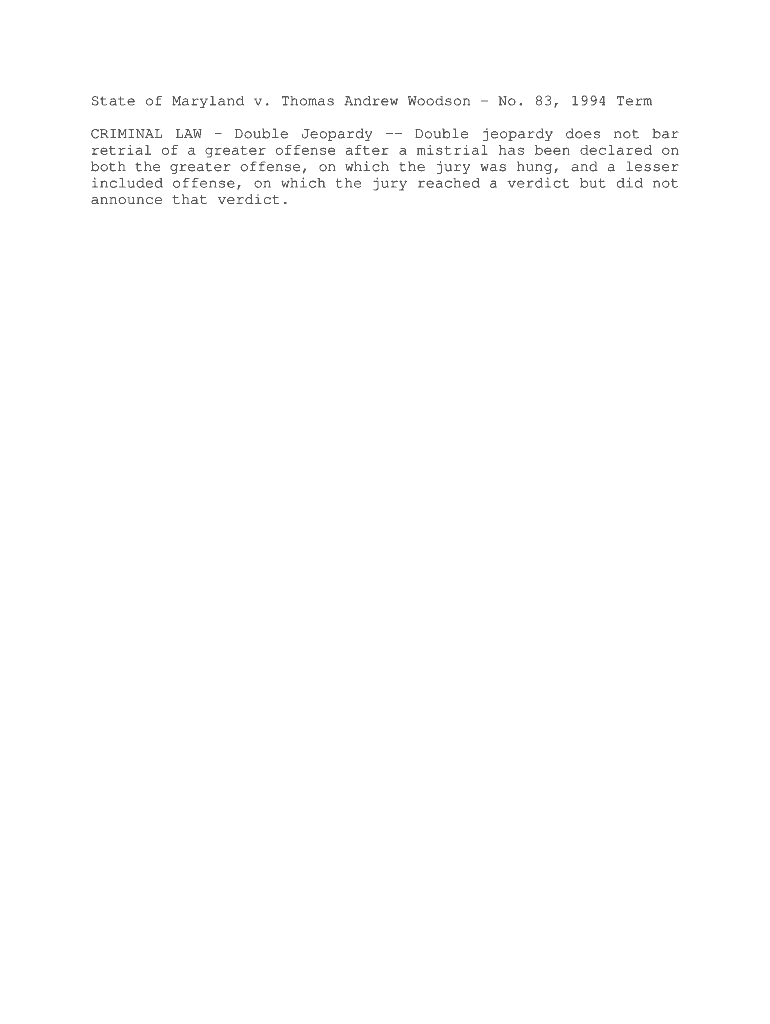
Double jeopardy refers to the constitutional protection preventing an individual from being tried twice for the same offense. In the context of the case "State of Maryland v. Thomas Andrew Woodson," the legal debate revolves around the application of double jeopardy after a mistrial. A mistrial occurs when a trial is invalidated due to an error or other issue that prevents a fair proceeding. The court in this case examined whether double jeopardy bars retrials for different charges when a mistrial has been declared. Specifically, it explored if the protection applies to both greater and lesser included offenses, ultimately determining that a retrial can proceed for a greater offense despite a previous mistrial.
Key Elements of the Case and Court's Decision
The court's ruling in the "State of Maryland v. Thomas Andrew Woodson" case delineated the conditions under which double jeopardy applies. The pivotal aspect of this case was the court's decision to allow retrials for greater offenses while barring retrials for lesser included offenses. This distinction is significant because it affects how prosecutions proceed following a mistrial. The court concluded that an unannounced jury verdict on a lesser charge does not automatically trigger double jeopardy protections for the greater charge, thereby permitting a new trial on the latter.
Important Terms Related to the Case
To fully understand the intricacies of this case, it is essential to grasp key legal terms:
- Double Jeopardy: Protection against being tried twice for the same crime.
- Mistrial: An invalid trial due to procedural errors or other issues.
- Greater Offense: A more severe charge encompassing elements of a lesser charge.
- Lesser Included Offense: A less severe charge that is part of a greater offense.
- Unannounced Verdict: A decision reached by a jury but not formally declared.
Legal Use and Implications of the Court's Ruling
The court's interpretation in this case has significant legal implications. By distinguishing between greater and lesser offenses in the context of double jeopardy, the ruling clarifies the extent to which prosecutorial actions can continue after a mistrial. This interpretation helps legal practitioners understand the nuances of retrying cases and provides a precedent for future cases involving mistrials and multiple charges.
Who Typically Uses This Legal Precedent
Legal professionals, including defense attorneys and prosecutors, frequently rely on precedents like the "State of Maryland v. Thomas Andrew Woodson" to guide their strategies in court. This decision is particularly relevant for cases involving complex charges and retrials after a mistrial. Judges also reference such rulings to ensure that their decisions align with established interpretations of constitutional protections.
Steps to Understand and Apply This Case
- Review Case Facts: Understand the charges, trial events, and the declaration of a mistrial.
- Examine Court’s Rationale: Analyze why the court allowed a retrial for the greater offense and barred it for the lesser included offense.
- Identify Applicable Precedents: Study other cases cited in this decision to see how they influence the court's interpretation.
- Apply Legal Standards: Use the decision to assess how double jeopardy applies to current or future cases involving multiple charges and mistrials.
Examples of Applying This Case in Court
Consider a scenario where a defendant faces charges of both robbery (a greater offense) and theft (a lesser included offense). If a mistrial occurs due to a procedural error, and the jury had reached an unannounced verdict only on theft, the precedent established by the "State of Maryland v. Thomas Andrew Woodson" could allow for a retrial of the robbery charge while barring a retrial of the theft charge.
State-Specific Rules and Their Impact on the Ruling
Maryland's legal framework played a critical role in this decision. While the federal interpretation of double jeopardy sets a baseline, individual states can implement additional protections or clarifications. In Maryland, the court reaffirmed that specific procedural elements unique to the state, such as handling mistrial declarations and jury decisions, shape how double jeopardy is enforced.
Variations and Alternatives to This Legal Precedent
While the "State of Maryland v. Thomas Andrew Woodson" provides a specific resolution to the issue of retrials following a mistrial, different jurisdictions might interpret double jeopardy differently based on local statutes or judicial preferences. Legal professionals should consider other relevant cases or statutes in their jurisdiction to ensure a comprehensive understanding of how double jeopardy rules might apply in various legal contexts.




