







Definition & Meaning
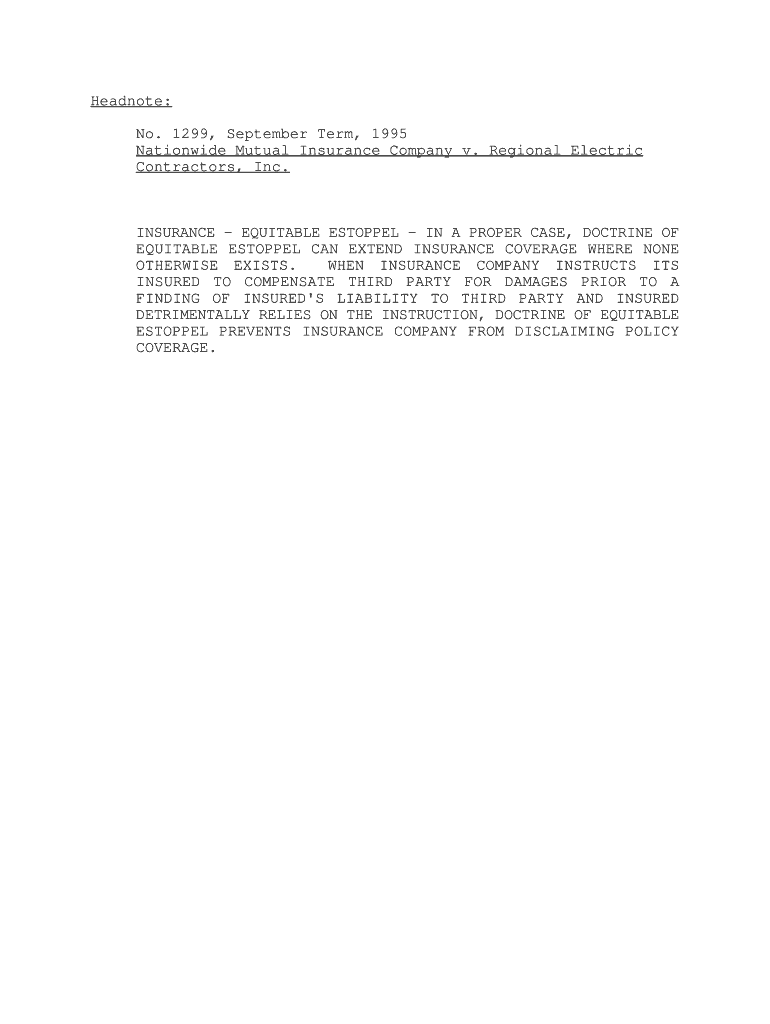
The term "Headnote: No 1299, September Term, 1995 Nationwide Mutual" refers to a specific legal case involving Nationwide Mutual Insurance Company and Regional Electric Contractors, Inc. The case centers on the application of the doctrine of equitable estoppel in the context of insurance coverage. Equitable estoppel is a legal principle that prevents one party from taking a position contradictory to an earlier stance, upon which the other party relied to their detriment. In this case, the court determined that Nationwide Mutual Insurance could not deny coverage because the insured party relied on the company's previous instructions, which obligated Nationwide to cover certain damages.
How to Use the Headnote: No 1299, September Term, 1995 Nationwide Mutual
To effectively utilize the "Headnote: No 1299, September Term, 1995 Nationwide Mutual," it's crucial to understand the legal implications of equitable estoppel in insurance contracts. Legal professionals can reference this headnote to argue similar cases where an insurance company is attempting to repudiate its obligations after an insured party has relied on its initial assurances. The headnote serves as a precedent to strengthen claims of coverage despite existing policy exclusions, underscoring the significance of prior communications in determining an insurer's liability.
Key Elements of the Headnote: No 1299, September Term, 1995 Nationwide Mutual
- Equitable Estoppel Doctrine: This is central to the headnote, emphasizing that insurers may be bound by previous misrepresentations if the insured acted based on those representations.
- Judicial Outcome: The court's decision reaffirms the judgment of a lower court, obligating Nationwide Mutual to compensate for damages despite policy exclusions.
- Reliance Factor: The insured party relied on Nationwide's instructions; thus, this reliance played a critical role in the court's decision.
- Policy Exclusions: Typically, these are clauses that deny coverage for certain risks. However, in this case, prior assurances negated such exclusions.
Steps to Complete the Headnote: No 1299, September Term, 1995 Nationwide Mutual
- Review Case Details: Understand the factual background and legal arguments presented.
- Analyze the Court's Decision: Examine the reasoning behind the application of equitable estoppel.
- Identify Precedents: Recognize other cases where a similar ruling was applied.
- Prepare Arguments: Use insights from this headnote to structure legal arguments in comparable cases involving insurance disputes.
Legal Use of the Headnote: No 1299, September Term, 1995 Nationwide Mutual
This headnote is instrumental in legal contexts, especially in disputes involving insurance coverage. Lawyers can use it to highlight scenarios where an insured party is subject to policy exclusions despite initial assurances from the insurer. It can be cited in legal filings, motions, or courtroom arguments to demonstrate the applicability of equitable estoppel in holding insurers accountable for their initial representations.
State-Specific Rules for the Headnote: No 1299, September Term, 1995 Nationwide Mutual
Laws regarding insurance coverage and the application of equitable estoppel may differ across states. It's essential to consider state-specific statutes or case law when using this headnote as a precedent. Legal practitioners should ensure that arguments align with the jurisdiction where the case is being heard, as local laws might affect the interpretation and enforceability of similar legal principles.
Examples of Using the Headnote: No 1299, September Term, 1995 Nationwide Mutual
- Case Study in XYZ State: An insured party cited this headnote when an insurance company attempted to deny coverage after previously assuring compensation for damages from a storm. The court upheld the claim due to the reliance principle established in the headnote.
- Application in Construction Insurance: In a dispute with a construction insurance provider, attorneys referenced Nationwide Mutual's case to argue against the insurer's denial citing policy exclusions, stressing the importance of prior assurances.
Required Documents
To effectively reference or challenge a case using this headnote, parties may need to gather and present:
- Insurance Policy Documents: To demonstrate the policy exclusions or coverage details.
- Communication Records: Emails, letters, or any correspondence from the insurer that provided initial coverage assurances.
- Court Filings and Legal Briefs: Documents filed in court to support claims of equitable estoppel.
- Previous Legal Decisions: Any relevant past rulings cited in legal arguments.
Filing Deadlines / Important Dates
Understanding the procedural timeline is crucial:
- Initial Filing Date: Note when the original lawsuit was filed to track the timeline of events.
- Judgment Date: Record the date of the court's decision to reference the case accurately in future legal documents.
- Appeal Period: Mark deadlines for filing appeals if the judgement is contested.




