






Definition & Meaning
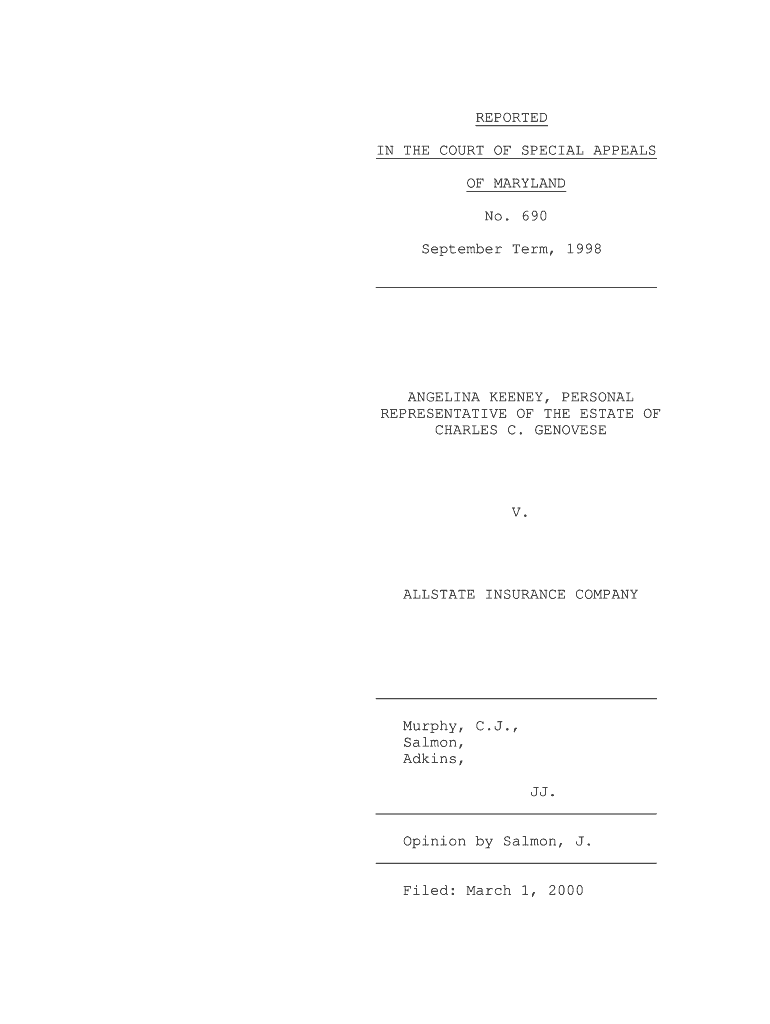
The "690 September Term, 1998 ANGELINA KEENEY, PERSONAL REPRESENTATIVE OF THE ESTATE OF CHARLES C" refers to a legal document within the context of a court opinion pertaining to a case addressed by the Maryland Court of Special Appeals. In this case, Angelina Keeney, as the personal representative of Charles C. Genovese's estate, was involved in legal proceedings with the Allstate Insurance Company. The document critically discusses whether a specific section of the Maryland Annotated Code related to insurance law has retrospective applicability to events prior to its enactment. Primarily, it serves as a legal precedent and interpretation regarding statutory application in insurance disputes.
Key Elements of the 690 September Term
- Case Title and Participants: The primary individuals and entities involved include Angelina Keeney in her capacity as the representative of an estate, and the defendant, Allstate Insurance Company.
- Legal Issue: The chief legal question is the application of Article 48A, section 542(b) of the Maryland Annotated Code concerning insurance law, specifically whether this statute can be applied retroactively.
- Judicial Decision: The court's opinion affirms the trial judge's ruling, which favored the insurance company, establishing that the statute does not apply to incidents before October 1, 1995.
Legal Use of the 690 September Term
In legal contexts, especially those involving insurance litigation and statutory interpretation, this form is instrumental. Courts and law practitioners often reference such documents to gain insights into judicial reasoning and precedence. The ruling highlights the importance of understanding the temporal scope of statutory applications, effectively serving as a cautionary guide for handling similar legal disputes in Maryland and beyond.
State-Specific Rules for the 690 September Term
- Maryland Jurisdiction: This case falls under Maryland law, emphasizing the state's legislative framework relating to insurance policies and claims.
- Application of Statutes: Maryland courts strictly interpret the non-retroactivity of laws unless explicitly stated, especially relevant in contractual obligations and settlements.
Steps to Complete the 690 September Term
While the document does not require an individual to "complete" it in a traditional form submission sense, engaging with it involves several careful steps:
- Examine: Review the court opinion to understand the case's background and the legal arguments presented.
- Analyze: Focus on the court's interpretation of statutory language, particularly how the timing of statutes impacts their applicability.
- Compare: Utilize this case to contrast with current or future legal scenarios that may involve similar statutory questions.
- Apply: Legal practitioners can apply these interpretations in arguments or briefs to support cases lacking clear legislative guidance.
How to Obtain the Document
If you need access to this specific court opinion:
- Online Legal Databases: These include LexisNexis, Westlaw, or public records sections of the Maryland judiciary’s website where court opinions are filed and archived.
- Public Libraries: Legal libraries or state archive facilities might have physical copies or terminals to access digital court document repositories.
Important Terms Related to 690 September Term
- Retrospective Application: Refers to a law being applied to events occurring before its enactment, an issue central to this court decision.
- Annotated Code: The collection of statutes, in this context, within Maryland law that guides all legal and insurance-related processes.
Examples of Using the Document
- Legal Precedent: Law students and practitioners study this case to understand the complexities of insurance law, especially regarding retroactive applications.
- Insurance Dispute Resolution: Used as a reference in new cases where parties may dispute insurance settlements and coverage due to statutory changes.
Penalties for Non-Compliance
In the context of this court ruling, failure to adhere strictly to contractual terms, or assuming retrospective applicability of laws without proper legal basis, can result in a loss in court, as illustrated in the court’s decision favoring Allstate Insurance Company. This emphasizes the critical need for compliance with both contractual and statutory requirements.
Form Variants and Alternatives
Though specific court opinions like this one do not have "variants" in the way tax forms might, it encompasses a judicial opinion type that might be referenced in related cases. Similar cases or differing court opinions may offer other interpretations or rulings that serve alternative uses for legal strategy or academic exploration.
Who Typically Uses the Document
- Legal Professionals: Judges, attorneys, and law clerks involved in insurance law or statutory interpretation.
- Academics: Law students and professors exploring case law and jurisprudence.
- Insurance Companies: In-house legal teams tasked with ensuring compliance and formulating defense or prosecution strategies around policy disputes.
Each of these sections provides clarity on the document’s purpose, legal implications, and its relevance in varying contexts, offering comprehensive insights into its importance and applications.