







Definition & Meaning
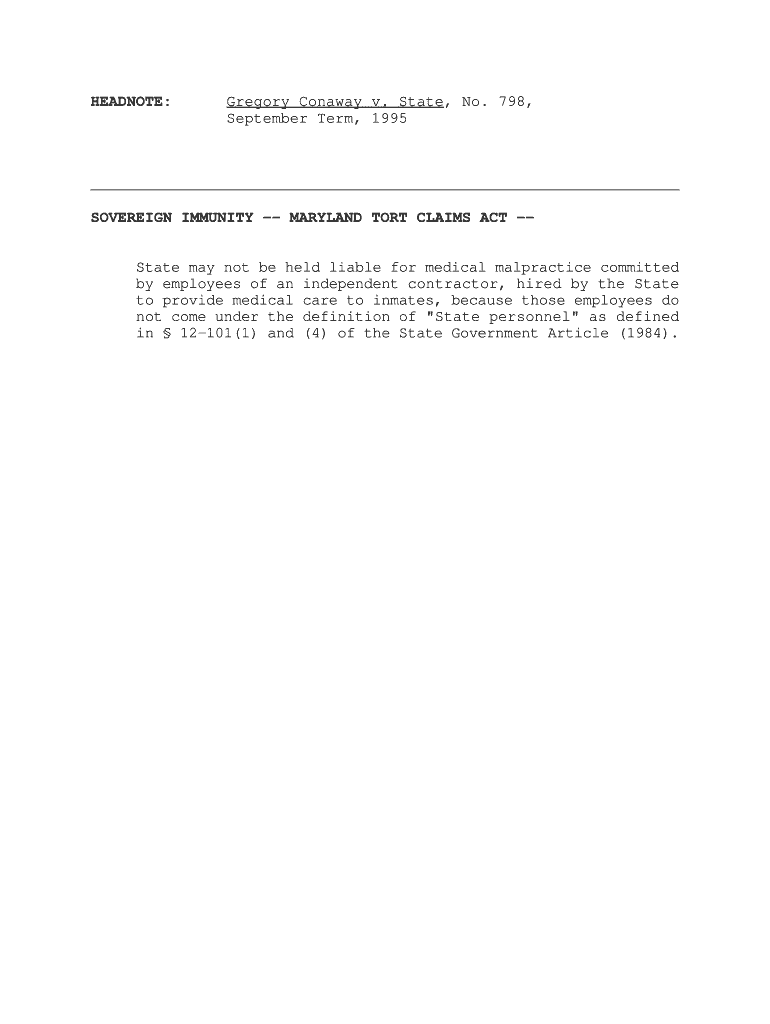
The case "Gregory Conaway v. State, No 798, September Term, 1995" involves the evaluation of sovereign immunity under the Maryland Tort Claims Act. This case specifically examines whether the State of Maryland can be held liable for the actions of medical professionals employed by independent contractors providing care within state facilities. The court's decision established that such employees do not qualify as state personnel under the Act, and as a result, the State maintains sovereign immunity from liability in malpractice claims involving these individuals.
Legal Use of the Gregory Conaway v State, No 798, September Term, 1995
This case is significant in legal contexts primarily related to the application of the Maryland Tort Claims Act. Legal professionals referencing this case often do so to understand the boundaries of state liability concerning independent contractors working in state facilities. It provides a critical precedent in cases where plaintiffs attempt to pursue claims against the state for acts carried out by non-state employees, reinforcing the doctrine of sovereign immunity within specific legal frameworks.
Important Legal Precedents
- Sovereign Immunity: Demonstrates applications of sovereign immunity to entities not directly employed by the state.
- Interpretation of 'State Personnel': Clarifies who qualifies as state personnel under the Maryland Tort Claims Act.
Key Elements of the Gregory Conaway v State, No 798, September Term, 1995
- Sovereign Immunity: Core to the case's outcome, impacting the State's liability in similar legal settings.
- Independent Contractors vs. State Employees: The case's resolution hinged on the classification of medical professionals under the relevant Act.
- Medical Malpractice and State Liability: Explores the limits of state responsibility in instances of alleged malpractice by third-party providers.
Examples of Using the Gregory Conaway v State, No 798, September Term, 1995
State-Specific Rules for the Gregory Conaway v State, No 798, September Term, 1995
This case is embedded within Maryland's legal landscape, carrying implications for how sovereign immunity is interpreted in the state's courts. It is crucial to understand that comparable cases outside Maryland might not yield identical results, as sovereign immunity standards and interpretations can vary significantly across different jurisdictions.
Maryland Tort Claims Act
- Application Scope: Limits the scope of who is considered a state employee, strongly influencing state liability.
- General Assembly Intent: Illustrates legislative intent behind sovereign immunity provisions, as reflected in case law.
Steps to Complete the Gregory Conaway v State, No 798, September Term, 1995 - courts state md
How to Obtain the Gregory Conaway v State, No 798, September Term, 1995 - courts state md
To access court documents related to the "Gregory Conaway v. State," interested parties can request records from Maryland's state court archives. These documents are invaluable for research, especially for parties requiring in-depth insights into legal precedence or those involved in related legal proceedings.
Access Methods
- Online Court Database: Many case documents might be available through online court portal systems.
- Public Records Request: A formal written request or visit to the courthouse may be necessary for document viewing.
- Legal Research Services: Subscription services might provide easier access and more comprehensive document support.
Important Terms Related to Gregory Conaway v State, No 798, September Term, 1995
Understanding the terminology used within this case provides clarity and context for its implications.
- Sovereign Immunity: Legal doctrine shielding the state from certain legal actions without its consent.
- Independent Contractor: Individuals or entities contracted to perform work for the state who are independent in their tasks.
- Maryland Tort Claims Act: Legislative framework governing liability and claims against the state of Maryland.
Who Typically Uses the Gregory Conaway v State, No 798, September Term, 1995
Legal practitioners, notably those specializing in sovereign immunity, malpractice, and state liability cases, frequent references to this ruling. It's also pivotal for legal scholars analyzing the evolution of liability laws involving state interactions with third-party contractors.


Common Users
- Attorneys: Especially those focused on tort law and governmental liability.
- Law Students and Researchers: Looking for precedents in the area of state immunity.

Application Process & Approval Time
Typically, applying the principles from this case in legal arguments demands comprehensive research and case study analysis. For legal professionals, preparations might involve gathering relevant precedents along with comprehensive planning for potential litigation, increasing the complexity and timelines for cases relying on the established judgement.


