







Definition and Meaning
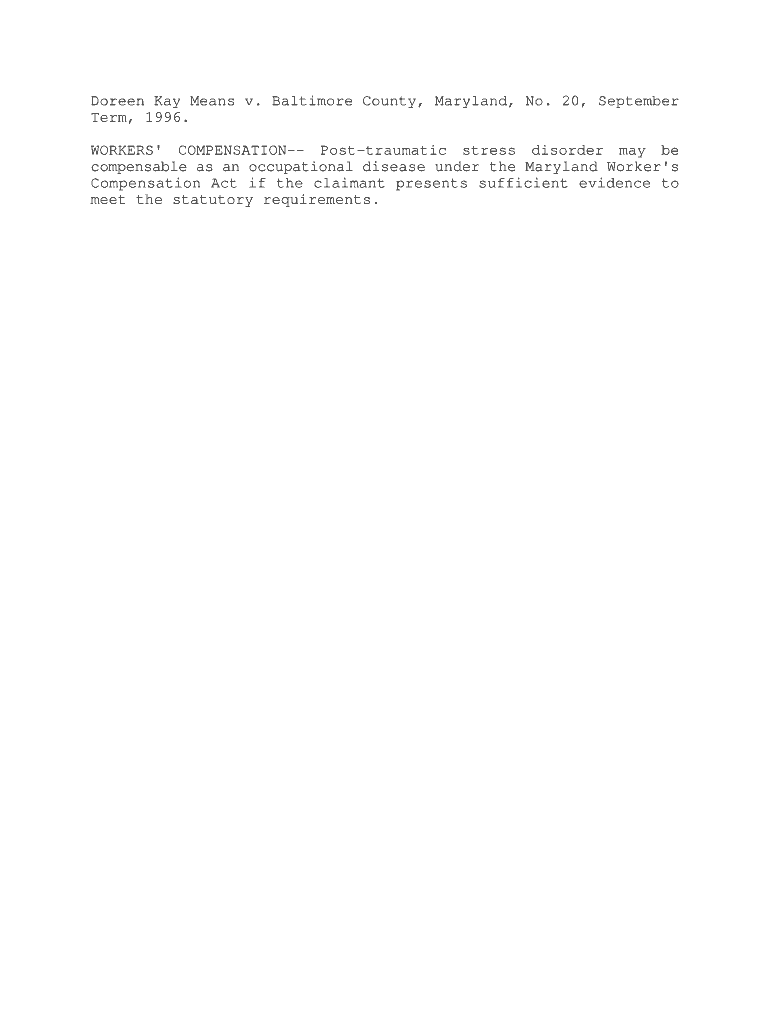
"Doreen Kay Means v. Baltimore County, Maryland" refers to a legal case that examines whether post-traumatic stress disorder (PTSD) qualifies as a compensable occupational disease under the Maryland Workers' Compensation Act. The court determined that PTSD could indeed be compensable, provided there is enough evidence to satisfy statutory requirements. This case is significant because it underscores the impact of traumatic events encountered in specific job roles, such as that of a paramedic, potentially leading to PTSD. By recognizing mental-mental claims, it opens the door for similar cases to be considered in workers' compensation contexts, thereby expanding the scope of what can be deemed compensable under occupational disease claims.
Key Elements of the Case
-
Occupational Disease: The primary issue in this case is the classification of PTSD as an occupational disease. The court looked into whether the mental health condition emerged due to the patient's job as a paramedic, which necessitated exposure to traumatic incidents.
-
Statutory Requirements: The ruling emphasized the need for sufficient proof to meet legal standards. The claimant must provide compelling evidence linking their PTSD to specific occupational hazards or incidents encountered during employment.
-
Mental-Mental Claims: This aspect of the ruling highlights the potential for purely psychological injuries to be acknowledged without accompanying physical injuries, which was a progressive step in workers' compensation law.
Who Typically Uses This Case
The case primarily serves stakeholders in legal, medical, and occupational health sectors.
-
Legal Professionals: Attorneys and law firms specializing in workers' compensation and employment law often refer to this case when representing clients with similar claims.
-
Healthcare Providers: Mental health professionals and occupational therapists use the case as a reference to understand how mental health conditions linked to occupational hazards can be legally addressed.
-
Workers and Unions: Employees in high-risk professions, including emergency responders, may utilize the case to guide their own workers' compensation claims if they experience similar mental health issues.
Legal Use of the Case
This legal decision serves as a precedent for future workers' compensation cases involving mental health issues without physical injury.
-
Case References: It is cited in legal arguments when similar psychological damage claims arise, reinforcing the argument that mental health conditions can be valid compensable claims.
-
Policy Formulation: Organizations use this case to develop internal policies and health programs aimed at recognizing and addressing occupational mental health risks.
Important Terms Related to the Case
-
Post-Traumatic Stress Disorder (PTSD): A mental health condition triggered by experiencing or witnessing a traumatic event, essential in understanding the claimant's diagnosis.
-
Workers' Compensation Act: A legislative framework that provides for compensation to employees who sustain injuries or illnesses directly related to their job.
-
Occupational Disease: Illnesses or conditions that result from work-related activities or environments, which are not always straightforward to prove legally.
Steps to Complete a Claim Related to the Case
-
Documentation of Symptoms: Start by documenting all psychological symptoms and their onset relative to work conditions.
-
Medical Evaluation: Secure a comprehensive evaluation from a qualified mental health professional to diagnose PTSD or related conditions.
-
Evidence Collection: Gather evidence linking the condition directly to job-related experiences, such as incident reports or testimonies.
-
Legal Consultation: Consult with a workers' compensation attorney to understand the legal implications and prepare for a claim submission.
-
Claim Filing: Submit the claim through the appropriate state or organizational procedures, including all necessary documentation.
State-Specific Rules in Maryland
-
Maryland Specific Criteria: Due to variations in workers' compensation laws across states, it is crucial to understand Maryland's specific requirements for such claims. The state mandates thorough evidence to prove the condition results directly from job duties.
-
Statutes of Limitation: Maryland has specific timelines within which these claims must be filed to be considered valid, necessitating prompt action following diagnoses.
Examples of Similar Case Outcomes
-
Case Studies: Several other cases have followed in Maryland and elsewhere, building on the precedent set by this decision to secure compensation for employees with work-induced PTSD.
-
Outcomes Analysis: Reviewing outcomes of subsequent cases can provide insight into the evolving interpretation of mental health claims in occupational contexts and assist in preparing more robust future claims.
Required Documents for Claim Submission
-
Medical Records: Comprehensive records illustrating the PTSD diagnosis and any treatments received.
-
Workplace Documentation: Incident reports or workplace records indicating exposure to traumatic events.
-
Testimonies: Statements from colleagues or superiors who witnessed the traumatic events or changes in behavior.
This thorough analysis provides a comprehensive exploration of the "Doreen Kay Means v. Baltimore County, Maryland - Maryland Courts" case, essential for those looking to understand or leverage this precedent in related legal or occupational fields.




